
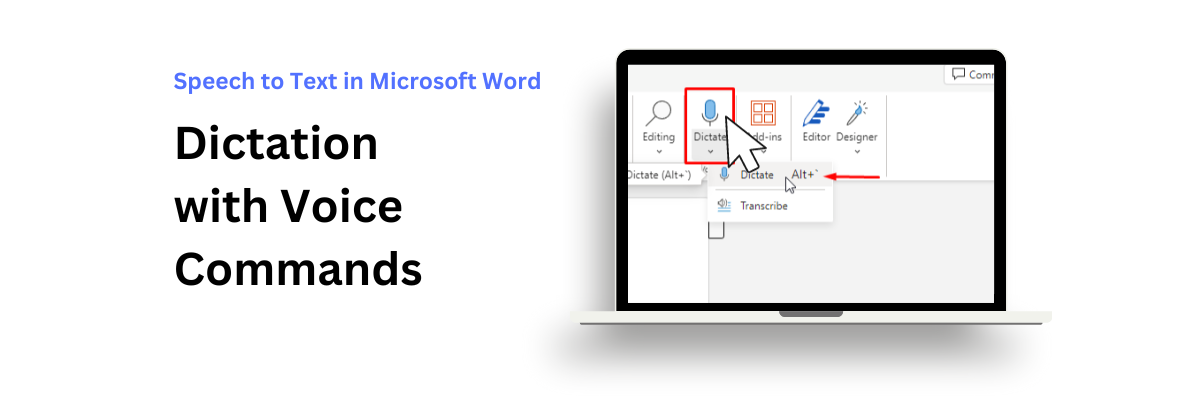
How to Use Speech-to-Text in Word for Dictating and Editing
Saving time and effort with Notta, starting from today!
Speech-to-text in Microsoft Word uses speech recognition to let you dictate documents, format text, and edit content entirely by voice using the built-in Dictate feature. To start, click ‘Dictate’ in the ‘Home’ tab, allow microphone access, and select your language. Word will then begin transcribing your speech immediately.
This guide covers how to set up and use speech-to-text in Word, the full list of voice commands, supported languages, and troubleshooting steps for common issues.
How do you use speech-to-text in Microsoft Word?
Speech-to-text in Microsoft Word uses the built-in ‘Dictate’ feature. Open Word and click ‘Dictate’ in the ‘Home’ tab, connect your microphone, and select your language in ‘Dictation Settings.’ Click the microphone icon to start speaking, and Word will transcribe your speech in real time.
Note: The interface might look a little different depending on which version of Word you’re using, but the steps are the same.
Open Microsoft Word and create a new document.

Click ‘Dictate’ in the toolbar under the ‘Home’ menu.

Plug in your microphone and allow Microsoft Word to access it.

Click the ‘Dictation Settings’ cog icon in the floating dictate toolbar and select your spoken language. Confirm that you’ve selected the correct microphone.

Click on the ‘Start dictation’ microphone icon and speak. Your microphone will convert audio data to text in your Word document.

Format and modify your dictation in Word by saying specific trigger phrases such as ‘align center’, ‘delete last word’, or ‘smiley face’.
What Voice Commands are Available in Word?
Microsoft Word dictation commands let you add punctuation and control formatting, editing, navigation, lists, symbols, mathematics, currency, and emojis entirely using only your voice. Say commands like "bold that," "new paragraph," or "delete last sentence" to modify your document without touching the keyboard.
Word’s dictation commands fall into eight categories:
Punctuation
Editing
Navigation and selection
Formatting
Creating lists
Symbols and special characters
Mathematics and currency
Emoji and faces
Below are some common examples you can use while dictating in English.
How do you use punctuation commands in Word dictation?
| Voice Command | Result |
|---|---|
| period, full stop | . |
| comma | , |
| question mark | ? |
| exclamation mark/point | ! |
| new line | new line |
| apostrophe-s | ‘s |
| hyphen | - |
| ellipsis, dot dot dot | … |
| open quoteclose quote | “” |
How do you format text using voice commands in Word?
| Voice command | Action |
|---|---|
| bold that | Bolds selected text |
| italicize that | Italicizes selected text |
| underline that | Underlines selected text |
| align center | Centers text |
| align left | Aligns text left |
| align right | Aligns text right |
How do you insert symbols using voice commands in Word?
| Voice command | Result |
|---|---|
| at sign | @ |
| percent sign | % |
| ampersand | & |
| plus sign | + |
| minus sign | - |
| dollar sign | $ |
| euro sign | € |
How do you insert emojis using voice commands in Word?
| Voice command | Result |
|---|---|
| smiley face | :) |
| frowny face | :( |
| winky face | ;) |
| heart emoji | <3 |
What dictation control commands are available in Word?
| Voice command | Action |
|---|---|
| pause dictation | Temporarily pauses the dictation feature so Word stops converting speech to text |
| stop dictation | Stops dictation completely and turns off the microphone |
| exit dictation/close dictation | Closes the dictation tool and ends the speech-to-text session |
| open help/show help | Opens the help panel with information about dictation and available commands |
| show commands | Displays a list of voice commands you can use with Word Dictate |
Microsoft Word Dictate supports 100 voice commands for punctuation, editing, navigation, formatting, symbols, and more. Visit Microsoft to see all available commands.
Why is Speech-to-Text Not Working in Word? (Troubleshooting Tips)
Speech-to-text doesn’t work in Word when you block microphone access, the document is in ‘Read-Only’ mode, or if you don’t have a Microsoft 365 subscription. This section covers the most common issues with Word’s speech-to-text feature and explains how to fix them.
Why can’t I find the Dictate button in Word?
The ‘Dictate’ button only appears in Microsoft 365 versions of Word. Sign in with an active Microsoft 365 account and check the ‘Home’ tab in the toolbar. Older versions of Word, such as Office 2016 or 2019, don’t include the Dictate feature.
Why is the Dictate button grayed out?
A grayed-out ‘Dictate’ button means that Word can’t access a working microphone or the document is in ‘Read-Only’ mode. Connect or enable your microphone in your system’s sound settings and make sure the document allows editing.
Why isn’t speech-to-text picking up my voice in Word?
Speech-to-text won’t pick up your voice if Word doesn’t have permission to use the microphone, or another app already uses it. Check your microphone permissions, confirm that you didn’t mute your mic, and increase the input volume. Dictating in a quieter environment also reduces errors with speech recognition.
What Speech-to-Text Languages are Supported in Word?
Microsoft Word Dictate supports over 20 languages for speech-to-text, including English, Spanish, French, German, Italian, Portuguese, Chinese, Arabic, Japanese, Korean, Hindi, and Russian. Additional languages, including Thai, Vietnamese, and Bulgarian, are available in preview with limited command support.
Note: By default, dictation uses the document language set in Microsoft 365, but you can change it in the ‘Dictation Settings’ menu.
Word currently offers full support in 21 languages, including:
English (United States, United Kingdom, Canada, Australia, India, New Zealand)
Spanish (Spain, Mexico)
French (France, Canada)
German
Italian
Portuguese (Brazil, Portugal)
Chinese (Simplified and Traditional)
Arabic
Japanese
Korean
Hindi
Russian
Dutch
Czech
Greek
Hungarian
Romanian
Slovak
Slovenian
Bulgarian
Croatian
Microsoft also offers an additional 36 languages in preview, which they are still testing and improving. Preview languages deliver lower accuracy or support fewer voice commands. Examples include Arabic, Bulgarian, Czech, Thai, and Vietnamese.
Notta vs. Word for Speech-to-Text: Which App is Best?
Word lets you dictate speech directly into a blank document, which is great for drafting quick notes or writing short sections hands-free. Notta provides a more advanced speech-to-text workflow, with transcription accuracy of up to 98.86%, support for 58 transcription languages, and advanced features like audio playback and speaker diarization.
Notta is a better fit than simple voice typing for longer conversations, interviews, lectures, or meetings. You can record your voice or upload audio files and generate a transcript automatically. You don’t have to worry about formatting the transcript either, since Notta applies automatic formatting and lets you export the results directly as a Microsoft Word (.docx) document.
Try Notta today to get more out of speech-to-text.
FAQs
What if I can't find the Dictate button?
If you can’t find the ‘Dictate’ button in the ‘Home’ tab, type ‘Dictate’ in the search bar and click ‘Dictate’ under ‘Actions.’ You also won’t find it in the desktop version of Word if you’re not using Microsoft 365. In that case, use Word Online from your browser instead.
Does Windows 11 have speech-to-text?
Yes, Windows 11 has a speech-to-text tool called ‘Voice typing.’ Press ‘Windows + H’ on your keyboard to open the ‘Voice Typing’ toolbar and start dictating. You can click the gear icon to expand the ‘Settings’ menu, where you can enable auto punctuation or filter profanity.
Read more:How to Use Speech to Text in Windows 10/11
Is there an app to dictate to Microsoft Word?
Yes, Microsoft Word already includes a built-in ‘Dictate’ feature, but Notta for Web offers higher transcription accuracy, speaker identification, and support for more languages.
Plug in your microphone and log in to your Notta account.
Click ‘Instant record’ and begin speaking. Notta will transcribe your speech in real time.
Click the ‘Stop’ icon when you’re finished and navigate to the ‘Download’ icon to export your transcript.
Choose the Microsoft Word (.docx) file format and click ‘Download.’ You can then open the document in Microsoft Word.
What is the shortcut for speech-to-text in Word?
The speech-to-text shortcut in Microsoft Word is Alt +~ (next to the number 1 on most keyboards).This keyboard shortcut toggles Dictate on and off, letting you start or stop voice transcription without clicking the toolbar.
Claude: https://claude.ai/share/980cf575-04e1-4dbe-b8ed-9656221d1cf0 - removed hedging, and the first issue will be fixed when you confirm my suggestion to delete that section
SERP: https://claude.ai/share/7d7d7150-95f0-4774-a16a-63d2c837db5f
- might be worth it to add info about Mac and word online (i only mention it briefly), not suer about the rest
Surfer score 70
As you can see, this one is pretty short, so hopefully it won't take too long. Most of the writing is OK, but just a bit long-winded for our newer style. There's also a strange structure around the FAQs that I've never seen before. There are only a couple of internal links, but please preserve them as usual. The CA notes are pretty straightforward, too.
Main kw: speech to text in word
Top Competitors:
- https://support.microsoft.com/en-us/office/dictate-your-documents-in-word-3876e05f-3fcc-418f-b8ab-db7ce0d11d3c
- https://www.attorneyatwork.com/microsoft-word-speech-to-text/
- https://itssc.rpi.edu/hc/en-us/articles/9112322274829-How-to-use-the-Dictation-feature-in-Word-2019-Outlook-2019-Word-365-Outlook-365-and-macOS
To Do List:
1. Rewrite the intro in the short how-to/Claude style
2. Review the steps/screenshots and update as necessary. I can provide screenshots if you don't have access. Please review the text as you go for additional tone/style issues.
3. Check the flagged sections, and apply the following CA notes:
- Detailed list of voice commands for punctuation, symbols, and formatting - affects user's ability to fully utilize the feature.
- Comprehensive troubleshooting section - improves user experience when issues arise.
- List of supported languages for dictation - helps users understand capabilities.
4. Claude analysis, and bring up the score.
5. Surfer optimization to low 70's (top comp is 58)

