
Notta vs. Fathom: Which AI Meeting Notetaker Should You Choose in 2026?

If you’re comparing Notta and Fathom, you probably don’t want a giant feature dump. You want to know which one actually fits the way you work. Short version: Fathom is easy to understand if you mostly want free online meeting notes. Notta makes more sense if meetings are just the starting point, because the next step is often a report, slide outline, follow-up email, multilingual transcript, or file your team needs later. Here’s how I’d think about the decision.
The Quick Verdict
Choose Notta if...
Here’s the simplest way to look at it: I’d lean toward Notta if your meetings need to become something useful after the call. Notta helps with in-person conversations, uploaded files, Webex meetings, multilingual workflows, and deliverables from Notta Brain, Notta’s AI Meeting Execution Engine. So instead of ending with another transcript, you can turn the meeting into a report, slide deck, infographic, follow-up email, or next-step list.
Choose Fathom if...
Fathom makes sense for the simpler version of this: lots of online meetings, mostly on Zoom, Google Meet, or Microsoft Teams, and a strong preference for unlimited free transcription. Its paid plans also lean toward sales workflows like call review, coaching, and deal tracking.
| Use case | Better fit | Why |
|---|---|---|
| Multilingual meetings | Notta | 58+ transcription languages, 23 bilingual languages, and 80 real-time translation languages |
| Bot-free recording across more apps | Notta | Notta Desktop records locally on Mac and Windows across 40+ meeting apps |
| Webex meetings | Notta | Notta supports Zoom, Google Meet, Microsoft Teams, and Webex |
| In-person conversations | Notta | Live recording and Notta Memo for in-person capture |
| Client-ready reports, slides, or infographics | Notta | Creates slides, reports, infographics, emails, and more through Notta Brain, Notta’s AI Meeting Execution Engine |
| Free transcription volume | Fathom | Unlimited recordings and transcriptions on the free plan |
| Paid sales workflows | Fathom | Team and Business plans add Customer view, team folders, and coaching tools; Deal View on Business |
How We Compared Notta and Fathom
We didn’t spend much time on features that feel basically the same. Both tools can help you record meetings and get notes. The more useful question is what happens when your workflow gets a little messier: different meeting platforms, in-person conversations, multilingual calls, uploaded files, sales follow-ups, or client-ready deliverables.
So we looked at the areas where the choice actually starts to matter:
- Meeting capture: online meetings, in-person recording, file upload, desktop recording, and bot-based capture
- Transcription: real-time transcription, post-meeting transcripts, speaker identification, editing, and exports
- AI output: summaries, action items, clips, reports, slides, and reusable deliverables
- Collaboration: comments, folders, sharing, and workspace controls
- Integrations: calendar, Slack, Notion, Zapier, Salesforce, HubSpot, and CRM tools
- Security and admin: compliance certifications, SSO, audit logs, and data hosting
Notta vs. Fathom: Feature Comparison
| Feature | Notta | Fathom |
|---|---|---|
| Online meetings | Zoom, Google Meet, Microsoft Teams, Webex | Zoom, Google Meet, Microsoft Teams |
| Bot-free desktop recording | ✅ Notta Desktop for Mac and Windows, 40+ apps | ⚠️ Bot-free option is narrower; Mac and English-language limits apply |
| In-person meetings | ✅ — live recording and Notta Memo | ❌ |
| Real-time transcription | ✅ | ❌ Full live transcript not supported; newer desktop experience has live summary |
| Transcription languages | 58+ | 38 |
| Bilingual transcription | 23 | ❌ |
| Real-time translation | 80 languages | ❌ |
| File upload transcription | ✅ | ❌ |
| Post-meeting AI summary | ✅ | ✅ |
| Action items | ✅ | ✅ |
| Slides, reports, and infographics | ✅ via Notta Brain, Notta’s AI Meeting Execution Engine | ❌ |
| Export formats | ✅ TXT, DOCX, XLSX, PDF, SRT, VTT | ❌ Copy to clipboard; no direct transcript download |
| Google Calendar | ✅ | ✅ |
| Outlook Calendar | ✅ | ❌ |
| Slack | ✅ | ✅ |
| Zapier | ✅ | ✅ |
| Salesforce | ✅ | ✅ |
| HubSpot | ✅ | ✅ |
| Additional CRMs | ✅ Pipedrive, Zoho, and more | ❌ |
| SOC 2 | ✅ | ✅ |
| ISO 27001 | ✅ | ❌ |
| SSO | Enterprise | Team and Business |
| Mobile apps | ✅ iOS and Android | ❌ |
| Hardware in-person recorder | ✅ Notta Memo ($149) | ❌ |
Pricing and Plans
Fathom’s free plan jumps out because it gives you unlimited recordings and transcriptions. That’s genuinely helpful if you just want to test online meeting notes without keeping one eye on your minutes.
Notta’s free plan has a monthly minute limit, so it is not the “record every call forever” option. The trade-off is that you get more of the broader workflow to try: file uploads, AI summaries, speaker identification, Webex support, screen recording, and Notta Brain. Once you move to paid plans, I’d look at what you actually need. Fathom gives you unlimited transcription earlier, while Notta’s Pro plan costs less and gives you more room for languages, exports, in-person capture, real-time translation, and ready-to-share outputs.
| Plan detail | Notta | Fathom |
|---|---|---|
| Free plan | 120 min/mo | Unlimited recordings and transcriptions |
| Pro | $8.17/user/mo (annual) 1,800 min/mo | $16/user/mo (annual) unlimited transcriptions |
| Business | $16.67/user/mo (annual) · unlimited transcription | Team - $15/user/mo (annual, 2-user min) Business - $25/user/mo (annual, 2-user min) |
| Enterprise | Custom | Custom |
Where Notta Is Better
Notta makes more sense when your meetings need to become real work, not just notes. Maybe you need to send a client recap. Maybe you need a slide outline. Maybe you need to upload an old interview and pull the useful parts into a report. That’s where Notta Brain comes in. Notta also gives you more ways to capture the conversation in the first place, including in-person discussions through Notta Memo, uploaded files, Webex meetings, and screen recording.
1. Multilingual and global teams
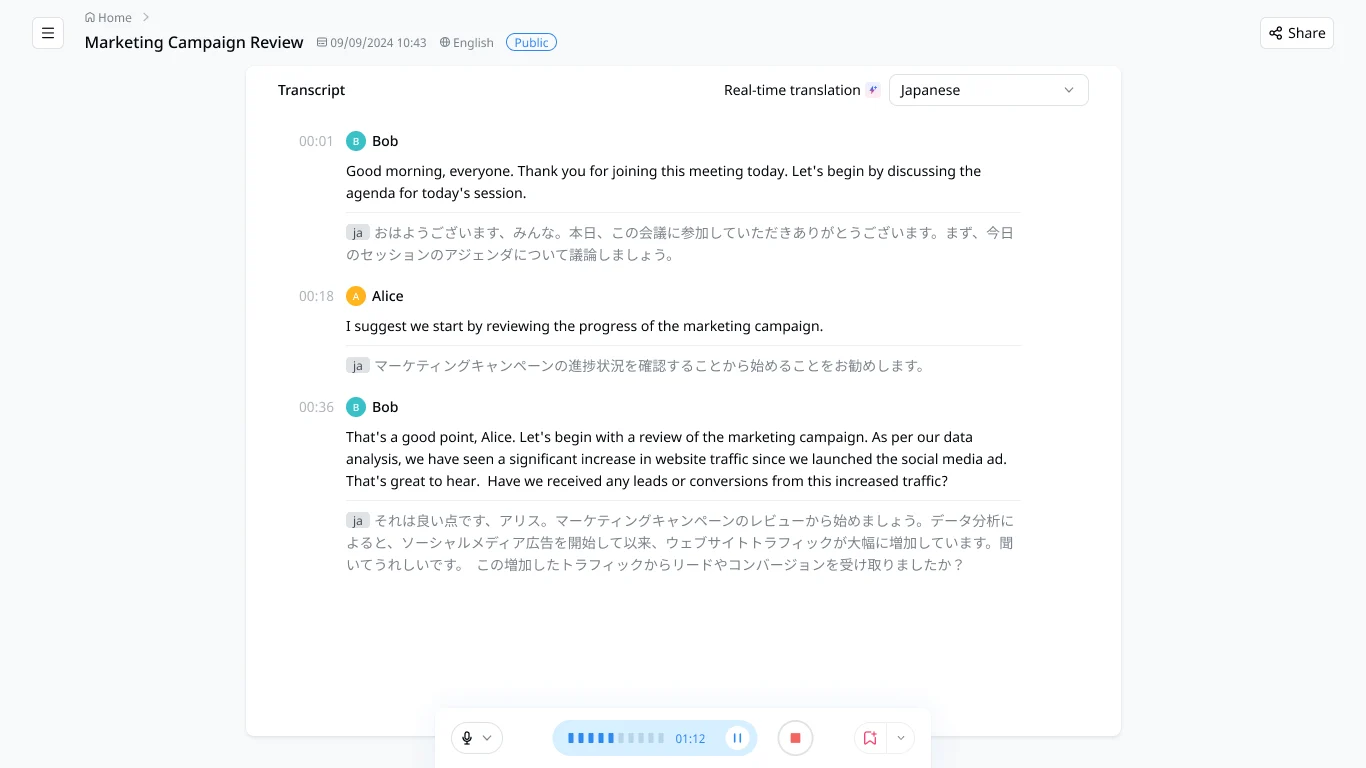
Notta supports 58+ transcription languages, bilingual transcription in 23 languages, and real-time translation in 80 languages including Japanese, Spanish, French, German and more. That matters if your team works across regions, runs bilingual calls, or interviews customers in more than one language.
Fathom supports 38 transcription languages. It can also translate summaries into six languages: Spanish, Portuguese, German, French, Italian, and Dutch. That may be enough for English-first teams with light multilingual needs, but Notta is stronger when you need bilingual transcription or real-time translation during the meeting itself.
2. Turning meetings into deliverables
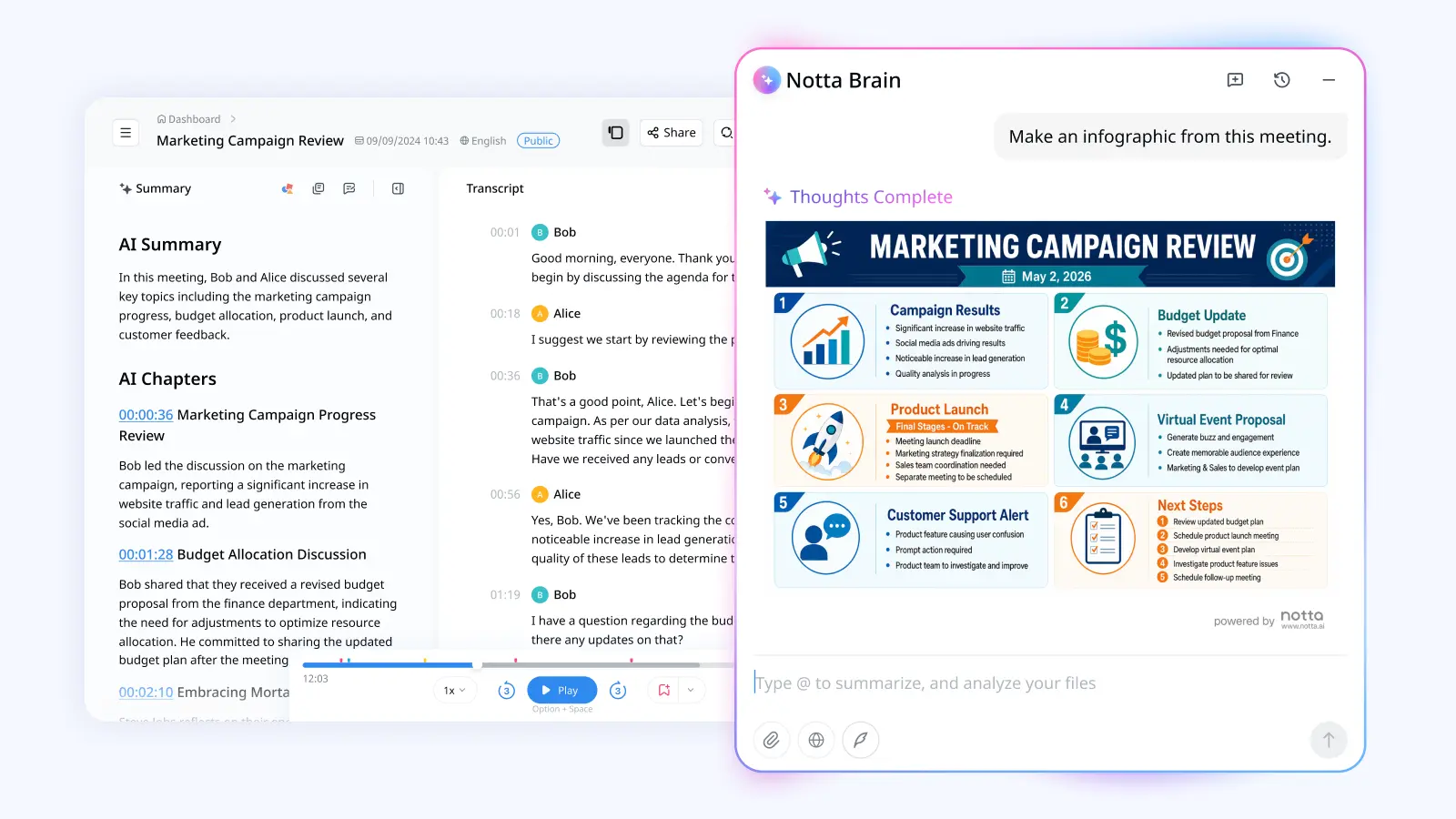
Think about the moment right after a call ends. You have the transcript, but now you’re thinking, “Okay, I still need to turn this into something useful.” Notta Brain can help with that. It can turn meeting content into slides, reports, infographics, follow-up emails, and other outputs. It can also answer questions across multiple recordings, which helps when you want to compare calls or spot patterns across several conversations.
That’s the real difference here. A transcript tells you what was said. A summary helps you catch up. But a report, slide outline, infographic, or follow-up email is something you can actually send, present, or build from.
3. In-person and hybrid conversations
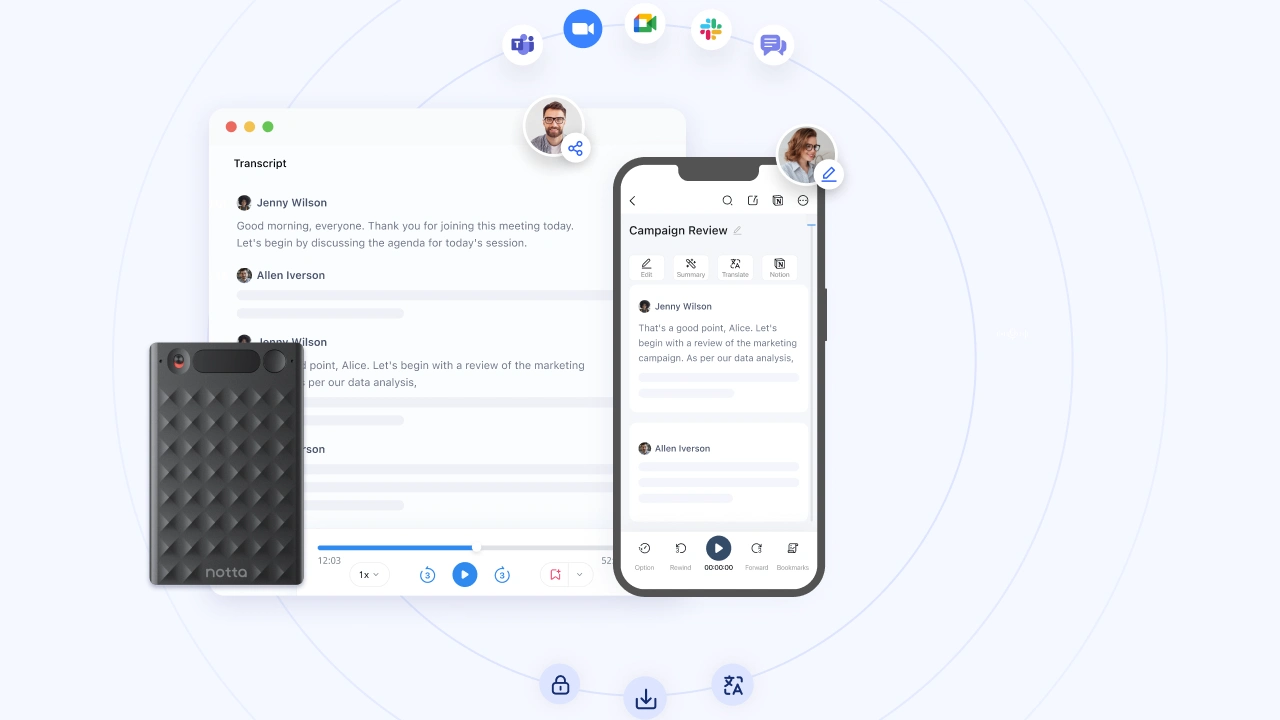
Not every important conversation happens on Zoom. Sometimes it’s a client visit, a workshop, a lecture, an interview, or a quick chat after a meeting. With live recording, mobile recording, Apple Watch recording, and Notta Memo, you can capture those conversations too and sync them back to your Notta workspace.
4. Exports and reusable files
Exports sound boring until you need them. Notta lets you export in TXT, DOCX, XLSX, PDF, SRT, and VTT, which makes life easier when you need to send a transcript to a client, create subtitles, or save meeting notes in your documentation system.
Fathom lets you copy transcripts, but it does not give you the same direct download options. If your notes need to live outside the app, this is one of those small details that can get annoying fast.
Where Fathom May Be Better
1. Free plan for unlimited online meetings
Fathom’s clearest win is the free plan. If your main goal is to record a lot of online meetings without watching your minutes, it is easy to see the appeal.
The trade-off is that the free plan is still mostly about online meeting notes. If you also need file uploads, screen recording, Webex support, or deliverables you can reuse, Notta gives you more of that workflow to try.
2. Sales-heavy paid workflows (with plan limits)
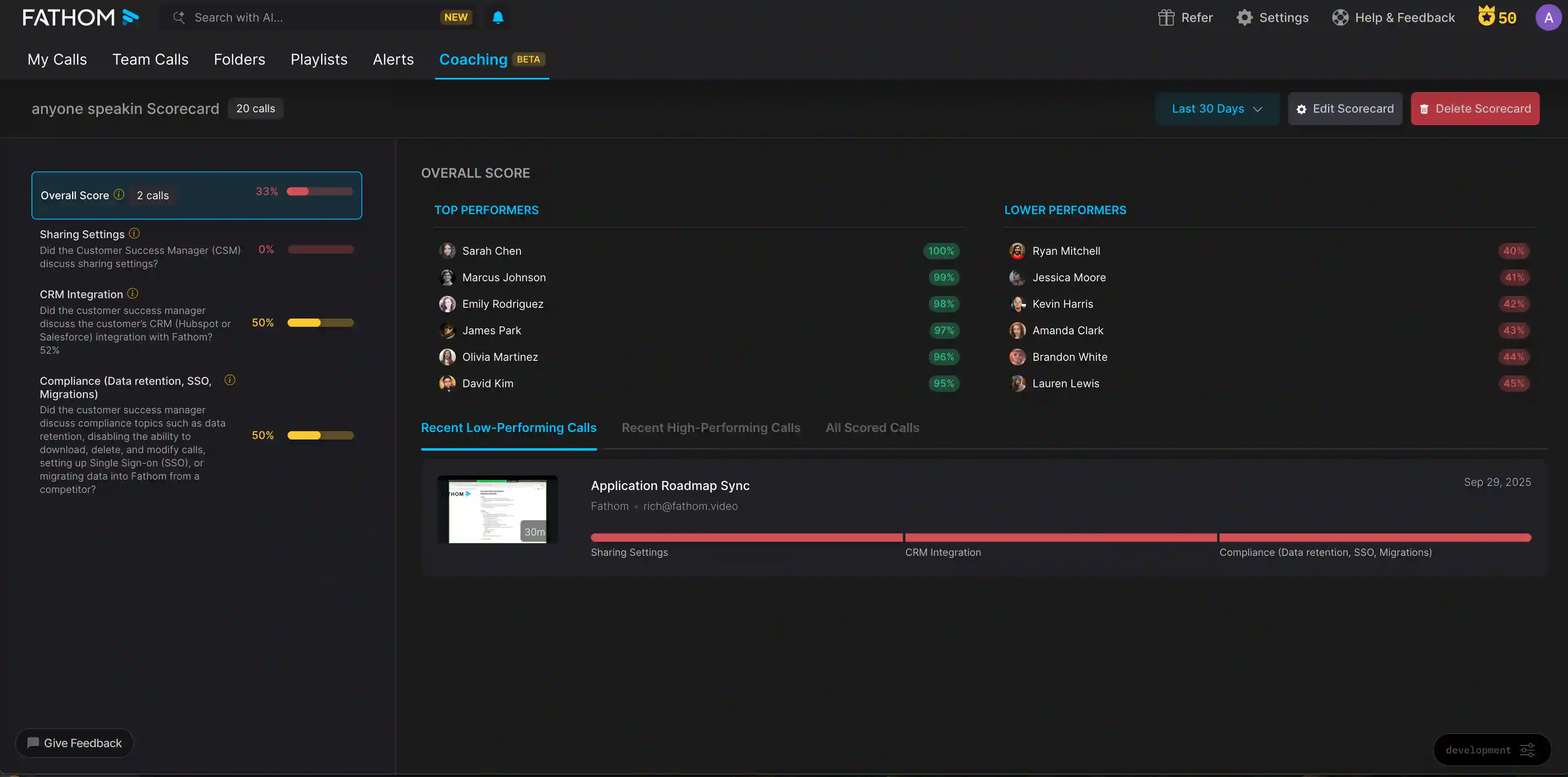
Fathom’s paid plans are more sales-shaped. You get features like CRM field sync, Deal View, coaching metrics, and AI scorecards. That can be useful if your team mostly wants to review sales calls and keep deal records updated. I would just be careful not to treat that as a general meeting-workflow advantage. It is a specific fit for sales call management.
Which One Should You Choose?
I’d think about it this way: is the meeting itself the thing you need to save, or is it the starting point for more work? If you just want unlimited free transcription for Zoom, Google Meet, or Microsoft Teams, Fathom is easy to understand. You record online meetings, get transcripts, and review summaries without worrying about minutes.
But if your meetings turn into work afterward, Notta gives you more room. Need to record a Webex call? Covered. Need to capture an in-person interview? Also covered. Need to upload an old file and turn it into a report or slide outline? That’s where Notta Brain comes in.
So the real question is not “which app has more features?” It is: do you just need online meeting notes, or do you need a wider meeting workflow? If it is the second one, I’d lean toward Notta.
Role-Based Recommendations
Global operations and program teams
If your team works across regions, the messy parts add up quickly. One call is bilingual. Another team sends a file. Someone uses Webex. Then leadership asks for a status brief by Friday. In that kind of workflow, Notta makes more sense because it handles multilingual transcription, real-time translation, file uploads, and outputs from Notta Brain in one place.
Consultants and client-facing teams
For consultants, the meeting is usually just the starting point. After the call, you still need the recap, follow-up email, report, slide deck, or next-step list. Notta Brain can help turn client conversations into deliverables you can actually send. If client-ready output is part of your job, I’d lean toward Notta here.
Researchers and knowledge teams
Research work usually means comparing interviews, files, and notes from different places. Notta is a better fit when you need file uploads, export formats, and cross-language transcription. Notta Brain can also help turn multiple recordings into tables, summaries, and comparison views.
Sales and revenue teams
Fathom Business Plan is clearly aimed at sales teams, with features like Deal View, CRM field sync, and coaching scorecards. That can be useful if your main workflow is reviewing calls and keeping deal records updated.
Notta is the better fit when sales is part of a wider meeting workflow. You still get sales support through Notta Sales Agent, but you also get broader capture options and deliverables from Notta Brain
FAQ
Is Notta better than Fathom?
Yes, if your meetings need more than simple online notes. I’d lean toward Notta for bilingual calls, live translation, Webex, in-person capture, file uploads, or Notta Brain outputs. Fathom makes sense if unlimited free transcription matters most.
What is Notta?
Notta is an AI-powered meeting productivity platform for business professionals and teams. It records online meetings, in-person conversations, and uploaded files, then turns them into transcripts, summaries, action items, and reusable follow-up work. It also supports multilingual workflows and Notta Brain outputs.
Does Fathom support real-time transcription?
Not in the same way Notta does. Fathom’s newer desktop experience includes a live summary during the meeting, but that is not a full live transcript. In its older bot-based experience, transcripts appear after processing.
Does Notta support more languages than Fathom?
Yes. Notta supports 58+ transcription languages by default. It also supports bilingual transcription in 23 languages and real-time translation in 80 languages. Fathom supports 38 transcription languages, with summary translation for six languages.
Does Notta work with Zoom, Teams, and Google Meet?
Yes. Notta works with Zoom, Microsoft Teams, Google Meet, and Webex. It also supports file uploads, screen recording, mobile recording, and Notta Desktop for bot-free recording across 40+ meeting apps.
Is Notta secure?
Yes. Notta is built for business use with SOC 2 Type II, ISO 27001, GDPR, CCPA, HIPAA, and AES-256 encryption. Business and Enterprise plans add user roles, sharing controls, audit logs, SSO, and IP restrictions.
Is Notta free?
Yes. Notta offers a free plan with 120 min/mo. Fathom’s free plan includes unlimited recordings and transcriptions. Paid Notta plans add more minutes, broader capture options, and access to Notta Brain.
Final Recommendation
Here’s my honest take: Fathom is a good choice if you want unlimited free transcription and your work mostly stays inside Zoom, Google Meet, and Microsoft Teams. Its paid Team and Business plans also add sales workspace features, with Deal View on Business only.
Notta is the one I’d choose when the meeting is only the beginning. It can capture online meetings, desktop calls, in-person conversations, and uploaded files. It also supports bilingual transcription and real-time translation, then turns meeting content into action items, summaries, reports, slides, and infographics through Notta Brain.
Try Notta free and see how your next meeting looks when it becomes more than a transcript.
Try Notta Free