
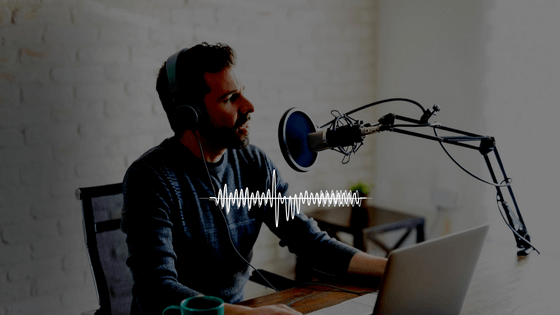
What is Dubbing? Everything You Should Know
Notta Showcase instantly translates your video into 15+ languages to reach a global audience.
Dubbing is the process of replacing the original spoken dialogue in a video with a new audio recording in a different language. The replacement audio is synchronised with the lip movements and timing of the original speakers, so the result feels natural to viewers watching in the target language rather than the source language.
You encounter dubbing whenever you watch a foreign film or TV series in your own language rather than with subtitles. The actors on screen are speaking one language, but what you hear is a different one entirely performed by voice actors and edited to match what you see.
Dubbing vs Subtitles
Dubbing and subtitles both serve the same underlying goal: making content accessible to audiences who don't speak the original language. But they achieve it differently, and audiences around the world have strong and often divergent preferences for one over the other.
Subtitles keep the original audio intact and display translated text at the bottom of the screen. Viewers hear the original actors and read the translation simultaneously.
Dubbing removes the original dialogue entirely and replaces it with a new voice performance in the target language. Viewers hear the content in their own language without needing to read anything.
The practical difference matters depending on context. Subtitles preserve the original performance, tone, and vocal identity of the actors, but they require viewers to read while watching. Dubbing removes the reading burden and creates a more immersive experience, but it requires skilled voice actors and careful synchronisation to feel authentic. For children's content, educational material, and any situation where viewers may find reading difficult or distracting, dubbing tends to be the preferred option.
Understanding dubbing and its applications
Audio dubbing refers specifically to replacing or adding audio content to an existing video track. While the term "dubbing" in everyday usage usually refers to language replacement, audio dubbing in a broader production context can also include:
Adding a music soundtrack or sound effects to a video
Replacing a damaged or low-quality audio track with a re-recorded version
Adding a narration or voiceover track to footage that was originally silent
In the localization context, audio dubbing and video dubbing are effectively the same thing — the distinction in terminology simply reflects the fact that what is physically being changed is the audio layer of a video file.
What are the different types of dubbing
Different projects call for different dubbing approaches. The main types differ in how closely the new audio is matched to what viewers see on screen.
Lip-Sync Dubbing
Lip-sync dubbing is the most technically demanding form. Voice actors must time their delivery so that the sounds they make correspond as closely as possible to the visible mouth movements of the on-screen actors. When done well, viewers have no reason to suspect the film wasn't originally made in their language.
This is the standard approach for major theatrical releases, big-budget streaming productions, and children's animated series where the audience is deeply engaged with the characters.
Voice Replacement Dubbing
Voice replacement dubbing replaces the original dialogue with a new language track but without requiring precise lip-sync accuracy. The timing is kept close to the original — the new dialogue fits within the same general rhythmic structure — but small deviations in mouth movement are considered acceptable.
This approach is more practical and cost-effective than full lip-sync dubbing. It's widely used in television, corporate video, and streaming content where production speed and budget matter.
Voiceover Dubbing
Voiceover dubbing adds a translated audio track on top of the original, rather than fully replacing it. The original audio is typically lowered in volume so viewers can still faintly hear it, while the translated track carries the content.
This approach is common in documentaries, news broadcasts, and interview footage. It preserves a sense of authenticity — viewers are aware they're hearing a translation — while still making the content fully comprehensible.
Narration Dubbing
Narration dubbing places a single narrator's voice over footage in place of reconstructed dialogue. This is distinct from voiceover dubbing in that it doesn't attempt to reproduce what characters are saying; instead, a narrator summarises or describes events.
Narration dubbing is typically used in documentaries and educational content where conveying information clearly is more important than dramatic authenticity.
Time-Sync Dubbing
Time-sync dubbing aligns the new dialogue with the general timing of the original speech without attempting to match lip movements precisely. Voice actors work within the timeframes of the original lines but have more flexibility with phonetic matching.
This approach is often used when dubbing content between languages with very different phonetic structures, where achieving lip-sync accuracy would require significant script rewriting.
Global Dubbing Preferences
One of the more interesting aspects of dubbing is how sharply preferences vary by country. Most of these preferences were established by the end of the Second World War and have remained relatively stable since, shaped by a combination of economics, language education levels, and cultural tradition.
Countries with a strong preference for dubbing: Germany, France, Italy, Spain, and Brazil are the world's most established dubbing markets. In these countries, it's been standard practice for decades to produce full theatrical-quality dubs for major releases, and audiences expect to hear foreign content in their native language.
Countries with a preference for subtitles: The United States, United Kingdom, India, Japan, and China tend to favour subtitles or original-language viewing. In English-speaking markets, this partly reflects the fact that the global entertainment industry already produces much of its content in English. In Japan and China, subtitles are deeply embedded in viewing culture.
The practical implication for content creators is that both approaches have value, and producing both a dubbed version and a subtitled version of content gives you the broadest possible global reach.
The dubbing process explained
Creating a professional dubbed version of a video involves several interconnected stages. The steps below represent the standard workflow for traditional dubbing.
Script Translation and Adaptation
The original script is translated into the target language by a qualified translator. Accuracy to the source material is essential, but so is adaptation — direct translations often result in dialogue that sounds unnatural when spoken aloud or that doesn't fit the timing of the original delivery.
A skilled adapter adjusts idioms, cultural references, and phrasing to feel natural in the target language while preserving the meaning and emotional tone of the original. This process is sometimes called transcreation.
Voice Actor Casting
Voice actors are selected based on linguistic fluency (ideally native speakers), vocal similarity to the original performers, and acting ability. For major productions, casting typically involves an audition process where actors read sample lines from the translated script.
Recording
Recording takes place in a sound-isolated studio. Voice actors perform their lines while watching the original footage, working to match the rhythm, pace, and emotional intensity of the on-screen dialogue.
A voice director typically oversees the session, guiding performances and ensuring consistency across scenes. Multiple takes are recorded to give editors options during post-production.
Mixing and Synchronisation
The recorded dialogue is edited to remove unwanted sounds, matched to the visual timing of the original performance, and mixed with the music and sound effects from the original audio track. This stage requires careful attention to synchronisation — the new audio needs to feel like a natural part of the video, not an overlay.
Quality Review
The completed dubbed version is reviewed against the original for accuracy, synchronisation, and overall quality before release.
Elevate your dubbing efforts with AI
Advances in artificial intelligence have significantly changed what's possible in dubbing, particularly for content creators and organisations working at scale or with limited production budgets.
AI dubbing uses machine learning to automate the translation, voice generation, and synchronisation steps that traditionally required large production teams. Modern AI dubbing tools can generate a reasonably synchronised dubbed version of a video in a fraction of the time and cost of traditional production.
The key limitation of fully automated AI dubbing is quality control. AI-generated voices can sound synthetic, and machine translations often miss the cultural nuances and emotional registers that make dubbing feel natural. For this reason, many professional solutions use a human-in-the-loop approach, where AI handles the time-consuming technical work while human translators and voice talent review and refine the output.
YouTube has also introduced its own auto-dubbing feature for eligible creators, which automatically generates dubbed audio tracks in additional languages for uploaded videos. This feature uses AI to handle the translation and voice synthesis, making dubbing accessible to individual creators who wouldn't otherwise have the resources for a full production workflow.
One of the standout AI dubbing software that combines effectiveness with speed is Notta Showcase.
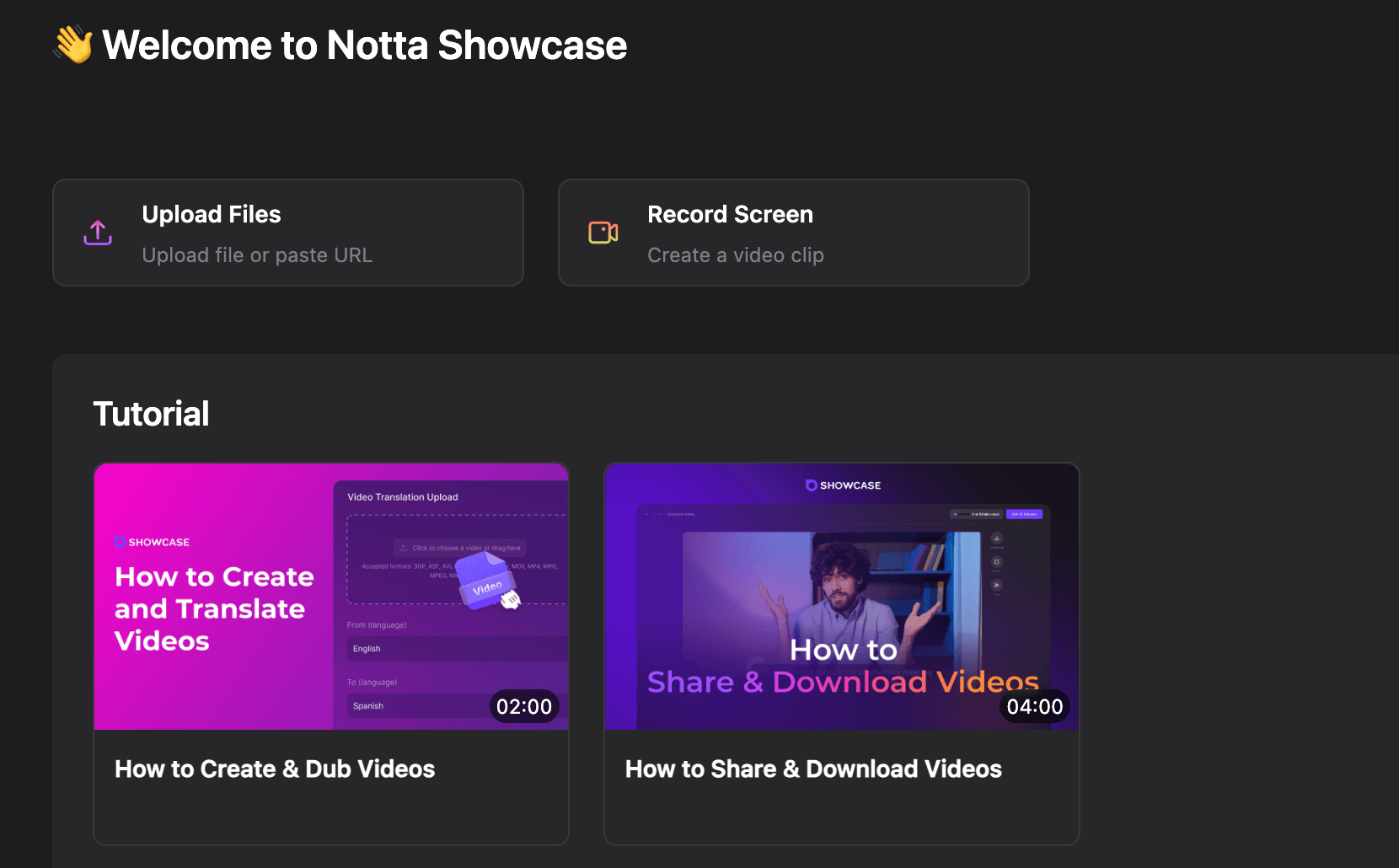
It uses advanced speech recognition and machine learning technology to analyze and create the dubbed version of videos in 15 of the most spoken languages, including Japanese, Chinese, English, and Spanish. With this, you can make your videos available to audiences in the biggest markets in a few minutes.
What's more, Notta Showcase has a voice cloning feature that helps you replicate the original speaker's voice in different languages. This helps keep a consistent intonation and style across your videos.
To dub your automate your video dubbing with Notta Showcase, follow the steps below:
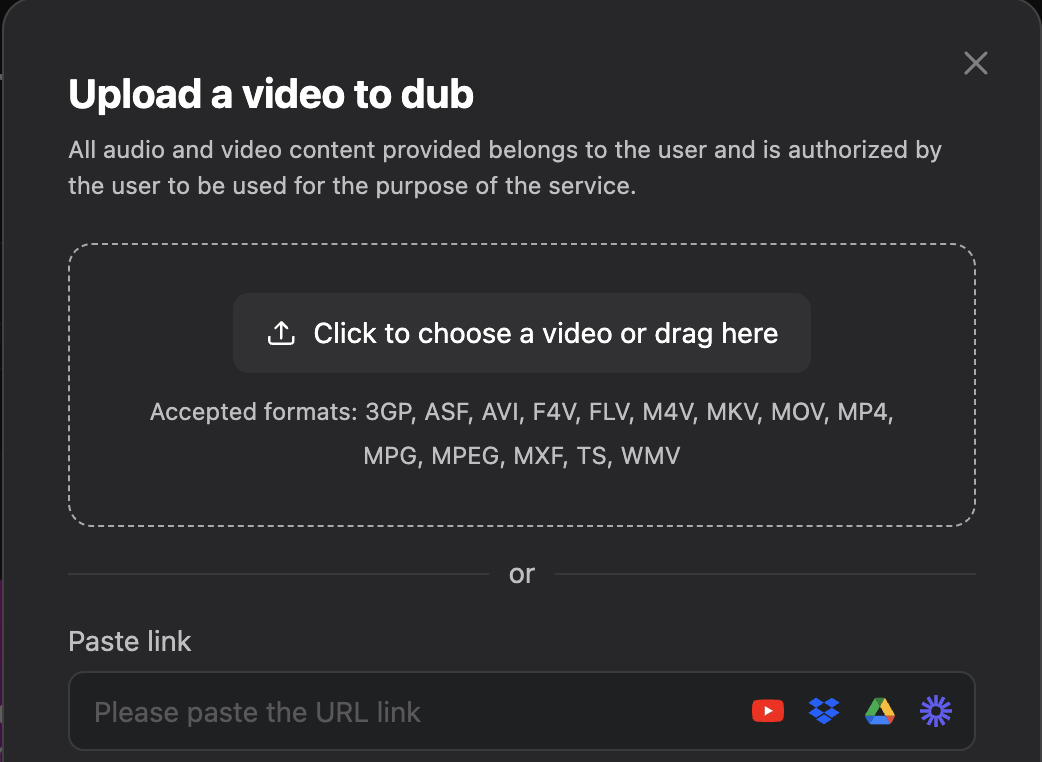
Step 1: Upload your video
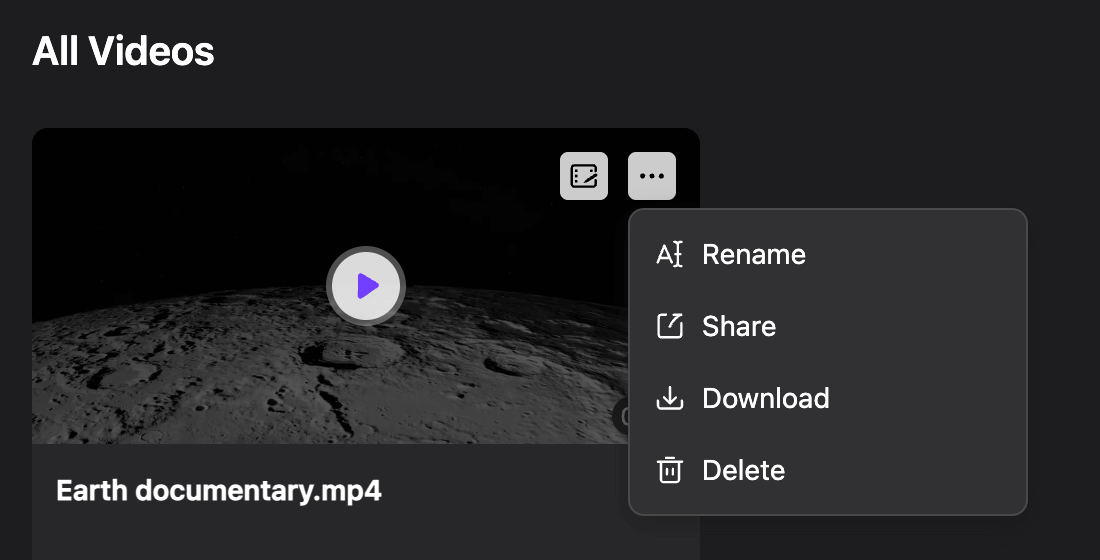
Launch Notta Showcase and click the ‘Upload Files’ button in the upper left corner of the dashboard. Upload the video you want to dub from your device. This tool supports different formats, such as MP4, MOV, and WMV.
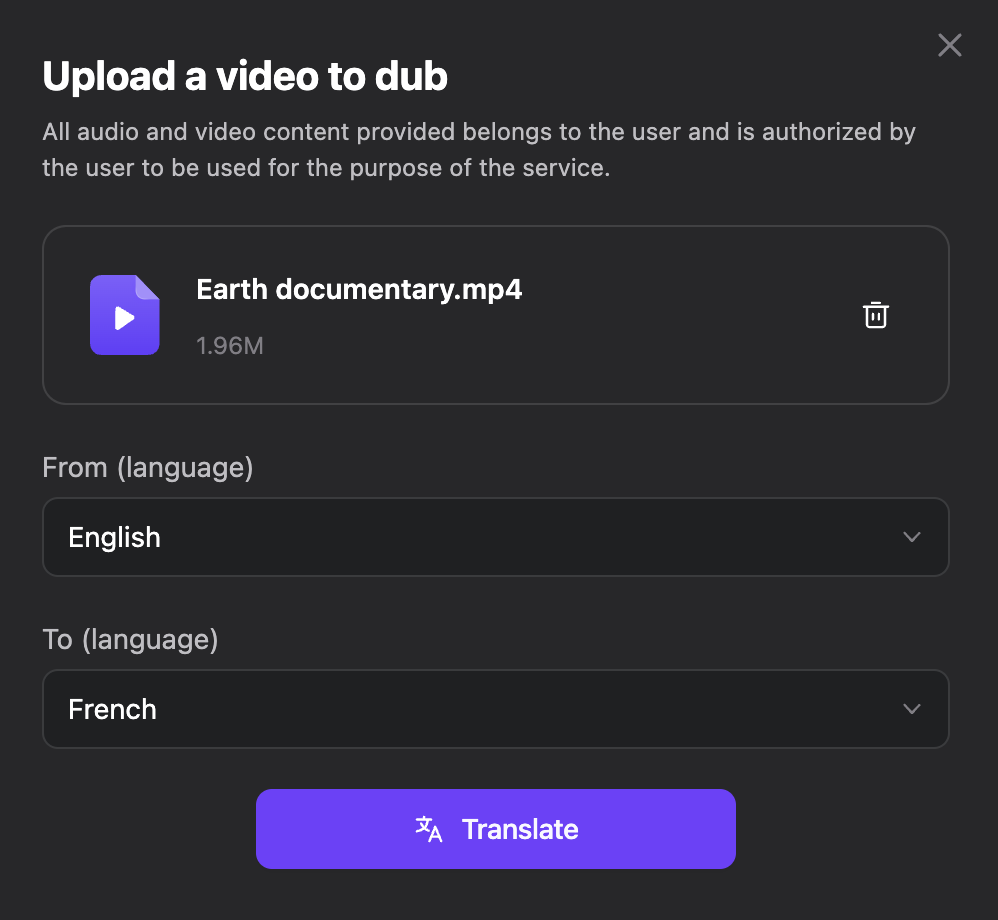
Step 2: Start translation
Select the source and target language and click the ‘Translate’ button to start translating the video.
Step 3: Review and export your video
When the translation process is complete, review the video to ensure it is precisely what you want and export it to your device.
Benefits of Dubbing
The case for dubbing video content comes down to audience reach and viewer experience:
Broader audience access. Dubbing allows viewers who don't speak the source language to engage with content fully, without the cognitive load of reading subtitles. This is particularly valuable for reaching older audiences, children, and people with reading difficulties.
Greater immersion. Viewers can focus entirely on what they're watching rather than splitting attention between screen action and subtitle text. This matters most for entertainment content where emotional engagement drives the experience.
Better performance for multitaskers. Dubbed content can be followed while doing other things — commuting, exercising, or working — in a way that subtitled content cannot.
Expanded monetisation. Content that's accessible to larger global audiences has more commercial potential, whether through advertising, licensing, or direct sales.
Challenges of Dubbing
Dubbing also comes with real constraints that content creators and producers should weigh:
Cost and time. Traditional dubbing is expensive. It requires translators, voice actors, recording studio time, sound engineers, and multiple review rounds. For smaller creators or tight production timelines, this can be prohibitive.
Synchronisation complexity. Matching translated dialogue to lip movements is technically demanding. Different languages have different rhythms, syllable structures, and common utterance lengths, making some language pairs harder to synchronise than others.
Cultural adaptation. Literal translations rarely work as dubbing scripts. Effective dubbing requires thoughtful adaptation that preserves the tone and intent of the original, not just the words — and that adaptation requires skilled linguists who understand both cultures.
Loss of original performance. Even excellent dubbing replaces the original actors' vocal performances. For some viewers, particularly those who are familiar with the source language, this can feel like a loss of authenticity.
Frequently Asked Questions
What is the difference between dubbing and subtitling?
Dubbing replaces the original audio with a new voice performance in another language. Subtitling keeps the original audio and adds translated text on screen. Dubbing is more immersive but more expensive to produce; subtitling is cheaper and preserves the original performance but requires viewers to read.
What does "dubbed" mean when referring to a movie?
A dubbed movie is one where the dialogue you hear has been re-recorded in a different language from the one originally spoken by the cast. The actors on screen may have spoken in Korean, German, or Spanish, but in a dubbed version, you hear the film in your own language.
What is audio dubbing?
Audio dubbing refers to replacing or adding a new audio track to existing video footage. In the context of localization, it means replacing the original spoken dialogue with a new voice recording in another language. In a wider production context, it can also refer to adding music, narration, or sound effects to footage.
What is AI dubbing?
AI dubbing uses artificial intelligence to automate the translation, voice generation, and synchronisation steps involved in producing a dubbed version of a video. It reduces the cost and time required significantly compared to traditional production workflows. Most professional-grade AI dubbing solutions also incorporate human review to maintain quality and cultural accuracy.
What is the difference between dubbing and voice-over?
Dubbing fully replaces the original dialogue with a new language performance timed to match what viewers see on screen. Voice-over adds a translated track over the original audio, which remains faintly audible. Dubbing is more immersive and requires more synchronisation work; voice-over is simpler to produce and retains a sense of the original audio.
Which countries prefer dubbing over subtitles?
Germany, France, Italy, Spain, and Brazil are the major dubbing markets where audiences expect foreign content to be fully dubbed into their language. English-speaking markets (US, UK), Japan, India, and China generally favour subtitles or original-language content.
What is the dubbing process?
The standard dubbing process involves five stages: translating and adapting the original script, casting voice actors, recording the new dialogue in a studio, mixing and synchronising the audio with the video, and performing a quality review before release. AI-assisted workflows can automate several of these steps.
Wrapping Up
Dubbing is an effective way of reaching audiences in any part of the world in their preferred language. However, you still need to know how to implement it properly to take maximum advantage of its benefits.
We have detailed the steps you need to follow to create perfectly dubbed videos, regardless of your field. However, the manual method introduced is primarily for big organizations and directors in the filmmaking industry who have the time and resources required.
As a solution for content creators running on tight budgets, we recommend giving AI-powered dubbing software a try, with which you can automate the dubbing process at a relatively low cost without compromising quality.

