
Read next: how to take notes in Zoom meetings

How to Annotate in Zoom on Virtual Meetings
Updated:2026-03-085mins
Content
Make the most of your meetings with Notta
Unlock the power of AI — Notta's meeting assistant records, transcribes and summarizes meeting minutes with one click.
Try it Free
Zoom's annotation tools let anyone in a meeting draw, highlight, type, or stamp directly on a shared screen or whiteboard in real time. Whether you're the host walking someone through a document or a participant flagging something on a colleague's presentation, the process is straightforward once you know where to find the controls — and why they sometimes disappear.
This guide covers annotation for hosts and participants separately, across desktop, Android, and iOS, and includes troubleshooting for when the annotation button goes missing.
If you are wondering how to annotate on Zoom in virtual meetings as a host or participant, read this detailed guide. Here we will reveal steps to easily annotate on Zoom via desktop, Android, or iOS devices.
Host vs Participant: How Annotate in Zoom Works
Before getting into steps, it helps to understand one key rule: participants can only annotate if the host has allowed it. This is a setting the host controls during the meeting. If you're a participant and can't find the annotation option, the host may have disabled it — not a technical fault on your end.
As a host, you can annotate freely once you start sharing your screen. You can also annotate on a shared whiteboard without screen sharing at all.
As a participant, you annotate on the host's shared content by going to View Options at the top of the screen, then selecting Annotate. This option only appears if the host has enabled participant annotation.
How to Annotate on Zoom on Desktop (Windows, Mac, Linux)
If You Are the Host (Screen Sharing)
Start sharing your screen in the meeting. Once your screen is live, a green toolbar appears at the top of the screen. Click Annotate in that toolbar to open the annotation panel.
If you're sharing a whiteboard rather than your screen, the annotation tools appear automatically along the top of the whiteboard without needing to click Annotate separately.
Once the annotation panel is open, you'll see the following tools:
Mouse — Deactivates all annotation tools and returns your cursor to a regular mouse pointer.
Select — Lets you click, move, or resize annotations already on the screen. You can select multiple annotations by clicking and dragging to create a selection area. This tool is only available to the person who started the share.
Text — Inserts a text box anywhere on the shared screen or whiteboard.
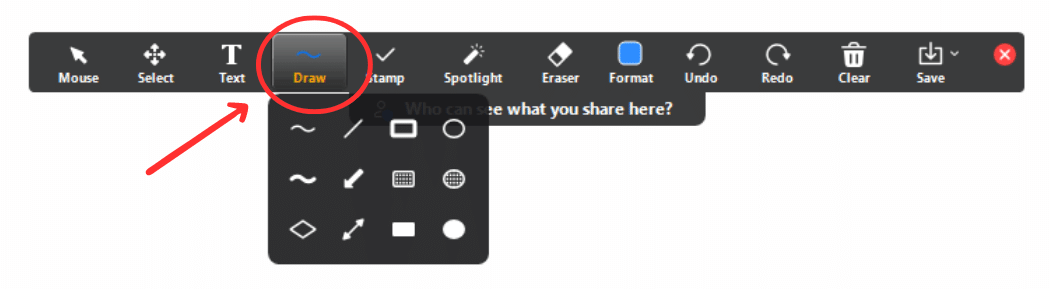
Draw — Adds lines, arrows, and shapes. To highlight an area with a semi-transparent overlay, select the square or circle icon within the Draw options.
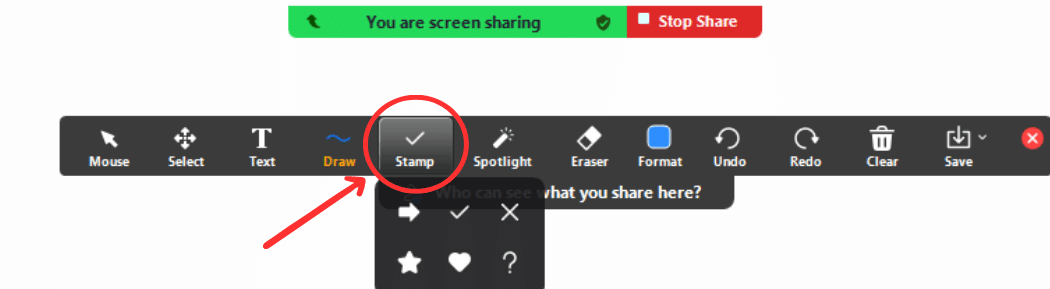
Stamp — Places predefined icons (checkmarks, stars, hearts, arrows) on the screen with a single click.
Spotlight — Turns your cursor into a visible spotlight that all participants can see, useful for pointing at specific areas without drawing anything permanent. Only available to the person sharing.
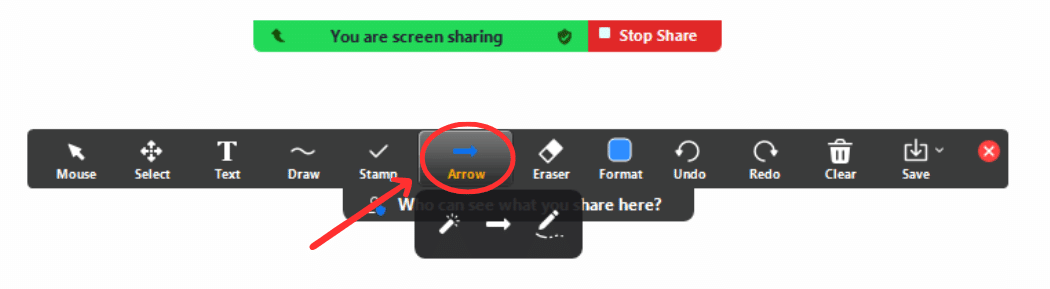
Arrow — Replaces your cursor with a small arrow that displays your name. Each time you click, the previous arrow disappears and a new one appears. Useful for pointing out annotations to others.
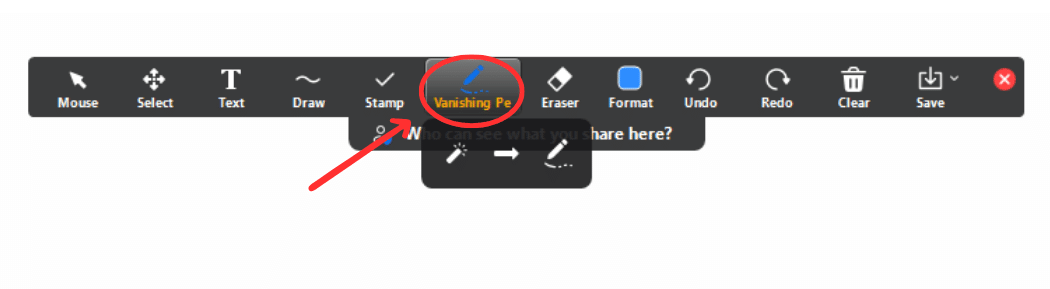
Vanishing Pen — Draws annotations that automatically fade away within a few seconds, so you can highlight something temporarily without needing to erase it. Only available to the person sharing.
Eraser — Click and drag to erase portions of existing annotations.
Format — Changes the color, line width, and font of your annotations. Select this before drawing or typing to apply the formatting to new annotations.
Undo / Redo — Removes or restores your most recent annotation.
Clear — Deletes all annotations from the current screen at once.
Save — Saves the annotated screen or whiteboard as a PNG or PDF file to your local recording folder. If you want to save as a specific format, click the downward arrow next to Save to choose between PNG and PDF. Note that participants can only use Save if the host has granted that permission.
To stop screen sharing and end annotation, click Stop Share in the toolbar.
If You Are a Participant (Viewing Shared Content)
When someone else is sharing their screen, look for View Options at the top of your screen. Click it, then select Annotate from the dropdown. This opens the annotation toolbar and lets you draw on the shared screen.
If you don't see Annotate under View Options, the host has disabled participant annotation. You can ask the host to enable it during the meeting (see the host controls section below).
How to Annotate on Someone Else's Screen in Zoom
This is the participant workflow described above, but it catches a lot of people out because the path is different from the host path.
When another participant is sharing their screen, go to View Options at the top of your Zoom window, then click Annotate. The same annotation toolbar appears. Your annotations are visible to everyone in the meeting, including the person sharing. Your name will briefly appear next to your annotations so the host can see who is marking what.
You cannot annotate on someone else's screen if:
The host has disabled participant annotation (the most common reason)
You are viewing the meeting in a reduced window that hides the View Options toolbar
You are on a mobile device and the host is sharing their full screen (mobile annotation has specific limitations covered below)
How to Annotate on Zoom Without Sharing Your Screen
You don't need to share your screen to use annotation tools. Zoom's whiteboard feature gives you a shared canvas where everyone can annotate without anyone sharing their desktop.
To open a whiteboard during a meeting, click Share Screen and then select Whiteboard from the sharing options. The whiteboard opens with annotation tools immediately available along the top. All participants with annotation permission can draw on it simultaneously.
This is useful for brainstorming sessions, quick diagrams, or any collaborative exercise where you want a blank canvas rather than a shared application or document.
How to Enable or Disable Annotation in Zoom
Enabling Annotation for Yourself
If the Annotate button isn't appearing in your meetings, annotation may be turned off in your account settings.
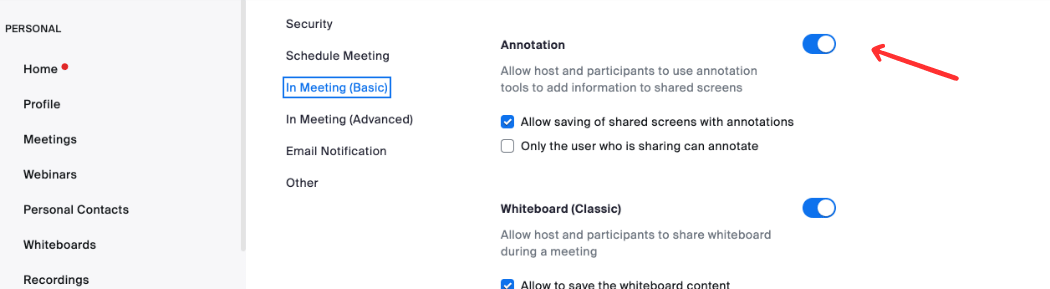
Sign in to the Zoom web portal at zoom.us. Go to Settings in the left navigation panel, then click the Meeting tab. Under In Meeting (Basic), look for Annotation and make sure the toggle is on. Zoom saves the change automatically.
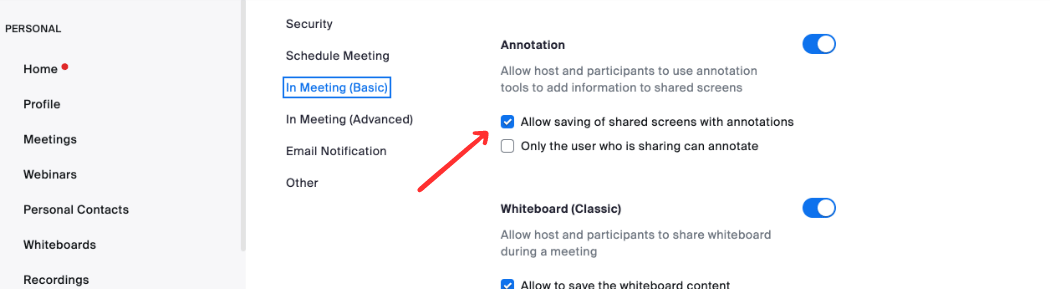
You can also choose here whether to allow participants to save annotated screens by checking or unchecking the relevant box beneath the toggle.
Enabling Annotation for Participants During a Meeting
As the meeting host, once you've started screen sharing, click More (...) in your screen share controls. From the dropdown, select Enable Annotation for Others to give participants the ability to draw on your shared screen. Selecting it again will disable participant annotation.
You can also select Show Names of Annotators to make participant names briefly visible next to their annotations, which helps you track who is marking what during collaborative sessions.
Disabling Annotation Entirely
To prevent all annotation in your meetings, go to the Zoom web portal, navigate to Settings, find Annotation under In Meeting (Basic), and turn the toggle off. With this disabled, neither you nor participants will see annotation tools during meetings.
Annotation Keyboard Shortcuts
For faster access to annotation controls on desktop, use these shortcuts:
Action
Windows
Mac
Undo
Ctrl + Z
Command + Z
Redo
Ctrl + Y
Command + Shift + Z
Switch to mouse mode
Right-click anywhere
Right-click anywhere
On Linux, right-clicking anywhere during annotation switches you back to mouse mode. Undo and Redo shortcuts follow the same pattern as Windows.
Use Zoom Annotation Tools: Windows | macOS | Linux
The process of annotating on Zoom is similar in Windows, macOS, or Linux operating systems. If you are the meeting host, here is how to annotate in Zoom in four easy steps:
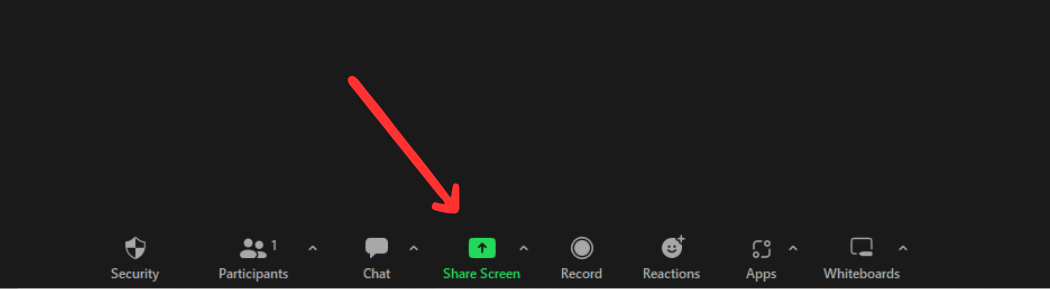
Step 1: Go to the Zoom meeting and select 'Share Screen.' Choose the windows you want to share and click 'Share.' You will find an 'Annotate' icon at the top of the green bar.
Step 2: Click the 'Annotate' icon, and all annotation tools will be available to use. (Note: If you are sharing a whiteboard, you can access the annotation tools right on the top of your screen.)
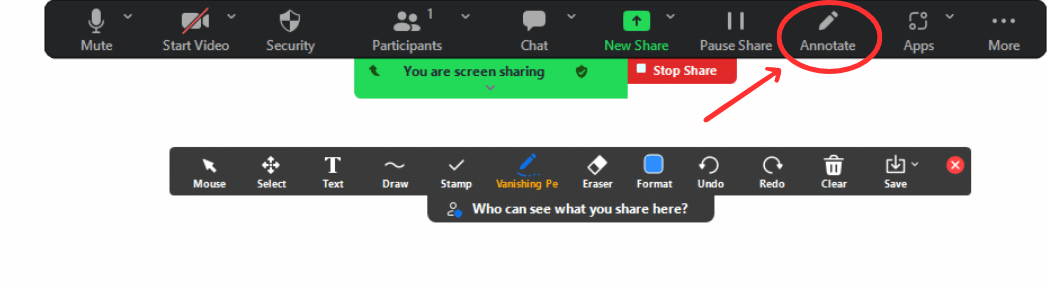
Before we move to step 3, let us explain the different Zoom annotation tools and their specific functions:
Mouse: The mouse icon deactivates all other annotation tools and selects your mouse pointer.
Select: It allows you to select, move, or resize the annotations present on the screen.
Text: As the name defines, the text icon lets you insert text on the shared screen or whiteboard.
Draw: This icon lets you add lines, arrows, or different shapes on the screen. The semi-transparent square or circle helps you highlight any area on the shared screen.
Stamp: It lets you add different predefined symbols like heart, star, arrow, etc., anywhere on the shared screen.
Spotlight: This icon is accessible only to the meeting host. With a spotlight, the host can point out important parts of the screen with a mouse pointer.
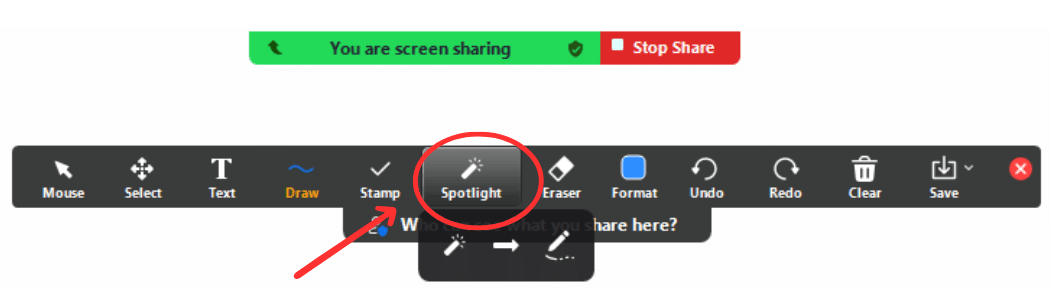
Arrow: It replaces the mouse pointer with a small arrow displaying the user's name. With a new click on the screen, the previous arrow disappears, helping participants understand the latest annotations.
Vanishing Pen: The icon enables you to add annotations on the screen that disappears within a few seconds.
Eraser: You can click and drag the eraser to remove a few or all previously added annotations on the screen.
Format: The formatting option enables you to modify the color, line width, and font of the annotations.

Undo/Redo: Undo icon allows you to remove the latest annotation, while redo adds the previously removed annotations on the screen.
Clear: The icon lets you clear all the Zoom annotations added on the shared screen or whiteboard.
Save: It allows you to save the shared screen or whiteboards with annotations as PDF or PNG on your device.
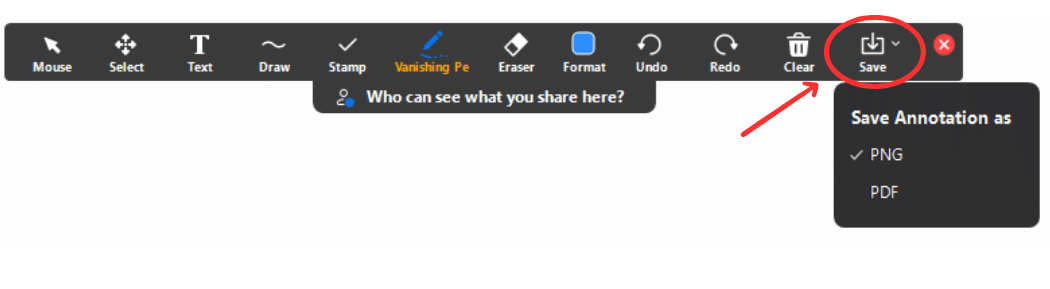
Note: The 'Save' option is only available if the meeting host grants the saving rights to the participants.
Step 3: Click on the 'Save' icon, and a drop-down menu will appear. Select either PNG or PDF to save the shared screen on your device.
Step 4: If you want to stop screen sharing, select the 'Stop Share' icon on the top of your screen.
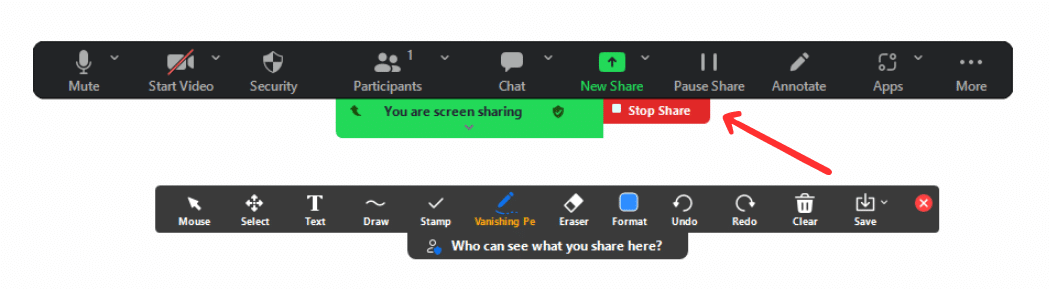
Note: If you are a participant, click 'View Option' positioned at the top of the screen and then select 'Annotate' to start annotating.

Use Zoom Annotation Tools: Android
Now that we have discussed how to annotate on Zoom via the desktop version, below are the steps to use annotating tools on your Android device.
Step 1: Start the Zoom meeting and select 'Share Screen.'
Step 2: Select the pencil icon to open the annotation toolbar.
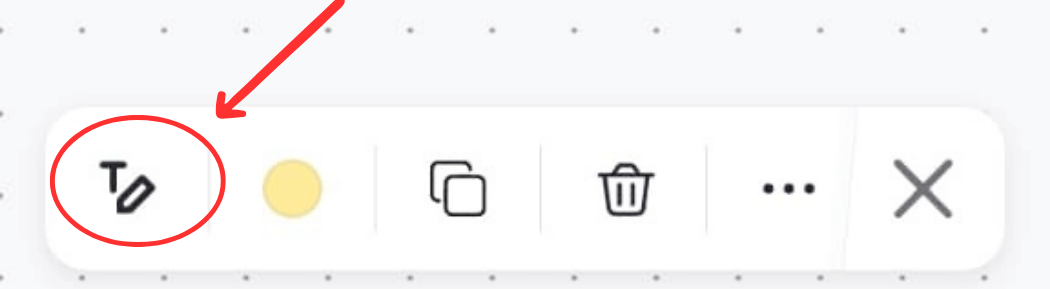
Step 3: Start annotating by using different icons, such as pen/highlighter, arrow, color, and eraser.
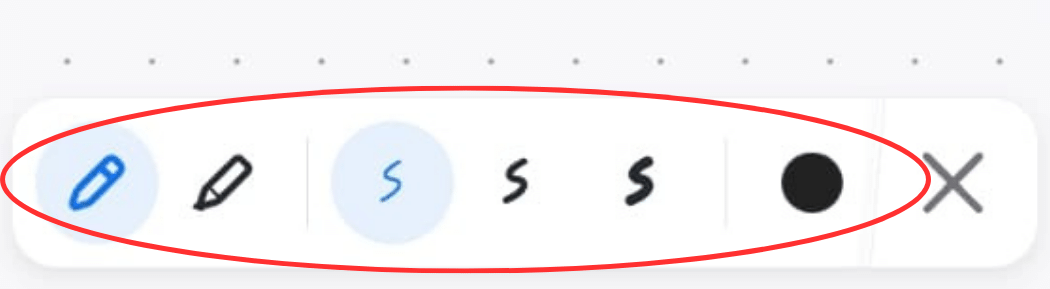
Note: If you are using Zoom via an Android tablet, you can access a few additional tools, including shapes, text, and undo/redo.
Use Zoom Annotation Tools: iOS
If you are joining a virtual meeting via an iOS device, here are the simple steps to use the annotation tools.
Note: Install a Zoom mobile app of version 4.2 on your Apple device with iOS 11 or higher to annotate.
Step 1: Select 'Share Screen,' and you will see a pencil icon positioned at the bottom of your screen.
Step 2: Click the pencil icon to access the annotation toolbar. A few notable tools you can use in virtual meetings on Zoom via iOS device include a spotlight, pen, color, eraser, and save. Other tools, like an arrow, shapes, undo/redo, and clear, are only available for iPad users.

Step 3: Click 'Save' to download the annotated screen on your iOS device.
Important Note: Unlike desktop versions, Android and iOS devices have limitations when accessing Zoom's annotation features. On mobile devices, you can only share a portion of your screen to access the annotation toolbar. Whereas, in desktop operating systems, you can use annotations while sharing the portion and your complete screen in Zoom virtual meetings.

Capture every detail with AI meeting notes
Notta offers the most integrated AI meeting notes, summaries, and action items so nothing gets missed.
Start for Free
How to enable or disable annotation tools
The meeting host and the invited participants must enable the annotation tools before using them in the virtual meetings.
For your own use
Follow the below-mentioned steps to enable annotations for your own use:
Step 1: Sign in to the Zoom web portal.
Step 2: Head to the navigation panel and click 'Settings.'
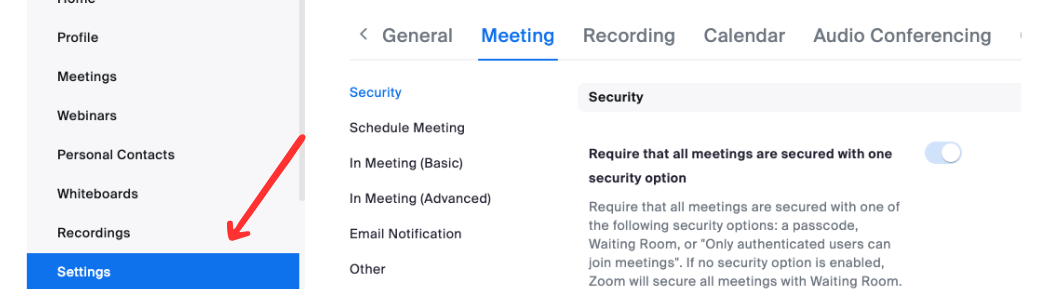
Step 3: Select the 'Meeting' tab.
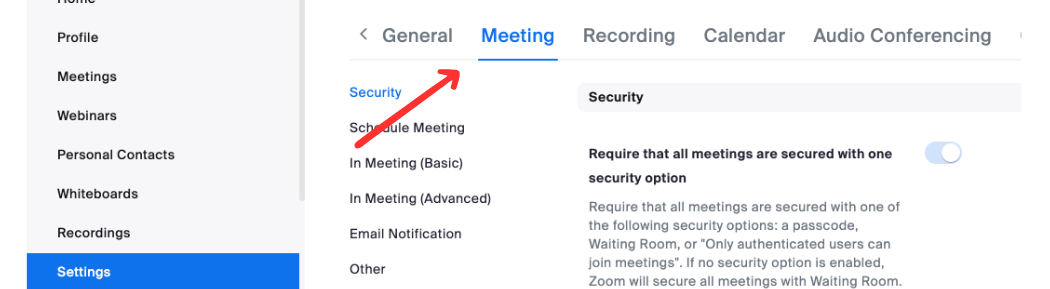
Step 4: Click 'In Meeting (Basic)' and verify if 'Annotation' is enabled.
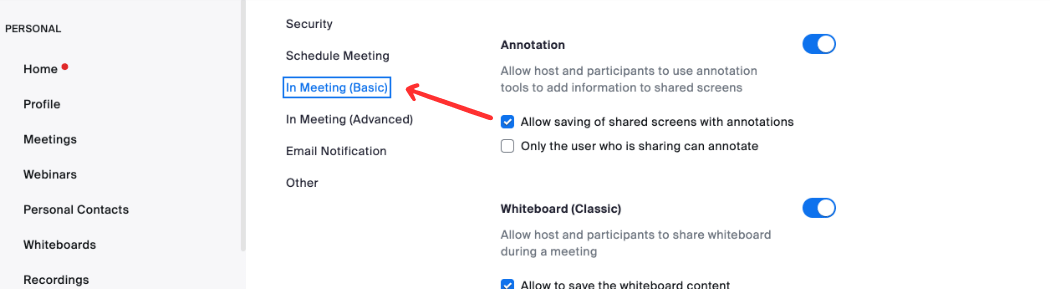
Step 5: If it is disabled, enable the 'Annotation' by selecting the toggle. The system will automatically save your new settings.
Step 6: Check the box to allow the saving of shared screens with annotations. The meeting host can alter the annotation rights for participants by allowing or restricting content sharing by unchecking the boxes.
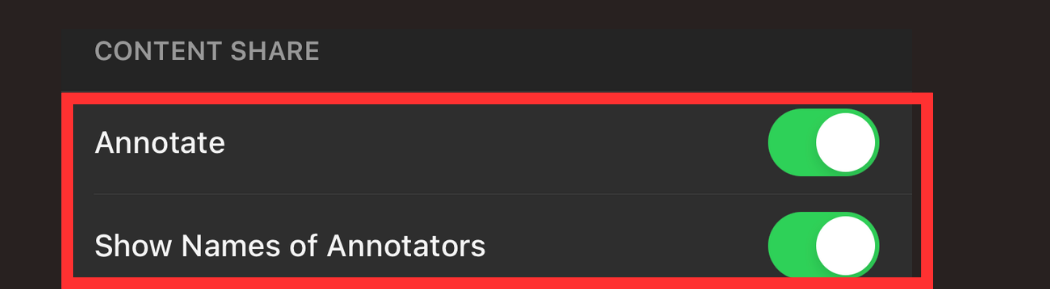
If you are joining the Zoom meeting via iOS or Android device, select More > Meeting Settings. Click on 'Content Share' to allow participants to annotate in Zoom.
For other participants
If you are organizing the Zoom meeting, here are a few steps to modify the annotation settings for other participants.
Step 1: Share your screen and click 'More (...).'
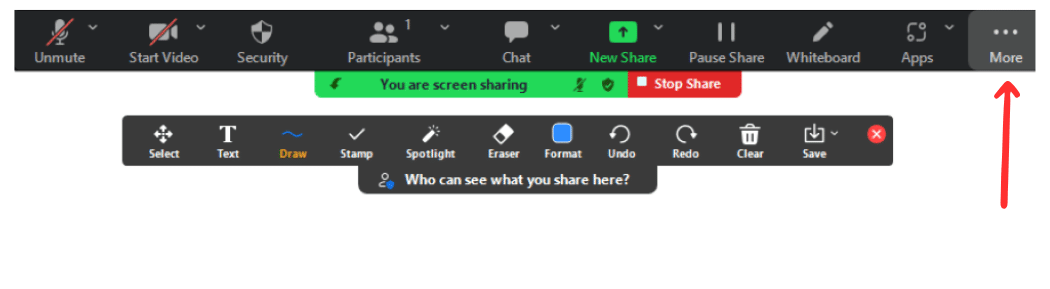
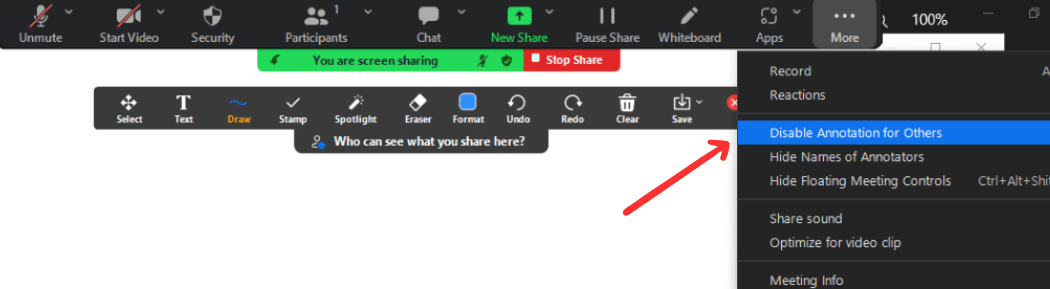
Step 2: Once you click on More, a drop-down menu will appear. Select 'Enable/Disable Annotation for Others' to allow or prevent participants from annotating.
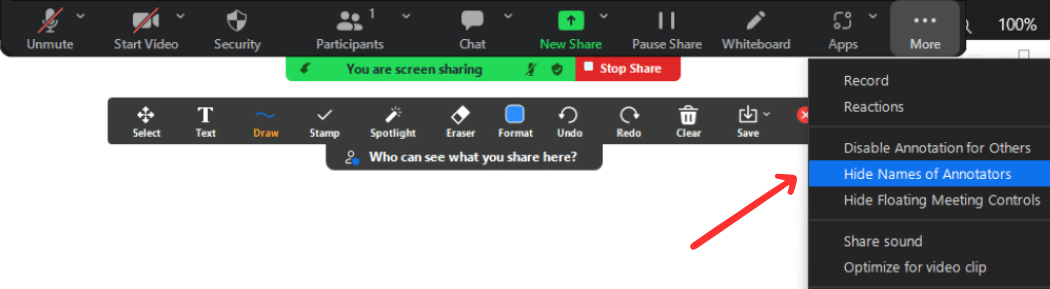
Step 3: Click 'Show/Hide Names of Annotators' to show or hide the attendees' names when annotating on the shared screen.
Notta: AI-powered meeting assistant
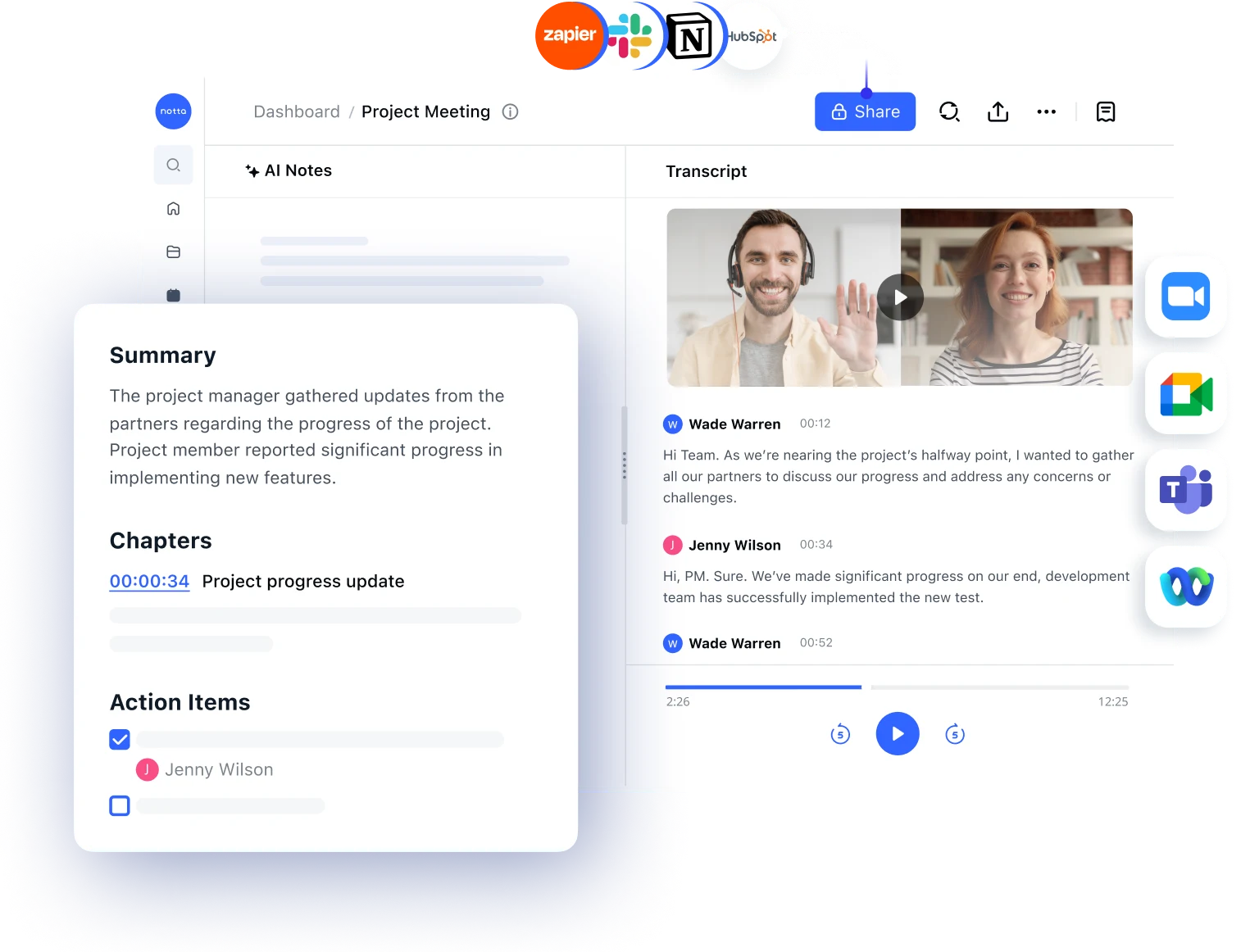
Zoom allows you to save videos, add annotations, and share them with participants for later review. However, the process can be cumbersome due to the complexities and technicalities involved in manually recording, transcribing, and annotating virtual meetings.
Fortunately, there is a solution to it! Notta is one of the feature-rich AI-powered software that helps users manage and record high-quality Zoom meetings in real-time. It is a recording and transcribing app for Zoom with an excellent edit/mark transcript and live stream text sharing feature so you can effortlessly find the key points of meetings.
But that's not all — Notta offers an AI bot that can attend meetings on your behalf, extract meaningful information, and create transcriptions with 98.86% accuracy. Check out Notta AI meeting notetaker today and streamline attending Zoom virtual meetings.
Annotation Missing or Not Working? How to Fix It
The Annotate button isn't showing on desktop: The most common cause is that annotation is disabled in your account settings. Sign into zoom.us, go to Settings, find the Meeting tab, and check that the Annotation toggle is turned on under In Meeting (Basic).
You're a participant and can't see Annotate: The host has either disabled participant annotation or hasn't enabled it. Ask the host to click More in their screen share controls and select Enable Annotation for Others.
You can't find View Options as a participant: View Options appears at the top of the screen only when someone is sharing. If the sharing window is too small or you're in a reduced view mode, the toolbar may be hidden. Try expanding the shared content window.
Annotation is missing on iOS: Check that you're sharing a portion of your screen rather than your full screen. Annotation on iOS is only available in partial screen share mode.
The annotation toolbar opens but tools aren't responding: Try right-clicking anywhere on the shared screen to reset to mouse mode, then click Annotate again to reactivate the toolbar. If problems persist, leaving and rejoining the meeting usually resolves it.
You saved annotations but can't find the file: Saved annotation files are stored in your local Zoom recording folder. On Windows this is typically C:\Users\[Username]\Documents\Zoom. On Mac it's /Users/[Username]/Documents/Zoom.
Run more productive meetings with Notta
Easily schedule meetings, auto-record and transcribe meeting minutes, and summarize key action items — all with one tool!
Start for Free
FAQs
Can participants annotate in Zoom without the host enabling it?
No. Participant annotation requires explicit permission from the host. Without it, the Annotate option won't appear under View Options for participants. The host enables this during the meeting through More in their screen share controls.
Can the host see who annotated what?
Yes, if the host has enabled Show Names of Annotators. When this setting is on, each participant's name briefly appears next to their annotations. The host can also lower or remove specific annotations using the annotation controls.
Does annotation work on Zoom's free plan?
Yes. Annotation is available on all Zoom plans including the free Basic plan. There are no annotation features locked behind paid tiers.
Can I annotate a PDF or document shared in Zoom?
Yes. Annotation works on any shared content, including PDFs, PowerPoint presentations, documents, images, or any application window being shared. The annotation tools draw on top of the shared content rather than modifying the underlying file.
Do Zoom annotations save automatically?
No. Annotations are not saved automatically. To keep a record, click the Save icon in the annotation toolbar before the meeting ends. The file saves as a PNG or PDF to your local Zoom folder.

