
How to Transcribe an Audio File in Google Docs (4 Methods That Work)

Contents
Google Docs can't transcribe an audio file directly. Its Voice Typing tool (Tools > Voice typing) only listens to live microphone input in Chrome, Edge, or Safari, and there's no button to upload an MP3, WAV, or M4A file.
There are still four ways to get an audio file transcribed into Google Docs. Dedicated tools like Notta upload the recording and sync it to Docs. Google's free Gemini Notebook imports audio so you can copy the text over. You can also route playback through a virtual cable into Voice Typing, or transcribe in Microsoft Word and open the .docx in Docs.
Here's how those four methods compare on speed, cost, speaker labels, and real-world limits.
Quick comparison: 4 ways to transcribe an audio file in Google Docs
Each method works with a pre-recorded file and ends in an editable Google Doc.
| Method | Processing speed | Cost & free limit | Speaker labels & timestamps | Works on IT-locked PCs | Main limit |
|---|---|---|---|---|---|
| 1. Notta (converter or app) | ~5 min per 1 hrWeb/App file upload; seconds for short converter clips (Notta Help Center, checked Nov 2026) | Free tier + paidConverter: first 30 min, 5/mo no sign-up; App Free: 120 min/mo, 3-min view cap; Pro from $8.17/mo annual (Notta pricing, checked Nov 2026) | ✅ YesSpeaker labels & timestamps in Web/App; converter downloads TXT/DOCX/PDF/SRT/XLSX (Notta Help Center, checked Nov 2026) | ✅ Web / MobileBrowser and mobile work without software installs via cloud; Privacy Mode needs Desktop install (Notta Help Center, checked Nov 2026) | App Free cuts view at 3 minPro ($8.17/mo annual or $13.49/mo monthly) unlocks full downloads (Notta pricing, checked Nov 2026) |
| 2. Google Gemini Notebook | Minutes on importTranscribes audio automatically when added as a source (Google Gemini Notebook Help, checked Nov 2026) | ✅ FreeUp to 200 MB or 500,000 words per source; 50 sources per notebook (Google Gemini Notebook Help, checked Nov 2026) | ❌ NoOutputs plain source text without speaker tags or clickable timestamps (Google Gemini Notebook Help, checked Nov 2026) | ✅ BrowserRuns in web browser without admin software installs (Google Gemini Notebook Help, checked Nov 2026) | Manual copy-pasteNo direct export to Docs; occasional upload limits or errors (Reddit, Jan 2026) |
| 3. Voice Typing + virtual cable | 1x real timeA 60-minute file takes 60 full minutes to play through (Google Docs Help, checked Nov 2026) | ✅ FreeUnlimited duration in Chrome, Edge, or Safari; VB-CABLE donationware or BlackHole free (VB-Audio & BlackHole sites, checked Nov 2026) | ❌ NoDumps unformatted text with no speaker breaks or timestamps (Google Docs Help, checked Nov 2026) | ❌ Needs driverAdmin rights needed to install VB-CABLE or BlackHole on work machines (VB-Audio & BlackHole sites, checked Nov 2026) | Fragile captureStops listening when you switch browser tabs or trigger tip popups (Google Docs Community, Apr 2026) |
| 4. Word Transcribe to Docs | Up to ~1x audio lengthProcesses uploaded files in background pane (Microsoft Support, checked Nov 2026) | M365 subscription300 min/mo with Microsoft 365 ($9.99/mo Personal); 30,000 min/mo with Copilot (Microsoft Support, checked Nov 2026) | ✅ YesSeparates | ✅ Word for WebBrowser version works in commercial M365 tenants without desktop install (Microsoft Support, checked Nov 2026) | Extra conversion stepRequires saving |
Sources verified November 17, 2026 across Notta Help Center, Notta pricing, Google Docs Editors Help, Google Gemini Notebook Help, Microsoft Support, VB-Audio, and BlackHole docs.
Which method should you pick? For interviews, multi-speaker calls, or long recordings, start with Method 1. If you want a free browser route for a clean single-speaker memo, use Method 2. Save Method 3 for short clips when you cannot upload files to a third-party app.
Method 1: Upload to Notta and sync or export to Google Docs (direct upload)
Direct upload skips real-time playback. On Reddit, u/ramazanburakekinci (Sep 6, 2026) called Voice Typing "painful" for multi-hour audio because it only runs at 1x speed. On Hacker News, eduction (Feb 14, 2026) also noted that tools requiring mic access fail people who record on external gear.
Notta offers two upload paths. Your choice depends on file length and whether you need speaker labels.
Option A: Quick files under 30 minutes (no sign-up)
Have an MP3, WAV, or M4A under 30 minutes and want to skip creating an account? Try Notta's free audio to text converter. In English regions, it converts up to 5 files per month and processes the first 30 minutes of each upload.
- Open the converter on the File upload tab and click Upload file (or drag your file in).
- Pick the spoken language of your audio and click Confirm.
- Wait for the transcript to appear, then download it as DOCX or TXT (along with PDF, SRT, or EXCEL).
- Upload the
.docxfile to Google Drive, double-click it, and select Open with > Google Docs.
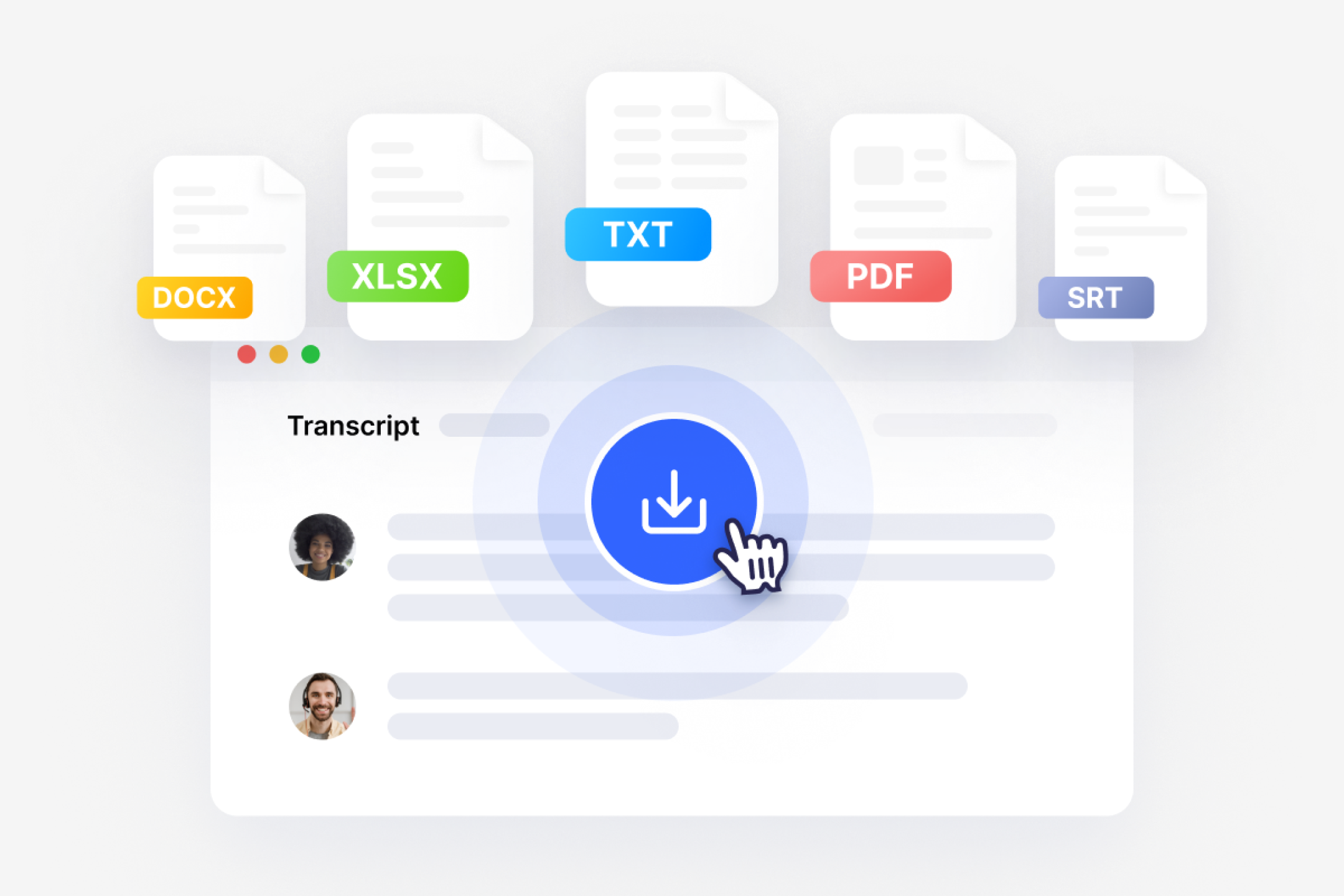
Notta lets you download transcripts as DOCX or TXT files that open directly inside Google Docs.
Keep one thing in mind. This web converter quota is separate from a Notta app account, and it does not save editable speaker history in a workspace.
Option B: Longer files with speaker labels and direct Docs sync
For multi-speaker interviews, podcasts, or lectures, use Notta's AI transcription workspace. It accepts 16 audio and video formats, including MP3, WAV, M4A, MP4, and MOV. Audio files can be up to 1 GB and video files up to 10 GB. Max length is 5 hours per file, or 3 hours with speaker identification turned on. A 1-hour file takes about 5 minutes to process.
- Sign in to Notta on the web or open the Notta mobile app on iOS or Android.
- On web, click Upload & transcribe and drop your file in. Pick the language, check Configure speaker identification if needed, and click Upload & transcribe.
- On mobile, tap +, choose Upload files, turn on Speaker identification, and tap Transcribe.
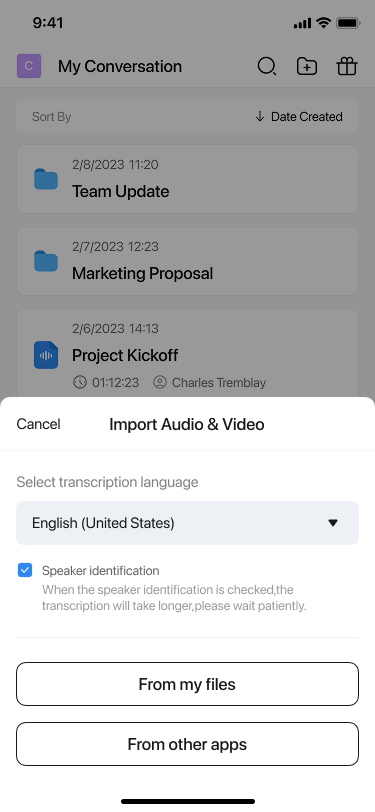
Notta's mobile import screen supports 16 formats and lets you toggle speaker identification before transcribing.
- Open the finished transcript to rename speaker tags (
Speaker 1,Speaker 2) or check timestamps. - Push the transcript into Google Docs using either option below:
- Direct Google Docs sync (all plans): Open Integrations & Apps in Notta, click Connect next to Google Docs, and sign in to Google. Once linked, Notta's Google Docs integration sends transcripts and summaries into a new Doc.
- Download or Google Drive sync (Pro+): Click Download on web (or Share & Export > Export on mobile) to save a
.docxor.txtfile with speaker names and timestamps. You can also connect the Google Drive integration.
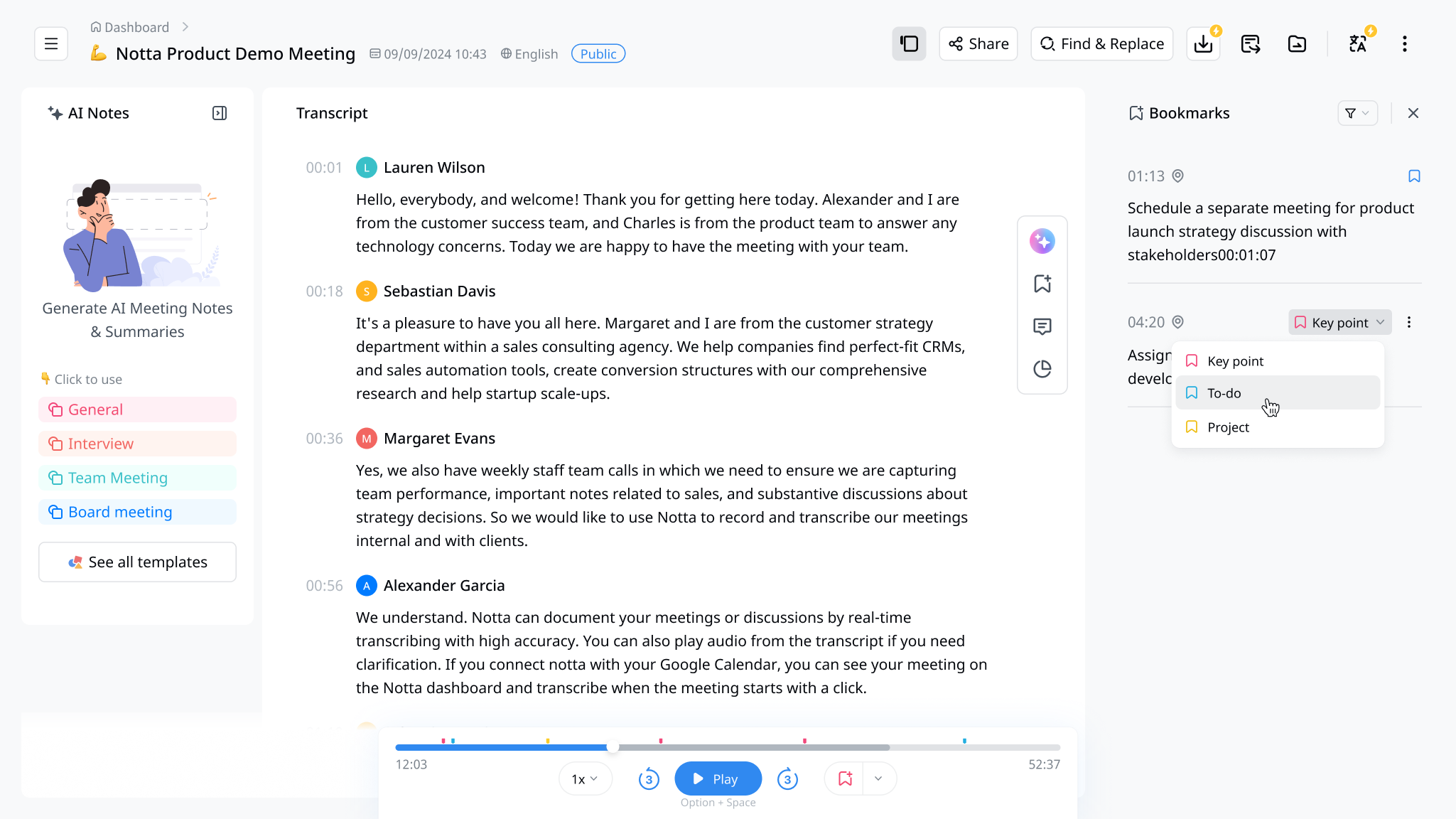
Completed transcripts in Notta Web display numbered speakers, timestamps, and a Share & Export menu in the top corner.
Free plan cap to know upfront: Notta's Free plan ($0) includes 120 minutes and 50 uploads per month. However, Free accounts only display the first 3 minutes of each transcript and cannot download .docx or .txt files. Pro costs $8.17/month billed annually ($97.99/year) or $13.49/month billed monthly for 1,800 minutes/month on Notta pricing. Business ($16.67/seat/month annual or $27.99/seat/month monthly) removes the monthly minute cap and gives 200 uploads per seat.
Important boundary for locked-down work laptops: Many office workers cannot install desktop apps, as u/girlwith_thecurl (Jan 7, 2026) shared on Reddit. In that case, you can use Notta Web in a browser or the Notta mobile app on your phone. Both run in the cloud. Audio is encrypted in transit (HTTPS/TLS 1.2) and at rest (AES-256), and Notta's Security page lists SOC 2 Type II, ISO 27001, GDPR, and HIPAA guidelines. Check with your compliance team before uploading regulated medical or client files.
Browser and mobile uploads don't use Privacy Mode. Notta's Privacy Mode (Pro, Business, and Enterprise, beta) works only inside Notta Desktop (macOS 13+ or Windows 10+). You must install the desktop app, pick a local folder, and download an offline speech model first. Audio then stays on your device, and you export .docx or .txt locally to open in Google Docs. In our Enterprise Desktop Privacy Mode test, the local transcript showed numbered speakers (Speaker 1, Speaker 2) and timestamps while staying on disk.
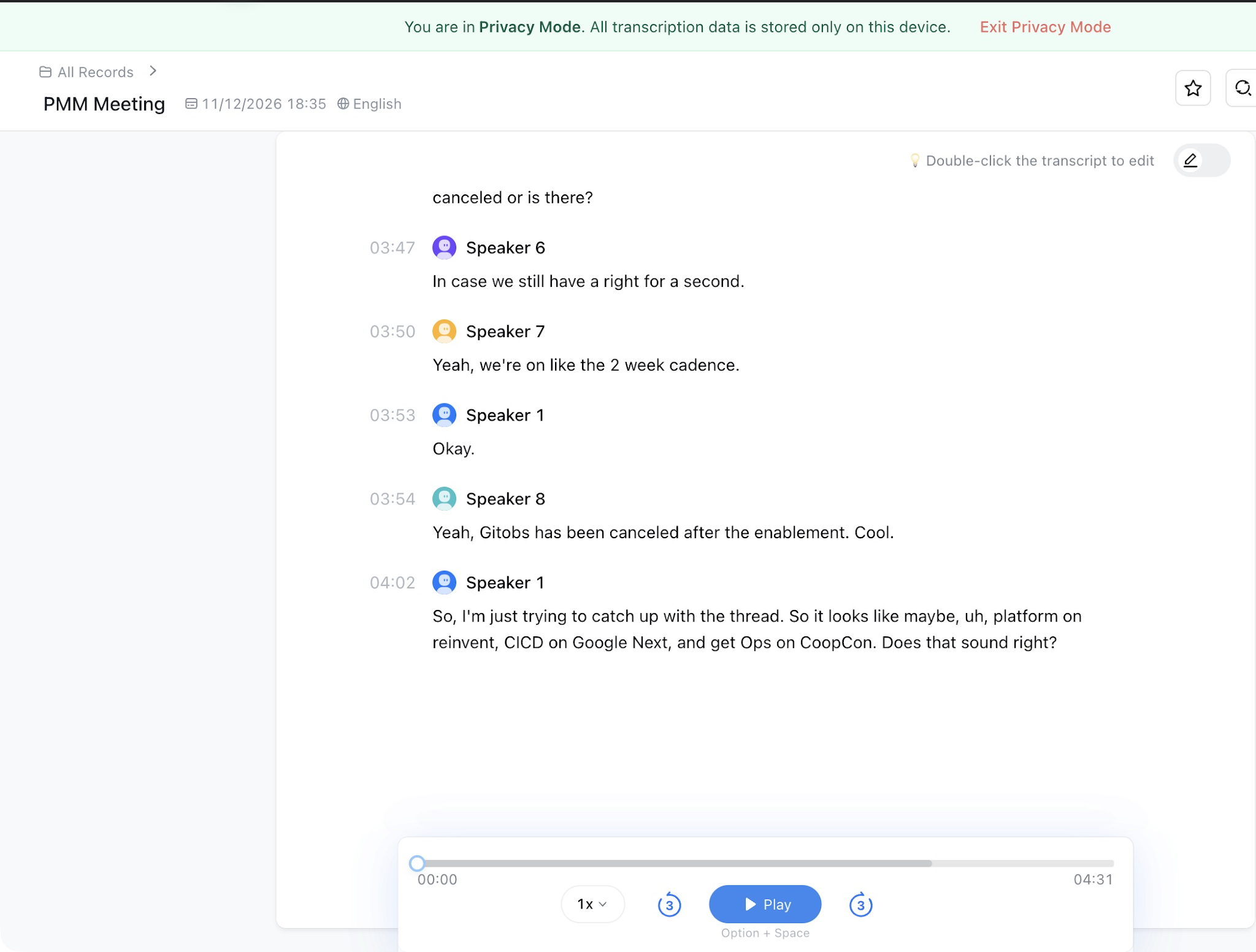
Enterprise Desktop Privacy Mode test: transcription stays in a local folder on your computer rather than syncing to cloud servers.
Want to skip the typing? Try Notta for free to upload an audio file and test Google Docs sync on your own recording.
Method 2: Upload audio to Google Gemini Notebook (free Google workaround)
Need a free Google tool that accepts audio files? Use Gemini Notebook (formerly NotebookLM), not Google Drive or standard Gemini chat. On Hacker News, rrherr (Feb 19, 2026) imports voice memos straight into NotebookLM to turn speech into text. Google user Richard Bolt (Jun 6, 2026) also moved to NotebookLM after Gemini chat greyed out .mp3 and .wav uploads.
Gemini Notebook accepts MP3, WAV, M4A, MP4, OGG, AAC, and other audio files. Each file can be up to 200 MB (or 500,000 words), and free users get up to 50 sources per notebook (Google Gemini Notebook Help, checked Nov 2026).
- Open Gemini Notebook in your desktop browser and create a new notebook.
- Click Add sources on the left panel and upload your local audio file.
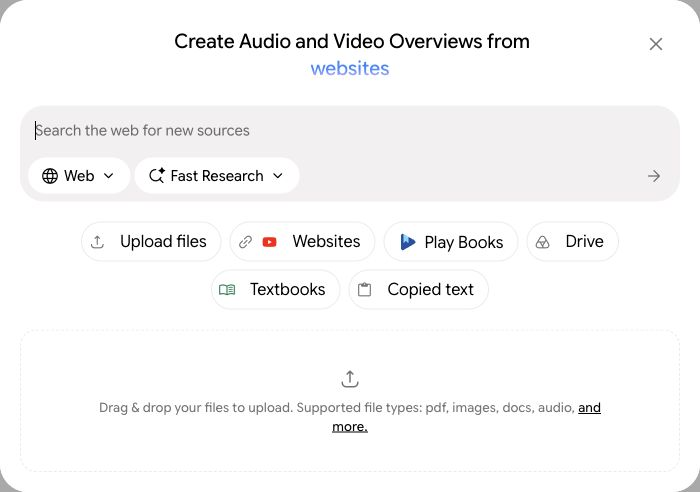
- Wait while Gemini Notebook transcribes the audio and saves the text as a source.
- Click the audio source in the left Source panel to open the full transcript.
- Select the text, copy it (
Ctrl+CorCmd+C), and paste without formatting (Ctrl+Shift+VorCmd+Shift+V) into Google Docs.
Do not confuse this with two other Google tools:
- Google Drive "Create audio overview" goes the wrong way. It turns Docs, PDFs, or videos into spoken audio summaries instead of transcribing audio files (Google Drive Help, checked Nov 2026).
- Google Vids stays inside Vids. Eligible Workspace or Google AI plans can show an English transcript side panel inside Google Vids, not inside Google Docs (Google Docs Help, checked Nov 2026).
Where Gemini Notebook falls short: It does not include speaker labels or clickable timestamps. Users also hit temporary upload blocks at times, as u/BackgroundPipe4292 (Jan 21, 2026) reported on Reddit. Google notes consumer uploads are not used for model training unless you send feedback (Workspace accounts exclude training even with feedback).
Method 3: Route audio into Google Docs Voice Typing (VB-CABLE or BlackHole)
Playing a recording from phone speakers into a laptop mic gives messy results. It also forces you to sit in a quiet room. A virtual audio cable lets your computer route audio straight into Chrome's mic input internally.
Set up virtual audio routing (Windows vs. Mac)
You need admin rights on your computer to install a virtual driver.
- On Windows (VB-CABLE): Install the free donationware VB-CABLE driver (VB-Audio site, checked Nov 2026) and reboot if asked. Set Windows Sound Output to CABLE Input and Input to CABLE Output.
- On macOS (BlackHole): Install BlackHole 2ch (free from Existential Audio, checked Nov 2026). Set Sound Output and Input both to BlackHole 2ch (or build a Multi-Output Device in Audio MIDI Setup to listen along).
Once your virtual cable is active, open Google Docs Voice Typing:
- Open a blank Google Doc in Chrome, Edge, or Safari. Other browsers do not support Voice Typing.
- Click Tools > Voice typing, or press
Ctrl+Shift+S(Windows) orCmd+Shift+S(Mac).
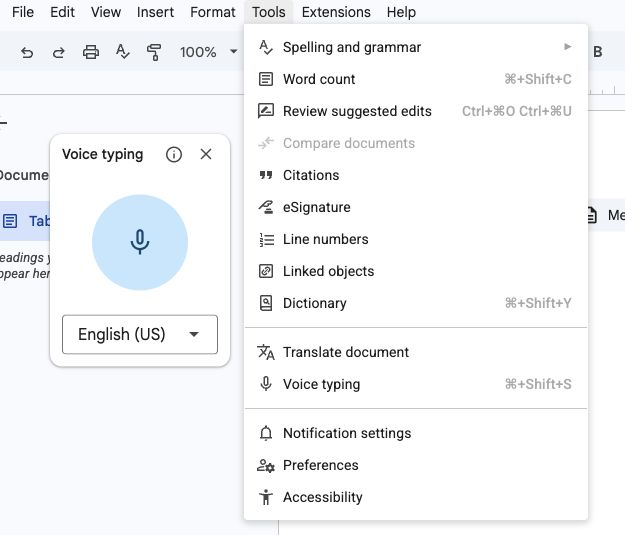
- Pick the language of your audio file from the dropdown above the mic icon.
- Click the microphone icon so it turns red, then press play on your audio player right away.
- Watch text appear in real time, and click the mic icon again when the audio ends. Switch your OS sound settings back to normal speakers and mic afterward.
Where Voice Typing still breaks on recordings
Virtual routing fixes room noise, but three limits remain on longer recordings:
- 1x speed and fragile setup. Advising a user with a 1-hour file, u/werbeagent-p (Jan 25, 2026) called VB-CABLE "the difficult solution." The browser session must stay active for a full hour.
- Tab-focus and popup shutoffs: Business Docs user Omarti (Apr 19, 2026) reported that Voice Typing cuts off the mic when you switch tabs or trigger command tip popups.
- Heavy editing and English-only commands: Spoken punctuation commands only work when both your Google account and document language are English (Google Docs Help, checked Nov 2026). Normal speech also lacks spoken punctuation, so podcaster u/Dazzling-Excuses (Oct 14, 2026) warns there is "definitely editing to do" later.
Method 4: Transcribe in Microsoft Word and open in Google Docs
Already pay for Microsoft 365 ($9.99/month or $99.99/year Personal standard pricing, checked Nov 2026)? Microsoft Word has a built-in Transcribe tool that accepts .wav, .mp4, .m4a, and .mp3 files. It also separates speakers (Speaker 1, Speaker 2) and adds timestamps (Microsoft Support, checked Nov 2026).
- Open Word for the Web (or Word for Microsoft 365 on Windows in a commercial tenant) with a blank document.
- Go to Home, click the arrow beside Dictate, and select Transcribe.
- Click Upload audio in the Transcribe pane and pick your file.
- Keep the pane open while Word processes the file. Word saves a copy of the audio in your OneDrive Transcribed Files folder.
- Click Add all to document when done, save the
.docx, then upload it to Google Drive and choose Open with > Google Docs.
Standard Microsoft 365 accounts cap uploads at 300 minutes per month. Microsoft Copilot licenses raise that limit to 30,000 minutes per month (Microsoft Support, checked Nov 2026).
When you should skip Google Docs Voice Typing and Marketplace add-ons
Automated transcription is not always the right fit. Third-party Google Docs sidebar plugins also come with real risks.
- Try oTranscribe for free manual typing. Need verbatim accuracy on sensitive files without uploading audio?
oTranscribeis a free, open-source browser player that keeps files strictly on your computer (oTranscribe site, checked Nov 2026). Keyboard shortcuts control speed, pauses, and timestamps in one window. That beats constant mouse rewinding, which pushed podcaster u/Jeric-2991 (Oct 14, 2026) to spend 3 to 4 hours per episode typing by hand. When done, oTranscribe exports straight to Google Docs or Google Drive. - Test Google Workspace Marketplace add-ons with caution: Docs sidebar plugins look tempting, yet 2026 reviews show frequent glitches. On
AI Transcription & Real-time Speech to Text(159K+ installs), Una Cruickshank (Aug 25, 2026) and John Rogers (Nov 5, 2026) wrote that it failed to work at all. OnAudio to Text AI Gemini GPT(71K+ installs), Ayanda Buthelezi (Sep 7, 2026) reported that the plugin auto-translated her audio instead of keeping the original language.
Quick note on recording consent: Recording laws vary by state and country. Check your local rules and inform participants before recording or transcribing someone else's voice.
How to format a raw transcript inside Google Docs
Once your words land in Google Docs, four quick steps turn rough text into a readable document:
- Paste plain text from Gemini Notebook: Press
Ctrl+Shift+V(Windows) orCmd+Shift+V(Mac) so you do not paste dark backgrounds or odd fonts. - Use
.docximports for multi-speaker files: Opening a.docxfile from Notta or Word via Google Drive keeps paragraph breaks, timestamps, and bold speaker labels intact. - Batch-rename speakers in seconds: Borrow the cleanup trick u/ReverendRider (Mar 12, 2026) uses in text editors. Press
Ctrl+H(orCmd+Shift+Hon Mac) in Google Docs to FindSpeaker 1and Replace all with the speaker's real name. - Add clickable section headers: Apply Heading 2 to topic changes and turn on View > Show outline so readers can jump through long interviews fast.
Working with a video recording instead of pure audio? Read our guide on how to transcribe a video, or compare other tools in our best free transcription software roundup.
Next step: If you have a short single-speaker memo, use Gemini Notebook or Notta's web converter. If you handle multi-speaker interviews or client calls and want direct Google Docs sync, start with Notta for free and test it on one file today.
FAQs
Can Google Docs transcribe an audio file directly?
No, Google Docs cannot upload or transcribe an MP3, WAV, or M4A file directly. Its Voice Typing tool only listens to live mic input in Chrome, Edge, or Safari. You need a direct transcription tool, Gemini Notebook, Word Transcribe, or a virtual audio cable to get pre-recorded audio into Docs.
How can I transcribe an MP3 or WAV file into Google Docs for free?
Yes, you can pick from three free options depending on file length and speaker count. Upload MP3 or WAV files up to 200 MB into Google's free Gemini Notebook and copy the text over. Or transcribe the first 30 minutes per file (5 times/month in English regions) on Notta's free web converter with no sign-up. You can also route playback into Google Docs Voice Typing with VB-CABLE or BlackHole.
Can Google Drive Audio Overviews transcribe audio files into text?
No, Google Drive's "Create audio overview" works in reverse. It uses Gemini to turn existing Google Docs, Slides, PDFs, or videos into spoken audio summaries rather than converting an audio file into Docs text.
Why does Google Docs Voice Typing keep stopping when I play a recording?
Google Docs Voice Typing turns off its mic whenever you switch browser tabs, click another app, or trigger command tip popups. Keep the Google Docs window active in front while your audio plays. Better yet, use a file-upload tool so you can work in other tabs while processing runs.
Can I use Notta Privacy Mode on a locked-down work computer?
No, Notta's Privacy Mode works only inside Notta Desktop (macOS 13+ or Windows 10+, Pro+ plans, beta). That requires installing the desktop client and downloading an offline speech model to your computer. If IT locks down software installs, use Notta Web, the Notta mobile app, or Gemini Notebook instead. Those run encrypted cloud transcription rather than offline local processing.
