
How to Use Google Translate to Transcribe Voice to Text
Saving time and effort with Notta, starting from today!
Google Translate transcribes voice to text using its Transcribe feature, available on Android, iPhone, and the web. Open the app on your phone, select your source and target language, tap the ‘Microphone’ icon, then tap ‘Transcribe’ to begin. Google Translate supports transcription in 8 languages, including English, Spanish, French, and German, and displays results in real time.
This guide shows you how to use Google Translate voice-to-text step by step, and what to use instead when it’s not up to the job.
How Does Google Translate Voice-to-Text Transcription Work?
Google Translate voice-to-text works by listening to spoken audio through your device’s microphone and converting it into text in real time. You can use it directly in your browser or through the Google Translate mobile app, but the features are slightly different on each platform.
The mobile app includes a dedicated ‘Transcribe’ mode that continuously records, automatically adding punctuation and capitalization. The web version only supports basic voice input and stops recording as soon as you pause speaking.
Because of these limitations, you’re better off using a specialized transcription app like Notta for consistent results, especially for longer recordings.
How Do You Transcribe Voice to Text on Android with Google Translate?
Before you start, install the Google Translate app on your Android device and make sure you’re using the latest version.
Step 1: Open the Google Translate app on your Android device.
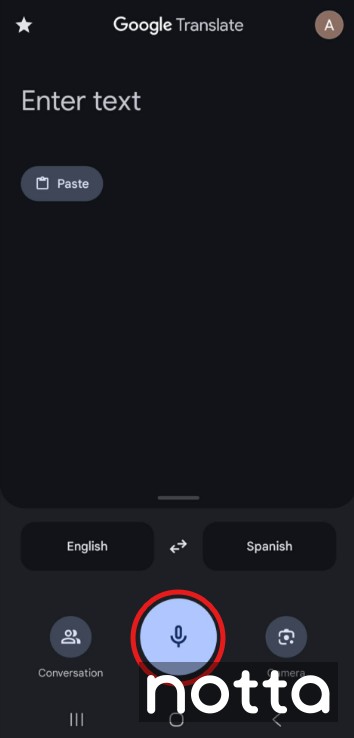
Step 2: Select your source language and target language at the bottom and tap the ‘microphone’ icon on the home screen.
Step 3: Tap the ‘Transcribe’ button.
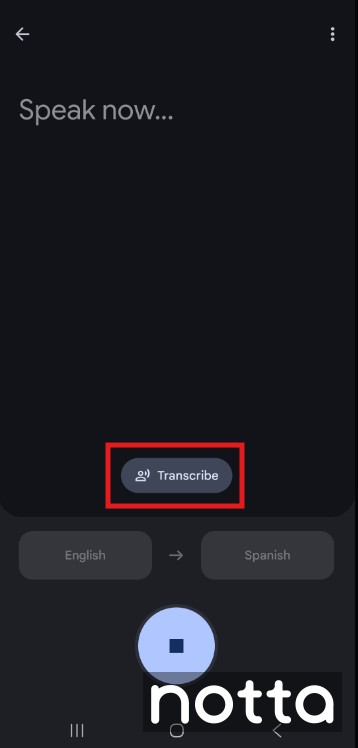
Note: If the ‘Transcribe’ button is disabled, Google Translate does not support the language you selected.
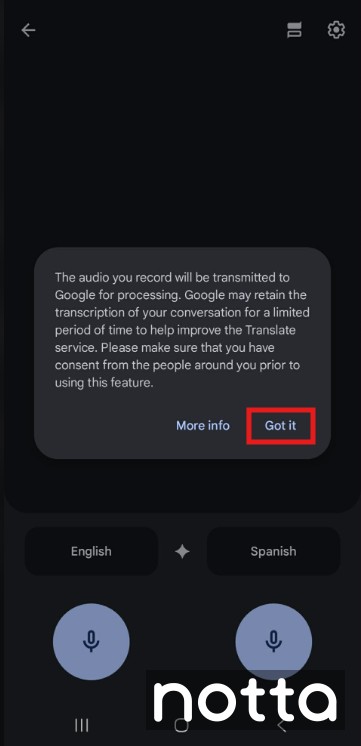
Step 4: Google informs you that using the Google Translate voice-to-text feature allows Google to send the audio and transcription data to its servers. Tap ‘Got it’ to proceed.
Step 5: Tap the ‘microphone’ icon to start transcribing speech in your chosen language.
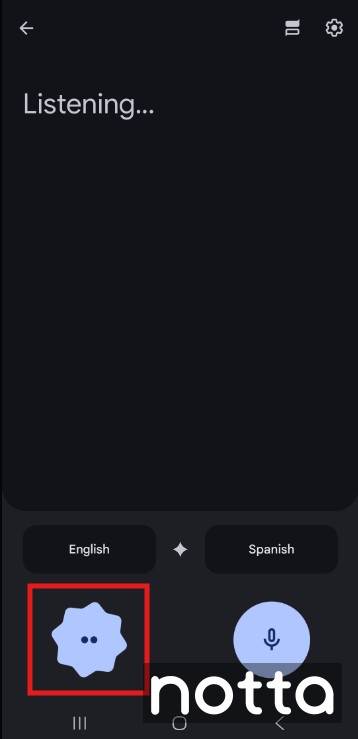
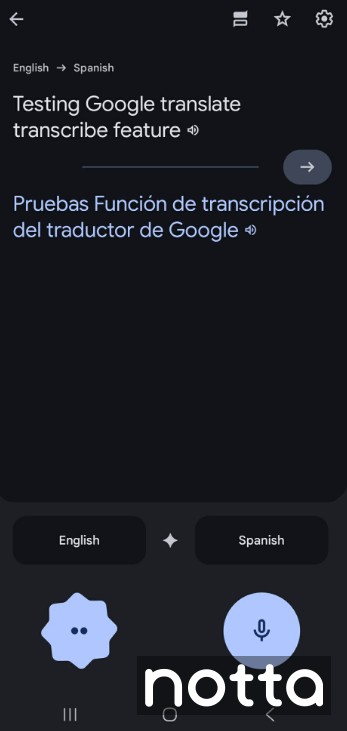
Step 6: Google displays the transcript on screen in both the original and translated languages. Tap the ‘speaker’ icon to play the audio back, or press and hold the text to copy or share it.
How Do You Use Google Translate to Transcribe Audio on iPhone?
Follow the steps below to transcribe voice to text on iPhone using Google Transcribe:
Step 1: To get started, download the Google Translate app and install it on your iPhone. Open the app, choose the languages, and tap the ‘microphone’ icon.
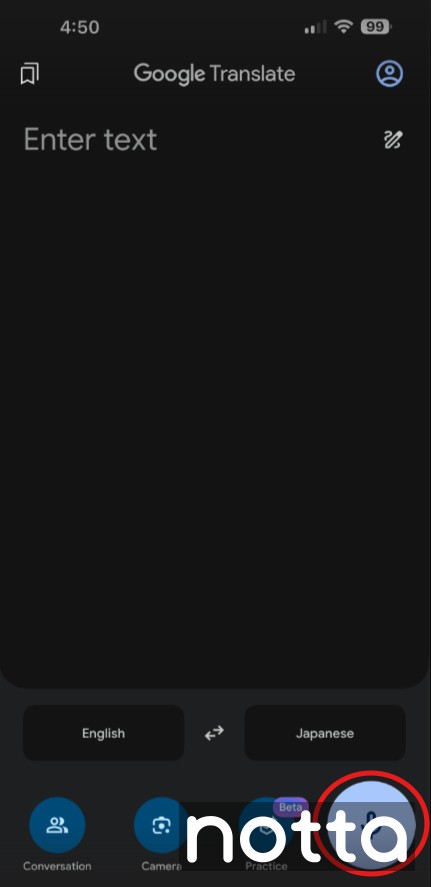
Step 2: Tap ‘Transcribe’ at the bottom of the screen to switch to transcription mode.
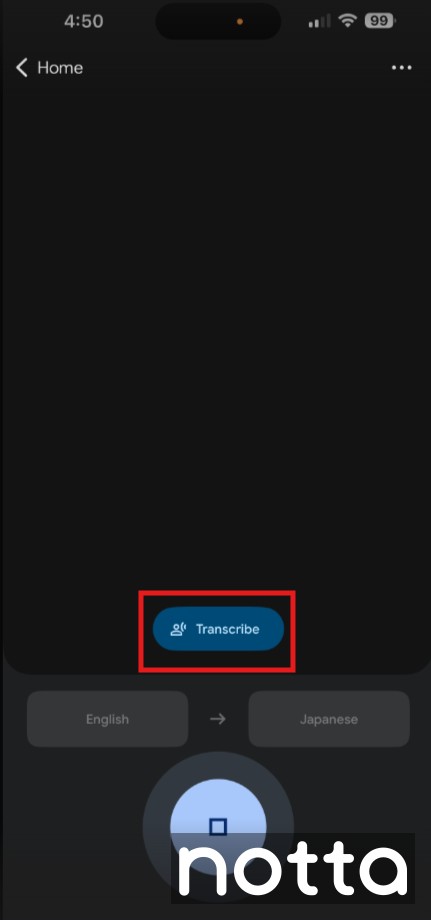
Step 3: When you see ‘Listening…’, start speaking clearly. Google Translate will begin transcribing your speech automatically.
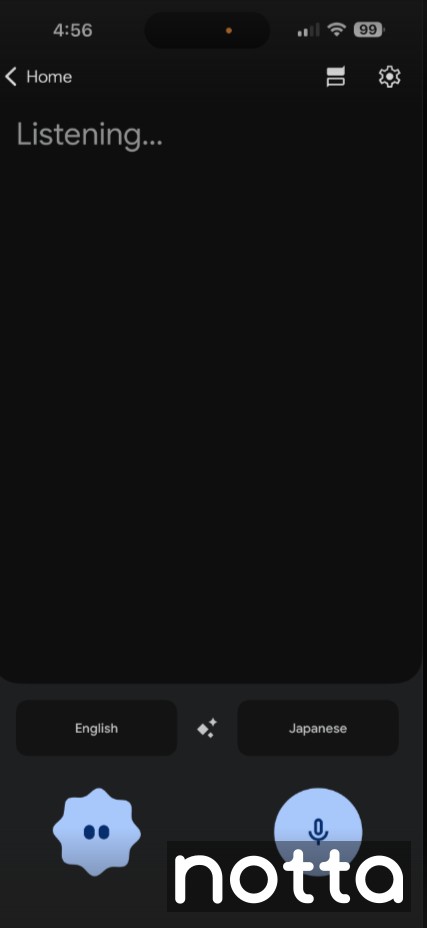
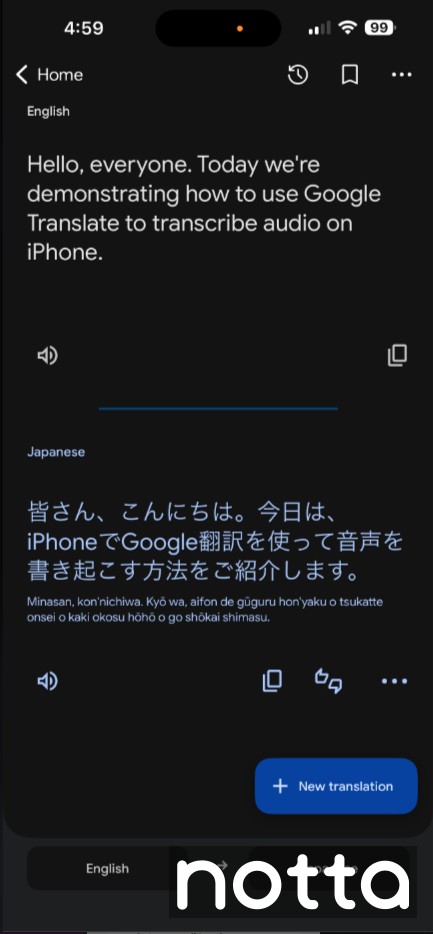
Step 4: View the live transcription on screen in real time, along with the translated text below.
How Do You Transcribe Voice to Text Using Google Translate on PC?
Follow these steps to convert speech to text with Google Translate on PC:
Step 1: Open your web browser and go to the Google Translate website (translate.google.com).
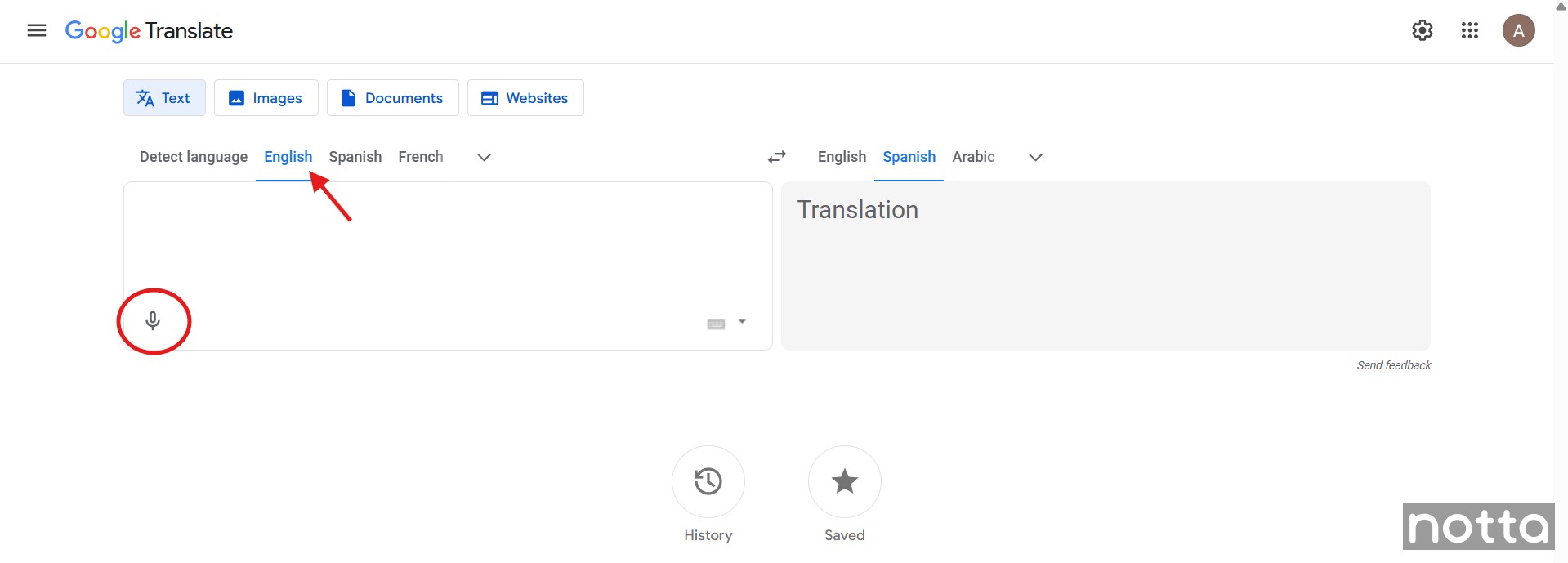
Step 2: On the left side of the Translate interface, you'll see the source language and the ‘microphone’ icon. Click on the microphone icon to activate the speech recognition feature.
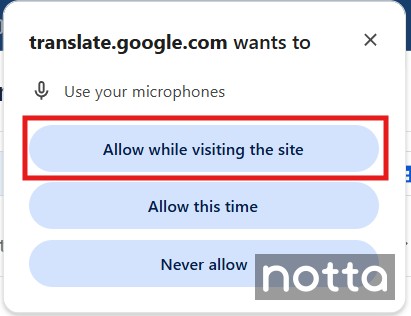
Step 3: Allow Google Translate to access your microphone.
Step 4: Play the audio file on your phone or speak directly into your computer's microphone. Make sure the audio is clear and without background noise so your microphone can pick up the sound more clearly.
Step 5: As you speak or play the audio, Google Translate will transcribe the speech in real-time. The transcribed text appears in the left text box, while the text translation appears on the right.
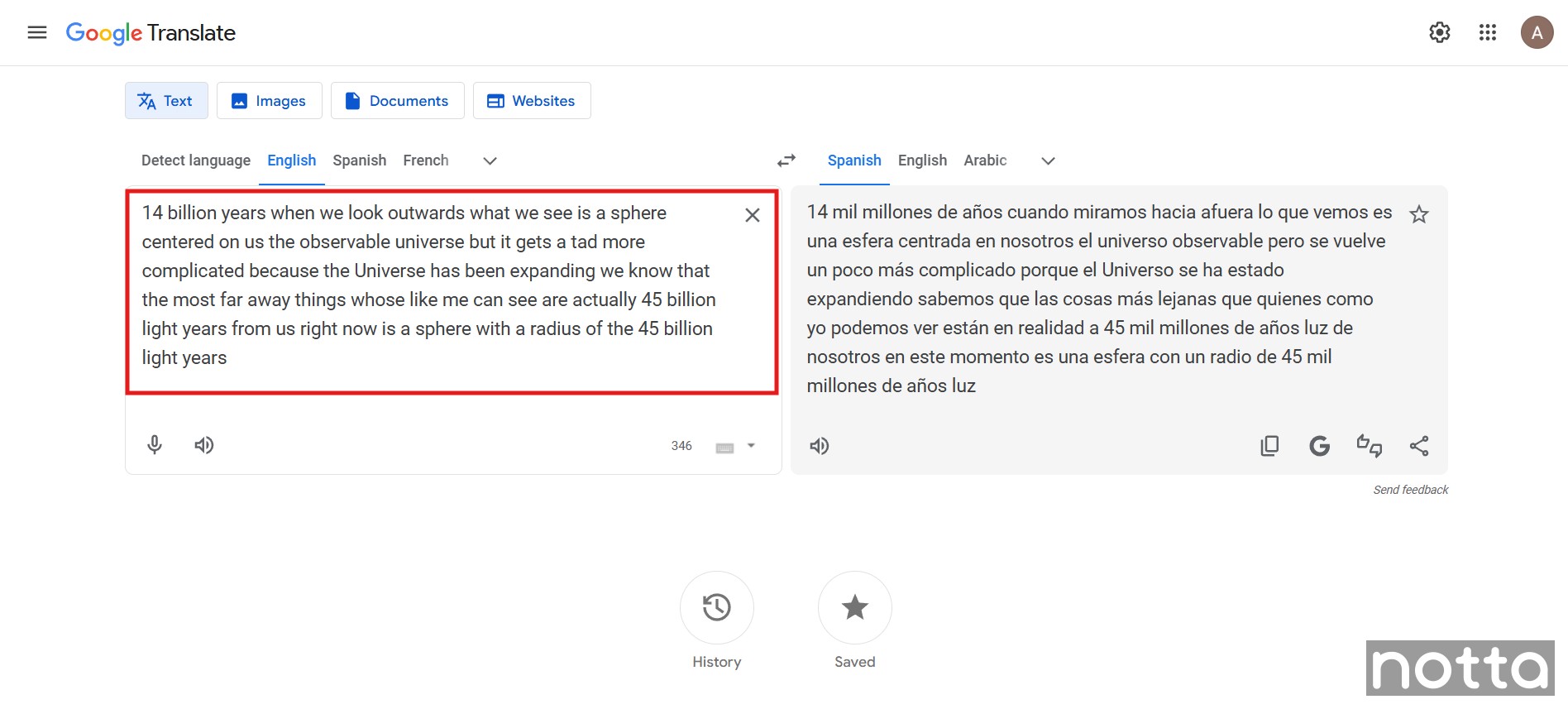
Step 6: After the audio finishes playing or you stop speaking, copy the transcript from the left text box and use it as needed.
The accuracy of the transcription depends on audio quality, background noise, speaking pace, and the selected language. Additionally, Google Translate has limitations with certain accents or dialects.
Google Translate works in a pinch, but it lacks advanced features to support full meeting transcription and content management. Dedicated transcription apps like Notta reach up to 98.86% accuracy and offer speaker identification, editing tools, and flexible export options.
How Do You Edit and Share a Google Translate Transcript?
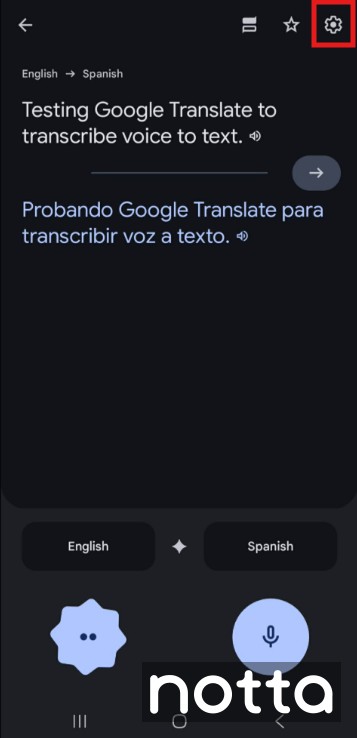
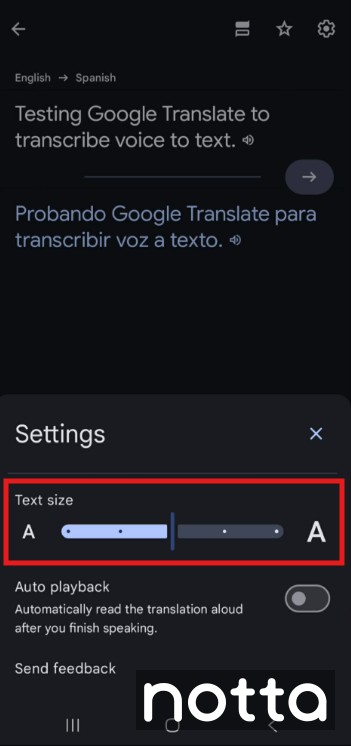
You can edit your transcript on Google Translate to adjust the text size. Follow the steps below to do this:
Step 1: Tap on the ‘Cogwheel’ icon at the top right of the screen.
Step 2: Use the slider to adjust the font size.
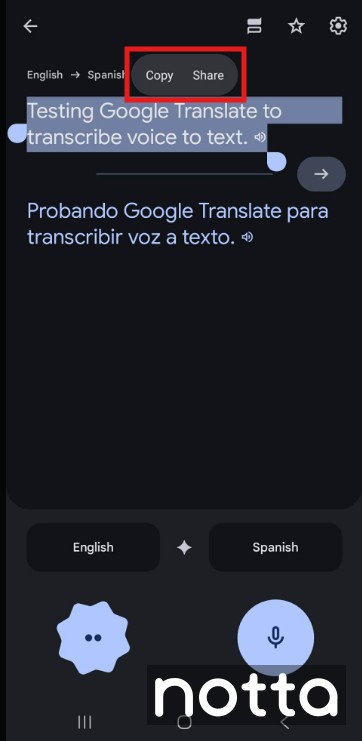
You can also share the transcript from the Google Translate app. Follow the steps below to share your transcript:
Step 1: Press and hold the transcript text to highlight it.
Step 2: Tap ‘Select all’ from the menu to highlight the entire transcript.
Step 3: Tap ‘Copy’ to copy the text, or tap ‘Share’ to send it to another app.
How Do You Save and Find Transcripts in Google Translate?
If you use Google Translate to, for example,convert Spanish audio to English text, you may want to save translated words for later reference. Here’s how it’s done.
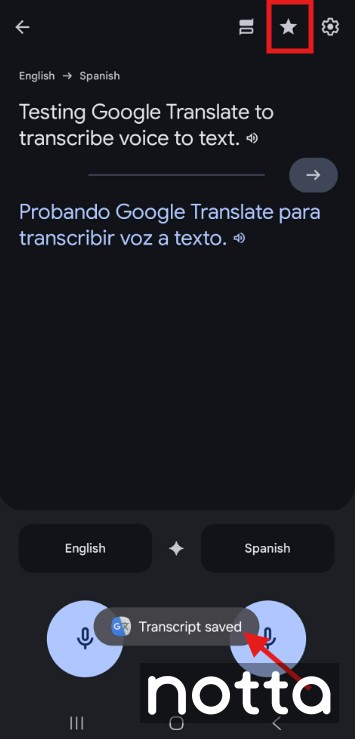
Step 1: Click on the ‘Star’ icon in the upper right corner after transcribing your audio to save your transcript.
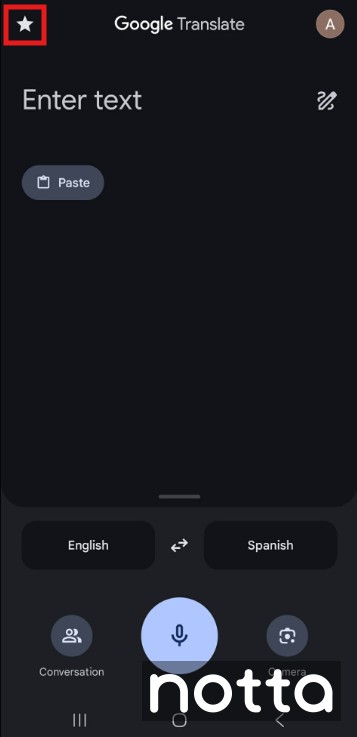
Step 2: Go back to the homescreen and tap the ‘Star’ icon in the top left corner.
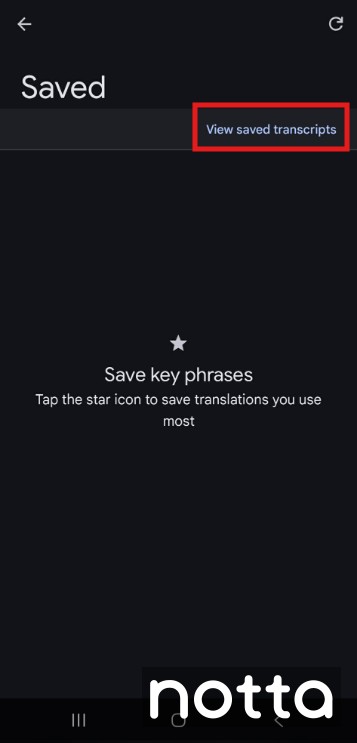
Step 3: Tap on ‘View saved transcripts.’
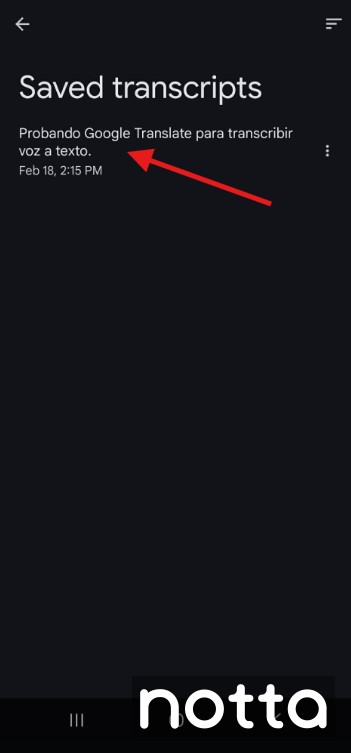
Step 4: Google Translate opens the ‘Saved transcripts’ page, where you can view and share any transcripts.
How Do You Use Google Translate to Translate Live Conversations?
Google Translate lets you translate live conversations using ‘Conversation mode.’ It works online, but you can also download language packs for offline access so you can translate even without an internet connection.
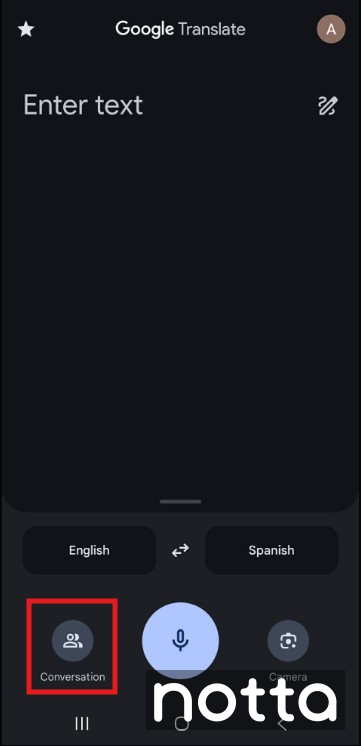
To translate bilingual conversations with Google Translate, open the mobile app and select the two languages at the bottom of the screen. Tap the ‘Conversation’ button on the home screen to enter bilingual mode. Each speaker taps their language’s microphone button before speaking.
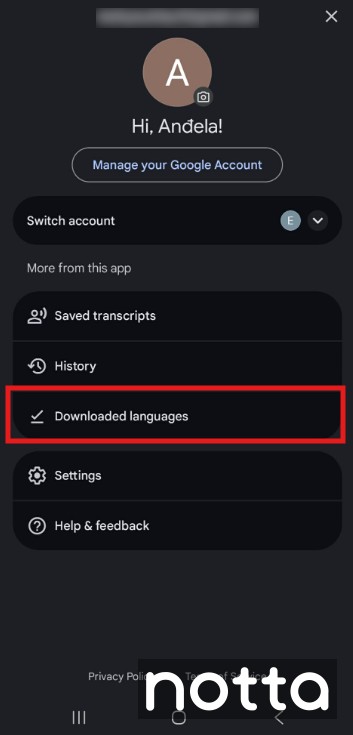
Google Translate also supports offline speech translation, but you must download the language packs in advance. To use Google Translate without an internet connection, open the app, tap your profile icon, go to ‘Downloaded languages,' and download the languages you need.
What is Live Translate for Pixel Phones?
Live Translate for Pixel phones (Google Pixel 6 and newer) is a built-in system feature that translates messages, photos, videos, and live speech directly across apps. It also supports instant camera translation, so you can point your camera at text and see translations in real time. Unlike the standard Google Translate app, it works system-wide on your device and integrates with apps like Messages, Camera, and Photos.
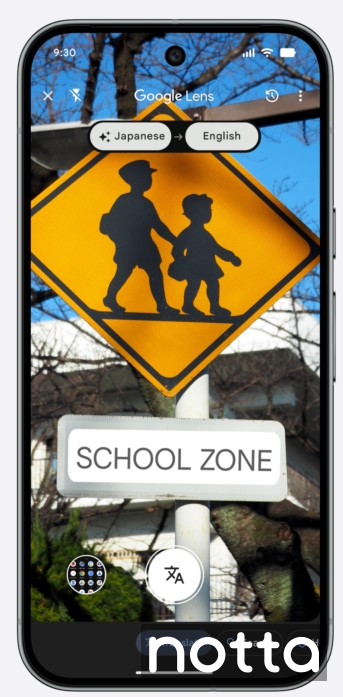
Image credit: Google Guidebooks
Is Google Translate or Notta Better for Voice Transcription?
| Feature | Google Translate | Notta |
|---|---|---|
| Transcription languages | 8+ | 58 |
| File upload | No | Yes |
| Speaker identification | No | Yes |
| Export formats | Copy only | TXT, DOCX, PDF, SRT |
| Price | Free | Free plan + paid tiers starting at $8.17 per month |
| Best for | Short, informal voice notes | Long-form, multi-speaker transcription (meetings, lectures, files) |
Google Translate is an efficient app for quick transcriptions and translations of casual in-person conversations, but it’s not exactly helping anyone become a transcriptionist. For long conversations, recordings, meetings, and lectures, you’re better off using Notta.
Notta transcribes speech in real time with up to 98.86% accuracy, complete with automatic formatting, punctuation, and capitalization, so your transcript is usable and ready to share from the start.
Swamped with online meetings and classes? The Notta bot joins your Microsoft Teams, Google Meet, and Zoom meetings and transcribes them in real-time. As a bonus, you can choose to create AI notes of key points and highlights.
Follow these steps to transcribe audio to text using Notta.
Step 1: Sign up for a Notta account if you don’t have one.
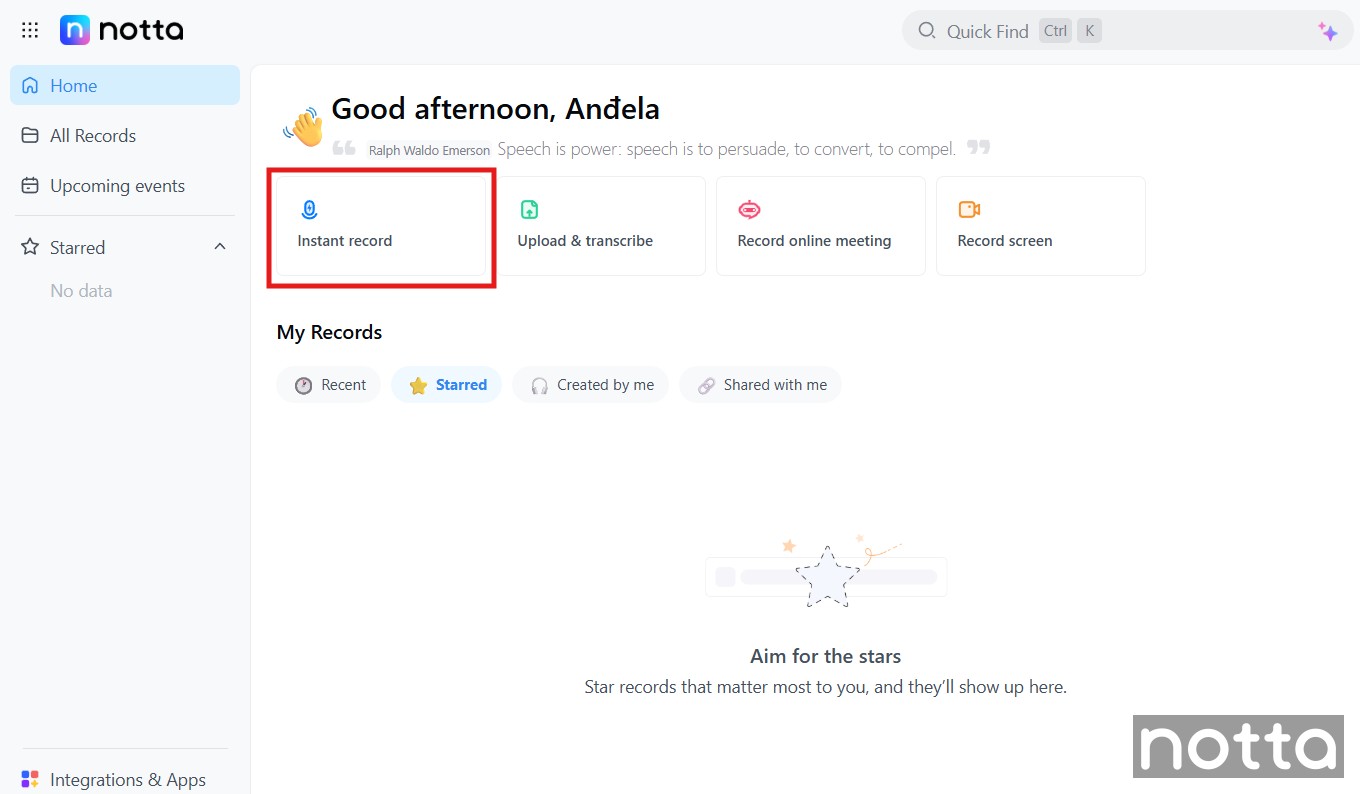
Step 2: Log into your Notta account on your PC and click the ‘Instant record’ button at the top of the dashboard.
Step 3: Select your transcription mode. Choose ‘Monolingual transcription’ (supports 58 languages), ‘Bilingual transcription’ (supports 23 language pairs), or enable ‘Real-time translation’ (supports 36 source languages with 61 available target language options).
Click ‘Record and transcribe’ to begin.
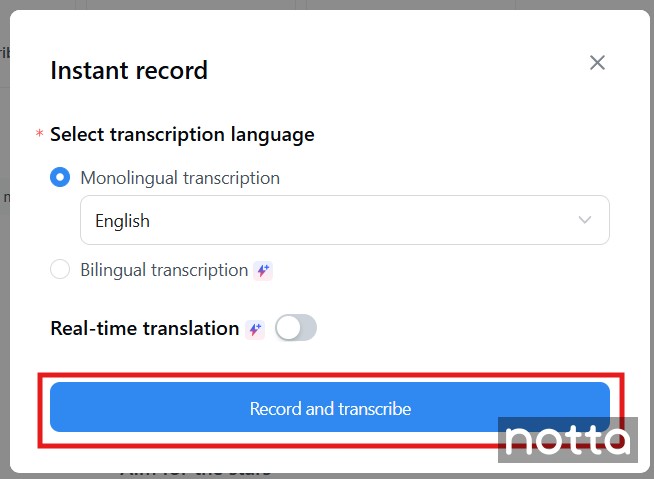
Note: Notta might request permission to use your microphone. Select ‘Allow’ to proceed.
Step 4: Start speaking into your microphone, and Notta automatically converts your voice to text in real time. You can also play an audio file from your smartphone for Notta to capture and transcribe. Alternatively, upload audio or video recordings directly from the Notta dashboard.
To generate structured transcripts instantly,sign up today.
FAQs
What transcription languages does Google Translate support?
Google Translate supports over 240 languages for translation, but it does not offer transcription in all of them. Google officially supports eight languages for the ‘Transcribe’ feature: English, Hindi, Spanish, German, Thai, French, Russian, and Portuguese. You may still be able to transcribe other languages in the app, even though Google doesn’t officially list them.
How do you translate spoken words with Google Translate?
To translate spoken words with Google Translate, open the app, select your source and target languages, then tap the ‘microphone’ icon. Next, tap ‘Transcribe’ to switch to transcription mode and allow microphone access. Start speaking, and Google Translate will transcribe your speech in real time.
Can I change the font size of the transcribed language?
Yes, you can change the font size of the transcribed language in Google Translate. Tap the ‘cogwheel’ icon in the top right corner to open‘Settings,’ then use the text size slider to choose from five available size options. Close ‘Settings’ to view your text in the font size you chose.
Can I translate a voice text?
Yes, you can translate a voice text with Google Translate, but you can’t upload a voice note directly into the app. Instead, open Google Translate on one device (such as your phone or computer) and use another device to play the voice message out loud. Google Translate will capture the audio through the microphone and translate it.
What app translates voice recording to text?
The Notta app translates voice recordings to text in 42 languages. You can upload audio files directly into the app to convert audio to text automatically. If you don’t have the file, play a recording on another device and use Notta's Live Record feature to capture, transcribe, and translate it in real time.
Is Google Translate transcription free?
Yes, Google Translate transcription is free to use. The ‘Transcribe’ feature is included in the Google Translate mobile app and does not require a paid subscription. You can also use the web version of Google Translate to transcribe speech for free using the microphone input.
How accurate is Google Translate voice to text?
Google Translate's voice-to-text is less accurate than dedicated transcription tools such as Notta, which reaches up to 98.86% accuracy. Google Translate works best when you speak clearly and record in a quiet environment. Background noise, multiple speakers, or technical terminology reduce transcription accuracy.
Does Google Translate transcription work offline?
No, Google Translate transcription does not work offline. You need an active internet connection because the speech processing runs on Google’s servers. However, you can still use offline translation if you download language packs in advance.
Okay so I'm officially *NOT* finished with this article. Current Surfer score is 67, here's the first Claude analysis but it's useless for now, I need you to answer some of the comments and I'll run it again and implement the remaining suggestions.
https://claude.ai/share/5e0e0e52-df0b-4335-8c4f-c1995f84c960
If Petrit is using Claude or a similar AI to create suggestions, we might be in trouble, since I can't find any official documentation to confirm/update the article (I noted these throughout as comments). Hopefully the rest of the articles won't have this issue.
I'll run the SERP prompt after the rest of the changes
OK I've reviewed all the comments and updated, let me know on Slack if there's anything else that's causing problems.
https://claude.ai/share/5e0e0e52-df0b-4335-8c4f-c1995f84c960
Basically we just need to fill out "How Does Google Translate Voice-to-Text Transcription Work?" this section.
Should I just use this information and be done with it? https://cloud.google.com/speech-to-text
Google AI Overview: "Google Translate voice-to-text uses Automatic Speech Recognition (ASR) and neural machine translation to transcribe spoken audio into text in real-time. It analyzes audio signals, converts them into text, and then translates them, utilizing context to improve accuracy. Key features include live, in-app transcription, language detection, and sometimes automatic playback.
"
Technically, it's Google, so I feel like it's somewhat safe to use. haha
https://claude.ai/share/5e0e0e52-df0b-4335-8c4f-c1995f84c960
As this is the first of the content audit rewrites, we may need a bit more back and forth on this than usual. Petrit didn't give us any keyword guidance, but he's off today, so I've left him a message, and we'll see what he says tomorrow about optimizing in Surfer. I'll set that up once the info is available.
I think we've got free rein to rewrite and change anything we need, but I'm confirming that with him as well. Start with updating the processes and screenshots, and we'll see what he says about the rewrite scope. You can also use 'suggestions' to work on the text, if you want.
For this piece, the original writing is extremely rough, with poor flow. That may be optimization, but we can re-optimize once the writing is improved.
To Do List:
1. updated how-to/Claude intro
2. fix the writing style throughout. I've tagged a few spots, but there are many others for you to correct.
3. update the steps for each process and add new screenshots with the new UI (I'll provide iPhone screenshots for that section)
4. Apply Petrit's notes from the tracking sheet. I've added 2 sections to accommodate the new info:
- Explain how Google Translate's voice-to-text feature works, including differences between mobile/web and features like punctuation/capitalization (affects understanding for ~50% of users).
- Add information about offline translation capabilities.
- Include instructions or mention of the conversation mode for bilingual dialogues.
- Briefly mention the Live Translate feature for Pixel devices as a related advanced capability.
5. Claude analysis/optimizations

