
Read more: Where do Voice Messages Save on iPhone?
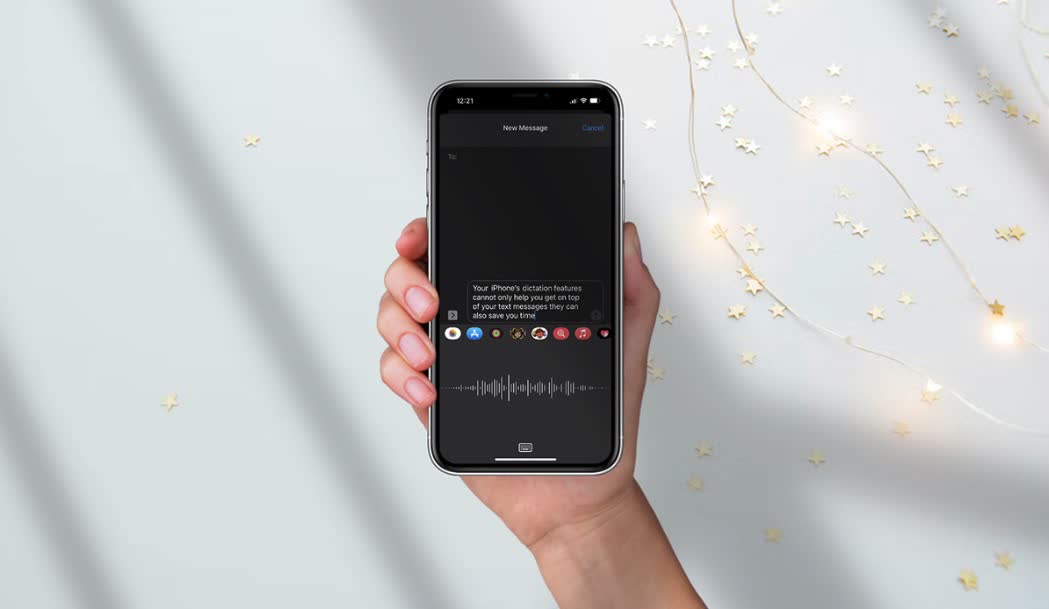
How to Use Voice to Text on iPhone?
Updated:2026-03-083mins
Content
Ready to Upgrade Your Voice?
Apple's dictation gives you a raw transcript. SpeakON gives you ready-to-send text shaped for the app you're in — Casual for iMessage, Professional for Slack, Formal for email. One press between thought and word.
Explore SpeakON
Your iPhone has had a built-in voice-to-text feature for years, and if you're not using it, you're typing a lot more than you need to. Whether you want to send a message without looking at your screen, compose an email while your hands are busy, or just get words down faster than your thumbs allow, dictation handles all of it. This guide walks you through turning it on, using it well, and fixing it when something goes wrong.
What Is Voice to Text on iPhone?
Voice to text on iPhone, officially called Dictation, is Apple's built-in feature that converts spoken words into typed text across any app on your device. Tap the microphone icon on your keyboard, speak, and your words appear in real time in whatever text field you have open, whether that's Messages, Mail, Notes, Safari, or a third-party app.
The feature processes most speech directly on your device, which keeps things fast and private. For more complex recognition tasks, like unusual names or technical terms, your iPhone may send audio to Apple's servers briefly. A stable internet connection generally improves accuracy, though basic dictation can function offline.
Dictation is genuinely faster than typing for most people. The average person types around 40 words per minute on a phone keyboard but speaks at roughly 130 words per minute. For anything longer than a sentence, speaking is the obvious shortcut.
Why use voice-to-text on iPhone?
If you're like most people, you probably find that in certain situations, typing out a text message can be a bit of a pain, especially if you're trying to reply quickly and you don’t have your hands free.
You may be visually or physically impaired and rely on the assistive technology built into your iPhone.
Either way, voice-to-text can come in handy, allowing you to dictate your replies using only your voice.
So, if you're ready to start using Voice-to-Text on your iPhone, just follow the simple instructions below:

Press. Speak. Done.
SpeakON turns voice into polished iPhone text without opening another app. A MagSafe button, a dedicated mic, Smart Polish and Attune on-device. Output appears exactly where your cursor is.
Learn more
How to turn on dictation on iPhone?
Open ‘Settings.’.
Scroll down to ‘General’> and tap it.
Scroll down, and tap ‘Keyboard.’
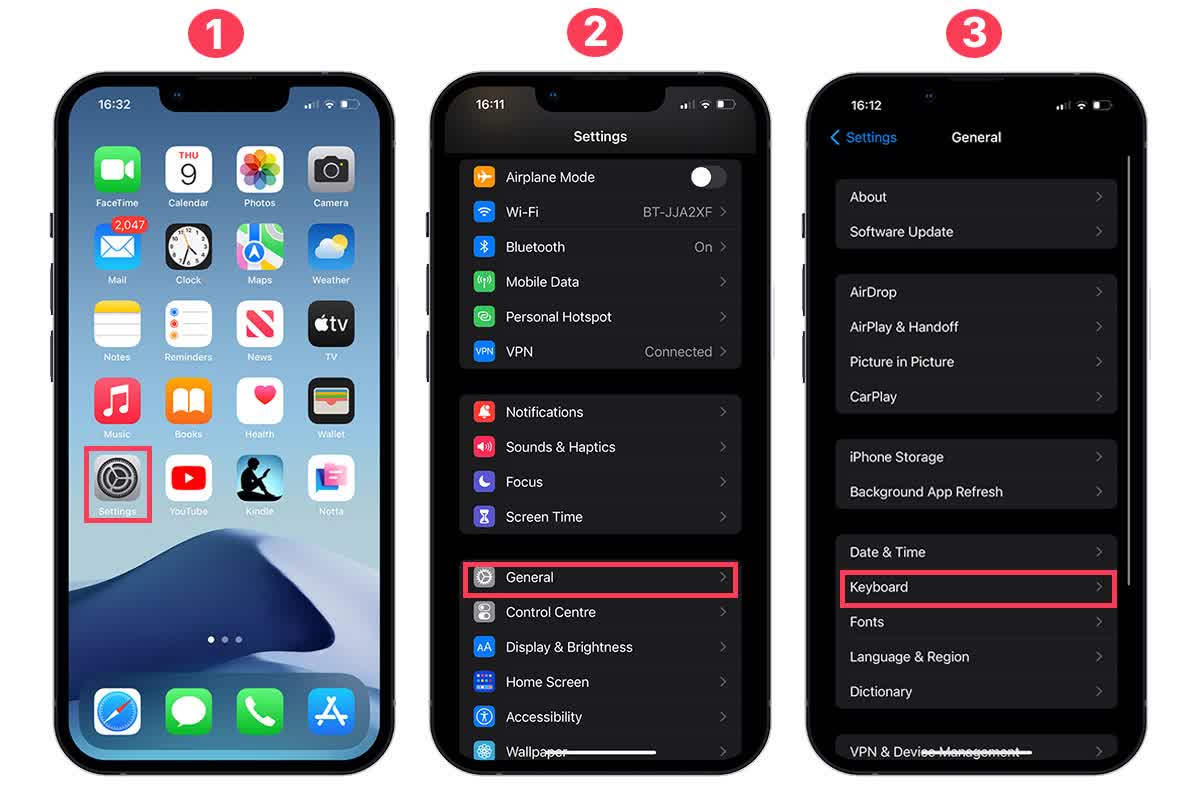
Scroll down again, and tap ‘Enable Dictation’ to turn on the iPhone’s dictation mode.
Accept the pop-up asking for permission to enable the feature.
That’s it! Voice dictation is enabled!
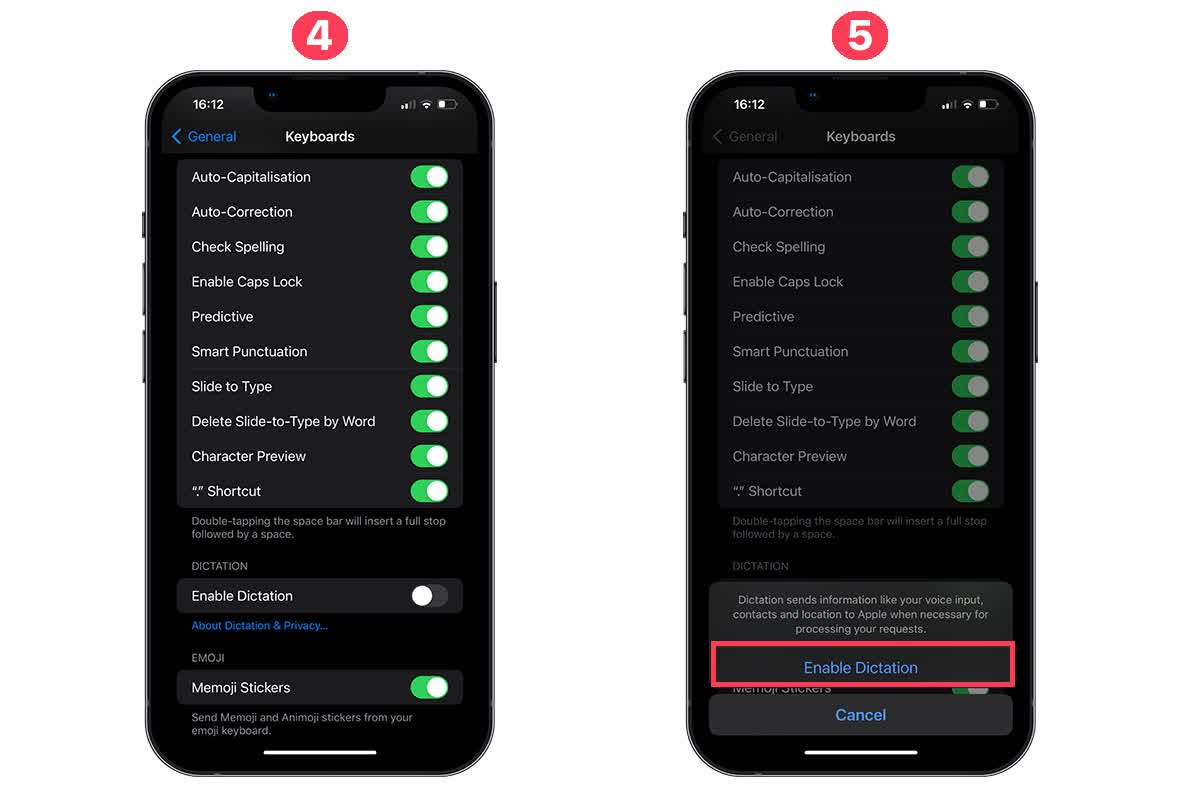
Now that voice-to-text is on; it’s time to start using it to send messages.
How do I turn voice dictation off?
It’s simple:
Tap ‘Settings’> ‘General’>’ Keyboard’ and scroll down to ‘Enable Dictation.’ Toggle the green slider to the off position, and voice dictation is disabled.

Send a voice text on iPhone using Messages
Now that you have everything set up, let’s look at how you can use it to send a message:
Open the Messages app and select a contact that you wish to message.
Tap the microphone icon in the bottom right-hand corner to compose a text message. Speak naturally and clearly into the microphone.
When you're finished dictating your text, tap on the small white keyboard icon in the bottom center of the screen.
You can now edit the text to correct errors and add punctuation and capitalization.
How to add punctuation to your messages
Simply speak it into the text as you progress.
For example, you might say:
“Hello John comma, you did a fantastic job on the report exclamation mark.”
The iPhone will then format this as:
“Hello John, you did a fantastic job on the report!”
You can also use common punctuation commands such as:
Period/Full stop
Colon
Semicolon
Question mark
Exclamation mark
Apostrophe
Dash
New line
New paragraph
Open quotes
Close quotes
A complete list of available voice commands is available from Apple here.
The voice-to-text feature is pretty accurate, so you won’t have to worry much about misspellings. It gets most things right, and it’s easy to correct errors afterward.
Using voice-to-text can save you a lot of time, and the good news is you’ll find other apps that support it. So you can send your emails, take notes, command your iPhone, and even search the web.
So, if you’ve not been using it, now’s the time to start! :)
Ready to Upgrade Your Voice?
Apple's dictation gives you a raw transcript. SpeakON gives you ready-to-send text shaped for the app you're in — Casual for iMessage, Professional for Slack, Formal for email. One press between thought and word.
Explore SpeakON
Tips for using voice-to-text on your iPhone
There are a few things to keep in mind when using the voice-to-text feature on iPhone:
Make sure you have a good signal. If you’re in an area with bad reception, the voice-to-text feature may not work well.
Try to ensure you're in a quiet environment so that it can accurately transcribe your words.
Speak clearly and slowly. The feature works best when speaking clearly and at a moderate pace. If you talk too quickly or mumble your words, the voice-to-text feature may not be able to understand you.
Remember that the voice-to-text isn’t perfect. While it’s usually very accurate, it may sometimes not understand you. If this happens, you can edit the text manually.
Keep an eye out for the microphone icon when using various apps. You’ll know that the app supports voice dictation when you see it.
Don’t forget that you can also use your voice to issue commands to Siri using voice control. To explore this further, visit the Apple guide here.
FAQs
Why does my iPhone voice text not work?
Most likely, you have ‘Enable Dictation’ toggled off. Go to ‘Settings’ > ‘General’ > ‘Keyboard’ and scroll down to toggle it back on.
How can I improve dictation accuracy on my iPhone?
Remember to speak, use punctuation, and consider buying a headset mic or a noise-canceling headset like Apple’s AirPods.
Can I use voice to text on my Android phone?
Yes, you can. Android phones are also equipped with the voice-to-text feature. It is easy to set up and use. Here is a detailed guide on how to activate voice-to-text on Android phones.
Can I dictate into any app on iPhone?
Yes. Once dictation is enabled, the microphone icon appears in any app with a text field, including Messages, Mail, Notes, WhatsApp, third-party apps, and search bars. The feature is system-wide, not limited to Apple's own apps.
Why does my voice to text keep stopping?
Your iPhone stops listening after about 30 seconds of silence. If it's cutting off sooner, a weak internet connection is usually the cause. Dictation needs Wi-Fi or cellular data to work fully. Check your connection and, if signal is an issue, move to a stronger coverage area.
Want Voice Typing Without Tapping the Keyboard Mic?
Apple's built-in dictation works, but every time you use it you still have to unlock the phone, open an app, tap the microphone icon, and wait for the keyboard to get out of the way. If you voice-text a lot, that friction adds up. And what you get back is a verbatim transcript — every "um" and "uh" included — that still needs cleaning up before you can actually send it.
SpeakON is a different setup for the same task. It's a MagSafe hardware button that clips to the back of your iPhone (iPhone 12 and above). Press the physical button, speak naturally, and polished, ready-to-send text appears directly in whichever app is on screen — iMessage, WhatsApp, Gmail, Notes, Slack, LinkedIn, or any other iOS app with a text field.
What you get beyond the built-in mic
Smart Polish — removes filler words and verbal tics automatically, so output reads like something someone actually wrote, not a raw transcript.
Attune tone engine — four modes (Off, Casual, Professional, Formal). The same spoken sentence comes out shaped for the channel you're writing in: Casual for iMessage, Professional for Slack, Formal for email.
Real physical activation — a dedicated microphone on the device, not your iPhone's system mic. One press, works from anywhere on your phone.
13 languages with real-time translation built in.
Who it's built for
Founders, VCs, consultants, and other professional communicators who send a lot of high-stakes messages on the go. If what you type on iPhone is seen by clients, investors, or colleagues, the time you spend cleaning up transcripts is time the message could have been sent.
Final thoughts
Overall, the voice-to-text feature on the iPhone is a great time-saver. It’s accurate, helpful, and (for some people, a real lifesaver). However, remember to speak clearly and (if possible) avoid slang or jargon.

