Rescheduling a meeting happens to everyone. A scheduling conflict, a personal emergency, a last-minute client deadline — these are normal parts of working life. What matters is how you handle it. A well-written reschedule email keeps the relationship intact, gives the other person enough time to adjust, and makes it easy to find a new time without unnecessary back-and-forth.
This guide covers what to include in a professional reschedule email and provides seven ready-to-use templates for different situations, each with a subject line
Let’s dive in!
What to Include in a Reschedule Meeting Email
Before reaching for a template, it helps to understand what makes these emails work. A professional reschedule email should do five things:
1. Use a clear subject line. The recipient needs to know immediately that the meeting is changing, not when they open the email. Subject lines like "Request to reschedule: [Meeting name]" or "Rescheduling our meeting on [date]" remove all ambiguity.
2. Apologize briefly and give a reason. You don't need to over-explain, but a short acknowledgment of the inconvenience and a brief reason shows respect for the other person's time. "A scheduling conflict has come up" is sufficient in most cases. You don't need to share personal details.
3. Propose alternative times. Always include at least two alternative dates and times so the recipient has genuine options. If you use a scheduling tool, including your booking link makes it even easier for them to select a time without another exchange of emails.
4. Send it as early as possible. The more notice you give, the less disruptive the change is. Sending a reschedule email the morning of the meeting is very different from sending one three days before. Earlier is always better.
5. Keep the tone professional and positive. You're asking for a favor — the recipient has to reorganize their schedule. Acknowledge that, thank them for their understanding, and keep the email brief. Long apologies can come across as worse than the rescheduling itself.
How to craft a proper meeting reschedule email?
A well-written email to reschedule a meeting will help you convey your regret for any inconveniences caused and encourage colleagues to respond fast to agree on a new meeting time.
To get these results, follow along to write an effective postponed meeting email.
1. Start with a clear subject line
The subject line is arguably the most important part of the email, as it will determine whether or not the receiver opens it.
A good subject line should be clear and concise while still conveying its importance. For example, "Rescheduling our Meeting" is much better than "I'm so sorry, but can we reschedule?"
If it’s a meeting with someone you are not familiar with or outside of your company, be sure to include your name and your organization. This helps the receiver immediately place who you are with no added confusion.
Some meeting rescheduled email subject line examples. For video content related to meetings, you can summarize youtube video presentations:
2. Provide an apology and a credible reason
Begin with a simple greeting, apologize sincerely for the inconvenience, and explain why you requested to reschedule the meeting. If there is a specific reason for the requested change (e.g., you have another meeting scheduled at that time), be sure to mention it to show credibility.
Again, be as concise as possible – no need to go into excessive detail. If you have audio recordings to reference, you can use audio to text conversion tools.
3. Propose an alternative meeting date and time
Be sure to propose alternative dates and times for the rescheduled meeting in the body of the email. For Google Meet users, you can utilize google meet ai note taker to ensure important details are captured. This will show that you're still committed to making the meeting happen, despite the inconvenience.
If there are multiple options and a meeting agenda, include them all in the email so that the recipient can choose the best option for them. You can also transcribe video to text free if you need to convert recorded meeting content. Also, show your willingness to adjust according to their schedule.
4. Notify everyone as soon as possible
Once you realize you are not able to attend the meeting and need to reschedule it, notify all the attendees as soon as possible. There is nothing quite as disrespectful as waiting until the eleventh hour to tell your team or clients that the meeting will not take place.
If you can, send out the meeting reschedule request several days before the meeting. You can also start by sending an instant message and then a formal email. For Teams users, consider using teams record and transcribe features for better meeting documentation. This will give other attendees time to adjust their schedules accordingly.
5. Find the right balance in tone
You don't want to appear flippant, but you also don't want to sound overly formal. The goal is to sound respectful and apologetic while still maintaining a level of professionalism.
Thank the recipient for their understanding and flexibility, and ask if the new meeting time will work better for everyone involved.
6. Personalize the email
Personalization helps to build rapport and maintain a positive relationship, even when you’re rescheduling. As a bonus, it demonstrates that you are organized and detail-oriented.
For example, you cannot send a rescheduled meeting email to a client without addressing them personally. The odds are that the client will be offended to receive an email that says “Dear All” or “To whom it may concern”– like they’re just another person on an email blast for you.
7. Show appreciation
Remember your team has made time and even much preparation for this meeting and is now changing their calendars again to accommodate you. Showing appreciation for your team members when meetings are rescheduled sets a great precedent for the future.
8. Call the recipient if needed
If you've sent a rescheduled meeting email and haven't received a response, or if the meeting is going to start soon, it's probably best to call the recipient instead. Emails can sometimes feel impersonal, and this is especially true when it comes to scheduling. You can also use voice memo transcription to capture important details from phone conversations.
If you call, you'll be able to tell them as soon as possible and get a sense of whether or not they're available on the new date/time.
Plus, it'll be one less email for them to respond to. If you're unsure how your meeting reschedule email will be received, pick up the phone instead.
Revolutionize your meetings with AI
Find an all-round AI meeting assistant to make your meetings more productive.
3 sample emails to reschedule a meeting politely
Want a ready-to-use meeting reschedule email sample? We’ve got you.
In the next part, We’ll provide three templates for both formal and informal meeting reschedule emails. Each email has an apology, reason, and alternate dates and times for the next meeting, helping you make a meeting reschedule politely.
Formal meeting reschedule email
A formal email template for rescheduling a business meeting will show your professionalism and better suit the following situations:
The meeting is with a client or prospect.
The meeting is with a senior executive.
The meeting is with a different business.
Subject Line: Rescheduling Request for [Meeting Name]
Dear [Name],
I’m [Name] from [Company/Department Name]. We had a meeting booked on [Date and time] to discuss [Topic].
While I was looking forward to the meeting, I’m afraid I can’t attend it due to [mention your reason], really sorry about this. Might it be possible for us to reschedule the meeting?
The following are my available time for the postponed meeting:
[New Date] and [New time]
[New Date] and [New time]
[New Date] and [New time]
Please let me know if any of these options work for you or if you require a different time.
I apologize sincerely for any inconvenience this may cause and look forward to connecting with you soon.
Thank you,
[Signature]
[Company and contact information]
Informal reschedule meeting email
In general, you might use an informal email template for any meeting that is not time-sensitive or the result of a formal request (such as a job interview). For Spanish-speaking colleagues, you can transcribe spanish audio to text for better communication. This includes:
Sample one
Dear [name]/ Hi Team,
I regret to inform you I am not able to attend [the meeting] scheduled on [date] and need to reschedule it. [Reason for rescheduling]. I apologize for any inconvenience and hope we can reschedule for another date.
Can we meet on either [date 1] or [date 2] instead? Please let me know what time would work best for you.
Thank you for your understanding.
Sincerely,
[Your name]
Sample two
Dear [name],
I'm afraid that we have to reschedule our meeting at [time] on [date] due to unforeseen circumstances.
Please accept my apology for any inconvenience caused, and hope we can postpone the meeting to another date.
Would you be available on [alternative time] or [alternative time]? If not, please let me know what works best for you, and I'll try to fit it into my schedule.
Again sorry for the trouble, and thanks for your understanding.
All the best,
[Your signature]
How to auto-join meetings scheduled on your calendar?
Imagine this situation: you have received multiple online meeting invitations and suddenly found they conflict with each other. You decide to absent yourself from some unimportant meetings instead of rescheduling them. However, you are worried that you may miss essential information. You can transcribe zoom recording to text free to review missed content later.
What if there is an assistant that can attend the meeting and record everything for you even without your presence?
This is totally realistic with the help of Notta!
Notta is an AI transcription free software that can record and transcribe your online meetings in real-time. What's more, it offers an AI assistant to replace you and automatically join meetings (Zoom, Google Meet, and Teams) scheduled in your calendar.
The steps are simple:
Connect Notta to your Google or Outlook Calendar.
Paste the meeting link in the Calendar.
Set the Notta bot to join the meeting at the start time.
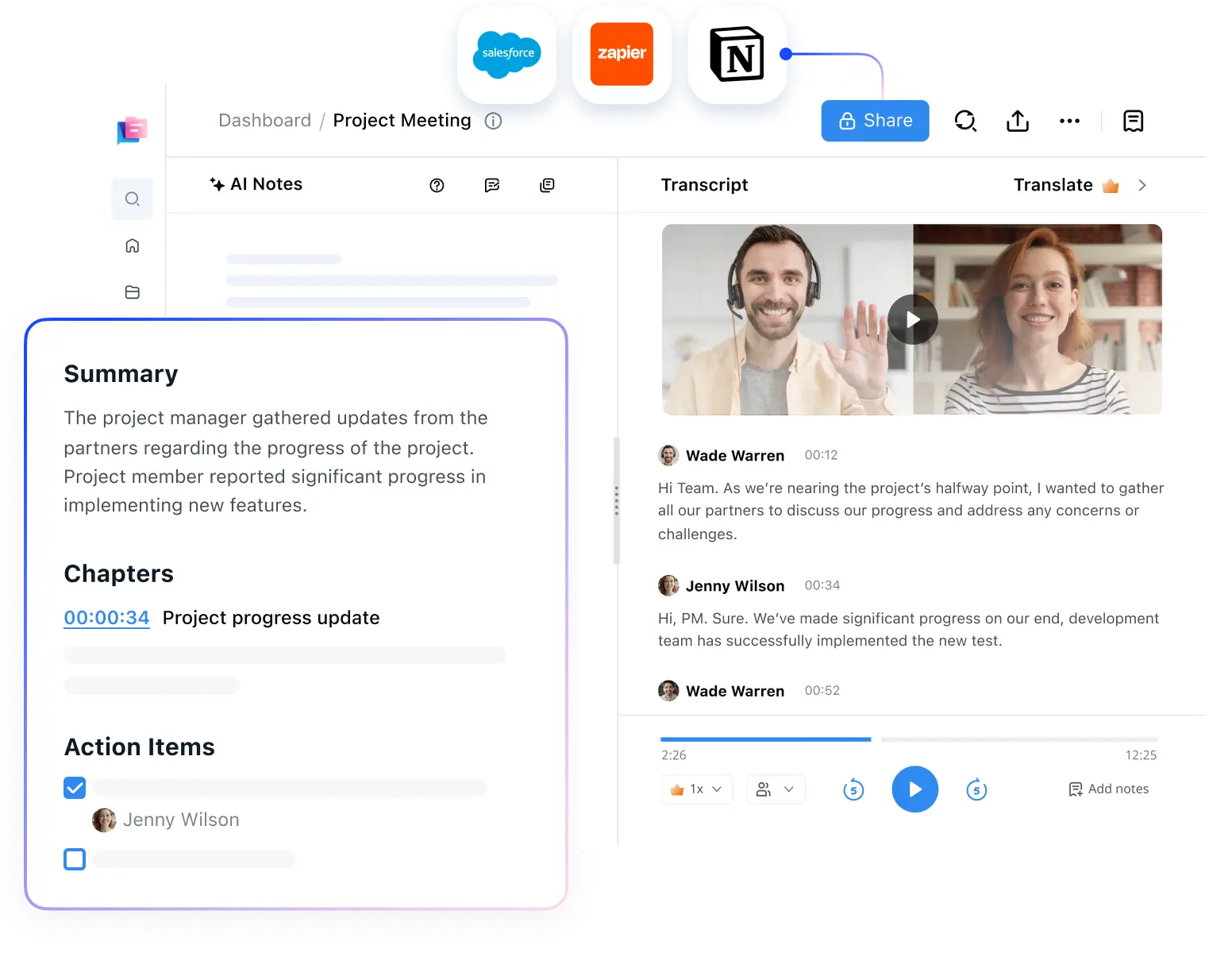
The best part is you can review the meeting recording at any time and rest assured that you are in the loop.
Reschedule better and faster
Knowing how to politely reschedule a meeting plays a significant role in building work relationships. Here's a little recap of what is most important in your rescheduled meeting email:
The email content should be apologetic and polite, explaining the situation as briefly as possible.
Timing is vital – send the email as soon as you know there will be a conflict.
Keep your tone respectful and understanding.
Choosing the Right Tone
The distinction between formal and informal isn't just about vocabulary. It's about the relationship, the stakes, and how well you know the other person.
Use a more formal tone when: rescheduling with a client or prospect you don't know well, communicating with a senior executive, or dealing with an external party where the professional relationship is still being established. In these cases, err on the side of more courtesy, not less.
Use a less formal tone when: dealing with colleagues you work with regularly, an internal team meeting, or anyone you have an established, comfortable working relationship with. Being overly formal with close colleagues can actually feel distancing.
Both tones share the same core elements: acknowledge the inconvenience, provide a reason, propose alternatives, and thank the person for their flexibility. The difference is in the language and level of formality rather than the structure.
Subject Line Examples
The subject line is what gets your email opened. Here are options you can adapt:
Request to reschedule our meeting on [date]
Rescheduling [meeting name] — [your name]
Need to shift our [date] meeting
Quick change to our meeting time
Apologies — rescheduling our [date] call
Urgent: rescheduling today's meeting
Change of plans: [meeting name] on [date]
Keep it factual and clear. Vague subject lines like "Quick question" or overly apologetic ones like "I'm so sorry but..." make it harder for the recipient to quickly understand what the email is about and act on it.
Frequently Asked Questions
How far in advance should you send a reschedule email?
As soon as you know. If a conflict arises three days before the meeting, send the email that day — not the day before. The earlier you notify the other person, the more time they have to adjust their own schedule. Same-day or last-minute rescheduling should be acknowledged explicitly and apologized for more emphatically.
Should you give a reason for rescheduling?
A brief reason is always better than none, but you don't need to over-explain. "A scheduling conflict has come up" or "an urgent personal matter needs my attention" is sufficient in most cases. Over-explaining can come across as defensive or unprofessional. Keep it short and move quickly to proposing alternative times.
What if the other person doesn't respond to your rescheduled email?
If you haven't heard back within a day or two and the meeting is approaching, follow up with a short message referencing your previous email. If the new meeting time is imminent, a phone call is often more effective than another email. A brief call confirms the change in real time and avoids the risk of the other person missing your messages.
Is it unprofessional to reschedule a meeting?
Rescheduling is a normal part of professional life. It only becomes a problem if it happens repeatedly with the same person, is done at the last minute without good reason, or isn't handled with appropriate courtesy. A well-written reschedule email actually demonstrates professionalism by communicating promptly and making it easy for the other party to find a new time.
How do you reschedule a meeting you didn't originally organize?
If someone else organized the meeting and you can't attend, reach out to the organizer directly rather than declining the calendar invitation without explanation. Let them know you have a conflict, briefly explain why if appropriate, and ask whether the meeting can be moved or whether you can catch up on what was discussed afterwards.