
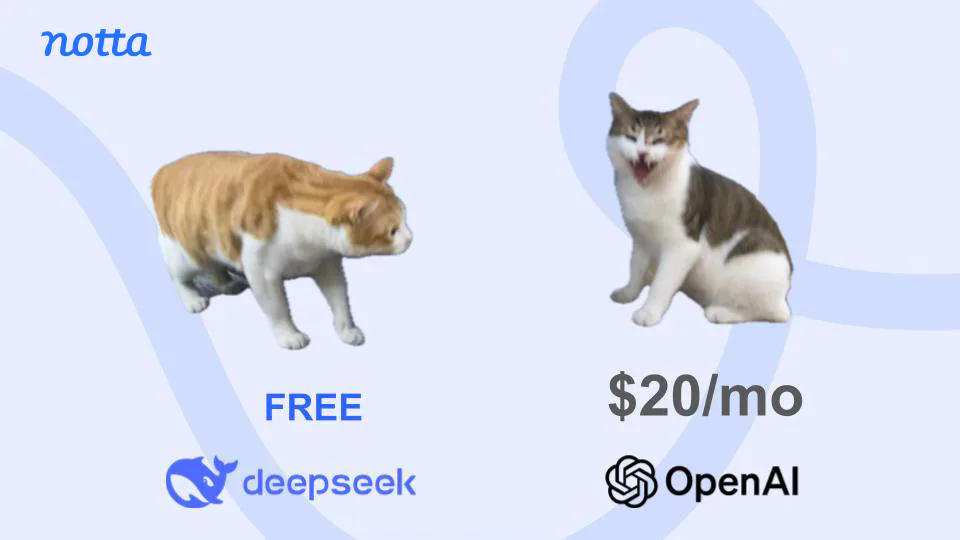
DeepSeek R1 Basically Replaces GPT O1 - for free
Record, transcribe and summarize conversations with one click.
If you're evaluating DeepSeek R1 and OpenAI o1 for API usage, the cost difference is stark. DeepSeek R1 charges $0.55 per million input tokens and $2.19 per million output tokens. OpenAI o1 charges $15 per million input tokens and $60 per million output tokens. On equivalent workloads, DeepSeek R1's API costs roughly 96% less than o1.
That gap is significant enough to change the economics of building with reasoning-capable models entirely, which is why this comparison has attracted so much attention from developers and teams evaluating their options.
This article covers the full pricing breakdown, a benchmark comparison across six widely-used evaluations, the technical reasons for the cost difference, and guidance on which model makes more sense depending on your use case.
API Pricing: DeepSeek R1 vs OpenAI o1
DeepSeek R1
OpenAI o1
Input (per 1M tokens)
$0.55
$15.00
Output (per 1M tokens)
$2.19
$60.00
Cost reduction vs o1
—
96.4% more expensive
Chat platform access
Free
Requires ChatGPT Plus ($20/month)
Licence
MIT (open weights)
Proprietary
Self-hosting
Yes
No
The pricing figures above reflect the DeepSeek API and OpenAI API pricing at the time of writing. Both providers update their pricing periodically, so verify current rates on the DeepSeek API pricing page and OpenAI pricing page before committing to a build.
What the Cost Difference Means in Practice
To put the gap in concrete terms: a workload that costs $100 on the OpenAI o1 API would cost approximately $3.60 on the DeepSeek R1 API for the same volume of tokens. For production applications that process large volumes of queries — document analysis, code review pipelines, automated reasoning tasks — that difference compounds significantly.
For individual developers or teams building prototypes, DeepSeek also offers free access to the main R1 model through its chat platform at deepseek.com. No subscription required.
Performance Benchmarks: DeepSeek R1 vs OpenAI o1
The pricing comparison only matters if the models are genuinely comparable in capability. Across most standard benchmarks, they are — with each model leading in different task categories.
Benchmark
DeepSeek R1
OpenAI o1-1217
Leader
AIME 2024 (math, Pass@1)
79.8%
79.2%
DeepSeek R1 (+0.6%)
MATH-500 (math reasoning, Pass@1)
97.3%
96.4%
DeepSeek R1 (+0.9%)
SWE-bench Verified (software engineering)
49.2%
48.9%
DeepSeek R1 (+0.3%)
Codeforces (competitive programming, percentile)
96.3%
96.6%
o1 (+0.3%)
MMLU (general knowledge, Pass@1)
90.8%
91.8%
o1 (+1.0%)
GPQA Diamond (general Q&A, Pass@1)
71.5%
75.7%
o1 (+4.2%)
Where DeepSeek R1 leads: Mathematical reasoning (AIME, MATH-500) and software engineering tasks (SWE-bench). These are precisely the domains where chain-of-thought reasoning models add the most value.
Where OpenAI o1 leads: General-purpose knowledge (MMLU), complex question answering (GPQA Diamond), and competitive programming (Codeforces). The GPQA Diamond gap of 4.2% is the most meaningful performance difference between the two models in this benchmark set.
For most practical applications — code generation, mathematical problem solving, reasoning tasks — the performance difference is small enough that the pricing gap dominates the decision.
For Students: Why R1 Will Be the Ultimate Study Sidekick
Here's why R1's transparency is actually super cool for learning: imagine having a study buddy who literally shows you their work instead of just giving you answers. While O1's like "trust me bro, this is how you solve it," R1's walking you through its thought process in real-time, showing where it got stuck and how it figured things out. When it's tackling a tricky Sudoku or an LSAT logic puzzle, you can see it think, backtrack, and try different approaches - kinda like watching someone speedrun a game with commentary. The best part? Since it's free, you can mess around and learn from its thinking patterns without burning through your ramen budget. Even when R1 goofs up (which happens), you can spot exactly where it went wrong and learn from those mistakes. Try doing that with O1's "behind the curtain" approach!
Below is my own attempt with an actual LSAT question. You can see how DeepSeek shows its own thinking. I guess you also do not have to buy these Kaplan test prep books either!

For Consultants: The Junior Analyst Who Works Non-Stop, Literally
Imagine a junior analyst who never clocks out, complains about "work-life balance," or demands a raise after acing your grunt work. R1 is that mythical creature—a 24/7 problem-solving intern fueled by logic, not caffeine. It’ll churn out competitor tear-downs at 3 AM, debug your pricing model mid-Zoom call, and still have the bandwidth to ask, “Want me to cross-check those market trends again?”
No sleeping, no whining about "burnout," and zero risk of it drunkenly Slack-ing the client at 2 AM. Consultants, it’s like cloning your best associate… if your best associate ran on open-source code and thrived on Excel hell.
Below is my own attempt. I gave R1 an Excel sheet of a company's financial and asked it to produce a memo.

For Small Business Owners: Save On Expert Consultation Fees
DeepSeek R1 doesn’t just hand you answers—it hands you a translator for expert conversations. Imagine walking into your CPA’s office and saying:
“R1 flagged my home office deduction as risky because I store inventory there. It suggested reclassifying 10% of the space as ‘admin-only’ and capping the write-off. Does that align with IRS guidelines?”
Suddenly, your CPA isn’t billing you $250/hour to explain what a home office deduction is. Instead, they’re tackling your specific edge case—and you’re learning the rules as you go.
Here are a few more examples:
A freelance photographer uses R1 to draft a client contract with kill fees and liability caps, then asks a lawyer: “R1 added a force majeure clause for weather delays. Should I specify ‘act of God’ or stick with ‘natural disasters’?” The lawyer tweaks it in 15 minutes instead of charging for a full billable hour.
A food truck owner debates trademarking “Taco Trauma” (R1’s USPTO search has already found a conflicting “Taco Drama” in Texas). They ask an attorney: “Is this a ‘likelihood of confusion’ or just a punny loophole?” The lawyer confirms R1’s hunch, saving $10k in rebranding costs.
Most owners avoid experts until disaster strikes—because $500/hour fees feel like gambling. R1 flips the script:
You walk in prepared, not panicked.
Experts focus on nuance, not basics (cutting their time—and your bill).
You learn as you go, turning pricey consults into mini-MBAs.
R1 isn’t about replacing professionals—it’s about making them allies, not emergencies. And in a world where 60% of small businesses fail due to cash flow mismanagement or legal surprises, that’s not just efficiency… it’s survival.
Why Is DeepSeek R1 So Much Cheaper?
The cost gap isn't just pricing strategy — it reflects genuine differences in how the models were built.
Reinforcement Learning Over Supervised Fine-Tuning
Most large language models rely heavily on supervised fine-tuning, which requires large volumes of human-annotated training data. DeepSeek R1 was primarily trained using reinforcement learning, where the model improves through self-generated feedback rather than requiring expensive human-labelled datasets at scale.
This approach significantly reduced DeepSeek's data annotation costs and allowed the model to develop reasoning capabilities through self-directed iteration. The total training cost for DeepSeek R1 has been reported at approximately $5.58 million — a fraction of the estimated billions spent training comparable proprietary models.
Mixture of Experts Architecture
DeepSeek R1 uses a Mixture of Experts (MoE) architecture with 671 billion total parameters, but only approximately 37 billion parameters are activated for any given inference request. This means the model delivers strong performance without incurring the full computational cost of running all parameters on every query — a meaningful efficiency gain at scale.
Distilled Model Variants
DeepSeek also offers a series of distilled models — smaller versions trained on synthetic data derived from the full R1 model — including variants based on Qwen and Llama architectures ranging from 1.5B to 70B parameters. These provide developers with lighter deployment options that maintain strong reasoning performance for cost-sensitive or latency-sensitive applications.
The Llama 33B distilled variant, for example, benchmarks comparably to OpenAI's o1-mini on several evaluations, at significantly lower inference cost.
Frequently Asked Questions
How much cheaper is DeepSeek R1 than OpenAI o1?
DeepSeek R1's API costs approximately 96% less than OpenAI o1 for equivalent token volumes. Input tokens cost $0.55 per million on DeepSeek R1 versus $15 per million on o1. Output tokens cost $2.19 per million on DeepSeek R1 versus $60 per million on o1.
Is DeepSeek R1 performance comparable to OpenAI o1?
On most reasoning benchmarks, yes. DeepSeek R1 outperforms o1 on mathematical reasoning tasks (MATH-500, AIME 2024) and performs comparably on software engineering tasks. OpenAI o1 leads on general knowledge (MMLU) and complex question answering (GPQA Diamond). The performance gap between the two models is small relative to the pricing gap.
Can I use DeepSeek R1 for free?
Yes. DeepSeek R1 is available for free on the DeepSeek chat platform at deepseek.com without a subscription. API access is paid, but at rates significantly lower than comparable models.
Is DeepSeek R1 open source?
DeepSeek R1 is released under an MIT licence with open weights, meaning the model weights are freely available for download, fine-tuning, commercial deployment, and self-hosting. The MIT licence is one of the most permissive available. This is distinct from OpenAI o1, which is proprietary and only accessible via API or the ChatGPT interface.
Can DeepSeek R1 be self-hosted?
Yes. DeepSeek's distilled model variants can be self-hosted using tools like Ollama, running locally on consumer or enterprise hardware depending on the model size. The full 671B parameter model requires significant GPU resources, but the distilled variants (7B, 14B, 32B) are practical for local or private cloud deployment.
What are DeepSeek R1's distilled models?
DeepSeek offers several smaller models distilled from R1, based on Qwen and Llama architectures, ranging from 1.5B to 70B parameters. These are designed for developers who need faster inference, lower costs, or local deployment without requiring the full model's compute footprint. The 33B Llama-based variant benchmarks comparably to OpenAI's o1-mini on several evaluations.
Conclusion: Give This New Kid on the Block a Try
DeepSeek R1 is the Swiss Army knife of AI: part street-smart consultant, part overachieving tutor. For consultants, it’s the junior analyst who works 24/7 for "exposure," churning out competitor tear-downs, stress-testing mergers, and drafting client-ready scripts—all while citing its sources like a nerdy paralegal (“Here’s why Supplier A’s ESG score tanks their viability…”). For learners, it’s the study buddy who wants you to copy its homework, live-streaming its logic like a Twitch coder debugging Sudoku algorithms (“Backtracking—column 3 can’t have two 5s. Let’s try 7…”).
Shoutout to OpenAI for pioneering the tech that made this possible. But where ChatGPT plays the mysterious oracle, R1’s the ADHD genius who can’t stop explaining how it hacked the Matrix. Open-source? Free? Yep. It’s like getting a Harvard MBA intern who runs on ramen and existential curiosity.
Final thought: Whether you’re a consultant billing by the hour or a curious mind geeking out over logic puzzles, R1’s your wingman—solving problems and teaching you to solve them better. Thanks, OpenAI, for the rocket science. Now, let’s put it to work.

