
How to Use ChatGPT for Meeting Notes
Saving time and effort with Notta, starting from today!
Are you looking for a way to quickly take meeting notes? ChatGPT can help.
ChatGPT is a widely used artificial intelligence (AI) tool that is taking the world by storm. It can process a long meeting transcript and summarize it for you in seconds.
We’ve helped millions of students, journalists, lawyers, and other professionals around the world use AI to take notes with ease.
In this article, we’ll show you how to take notes with Chat GPT. We'll also highlight other AI tools that are even easier than ChatGPT. By the end, you’ll have a simple, reliable note-taking system ready for your next meeting.
How to use ChatGPT for meeting notes
To use ChatGPT for meeting notes, just paste your meeting transcript directly into the chat and ask ChatGPT to summarize it. This summary will help you easily identify the important points of the discussion. You can share it with colleagues and refer to it during your next meeting. Here’s how to take notes with Chat GPT:
Step 1: Download your meeting transcript. You may already have a transcript, depending on how you recorded your meeting. If not, you can use software such as Notta to create a full transcript from the audio or video recording.
Try to get your transcript without timestamps or other distracting information. It may cause the AI to focus on the wrong parts of your transcript.
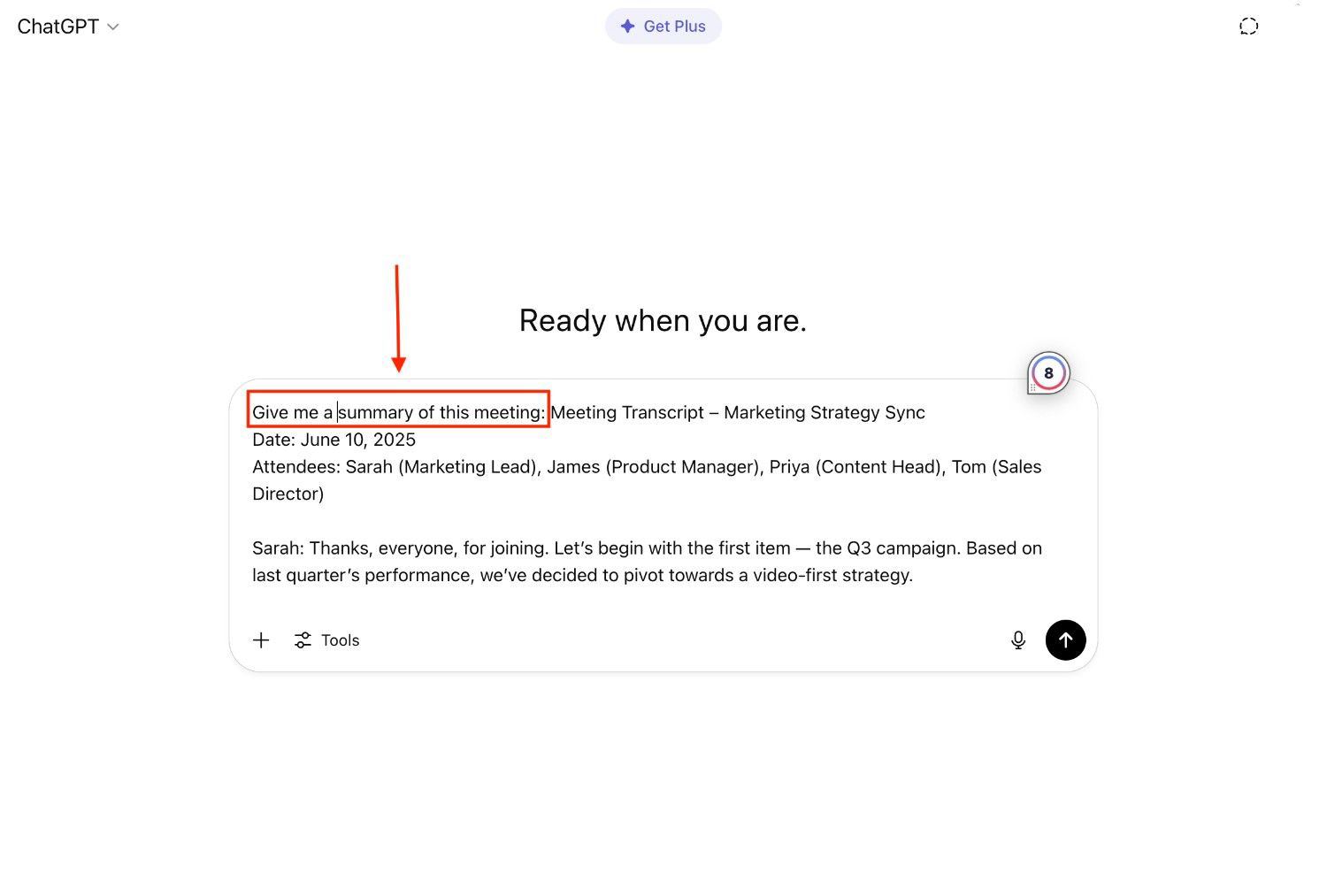
Step 2: Once you have your transcript, you can head over to ChatGPT. In the box where it says, “Ask anything,” type your prompt. You can skip to the ‘ChatGPT Prompts for Meeting Minutes’ section below, then come back when you find a suitable prompt.
In this example, we'll use the prompt 'Give me a summary of this meeting.'
Step 3: Type your prompt followed by a colon (:). This tells ChatGPT that the text after the colon is what we want to summarize. Then copy your entire transcript and paste it after the colon.
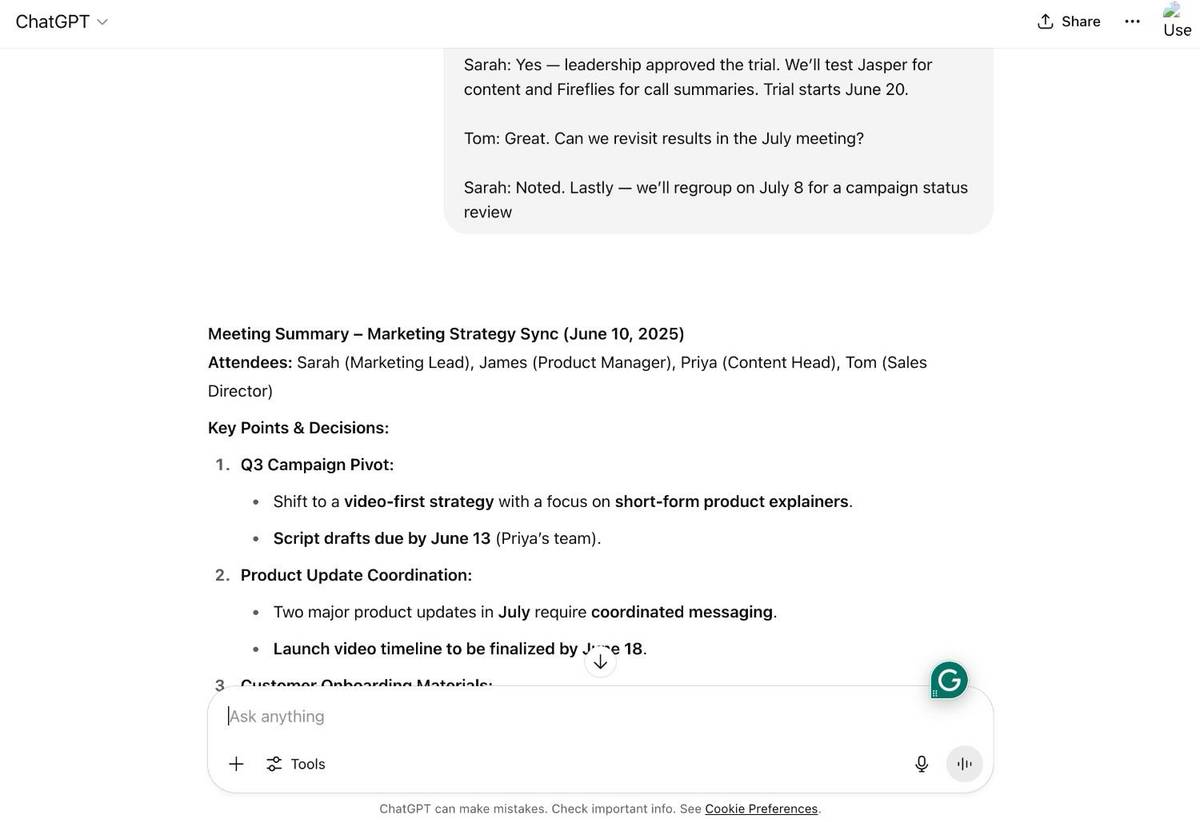
Step 4: Press ‘Enter’. ChatGPT will give you a detailed summary and highlight all the key points of the discussion.
ChatGPT prompts for meeting minutes
Let’s take a look at some prompts that you can use to prepare meeting minutes. We’ll look at three ways you can prompt ChatGPT to summarize meetings.
#1 Decision making
Here are some prompts for ChatGPT that help you quickly identify the key points and actionable tasks made during your meeting:
“What are the key decisions made in this meeting?”
“Give me a summary of the key decisions from this transcript.”
“Examine the potential impacts of the principal decisions made in the meeting.”
“Can you give me a comprehensive breakdown of the key decisions made in the transcript?”
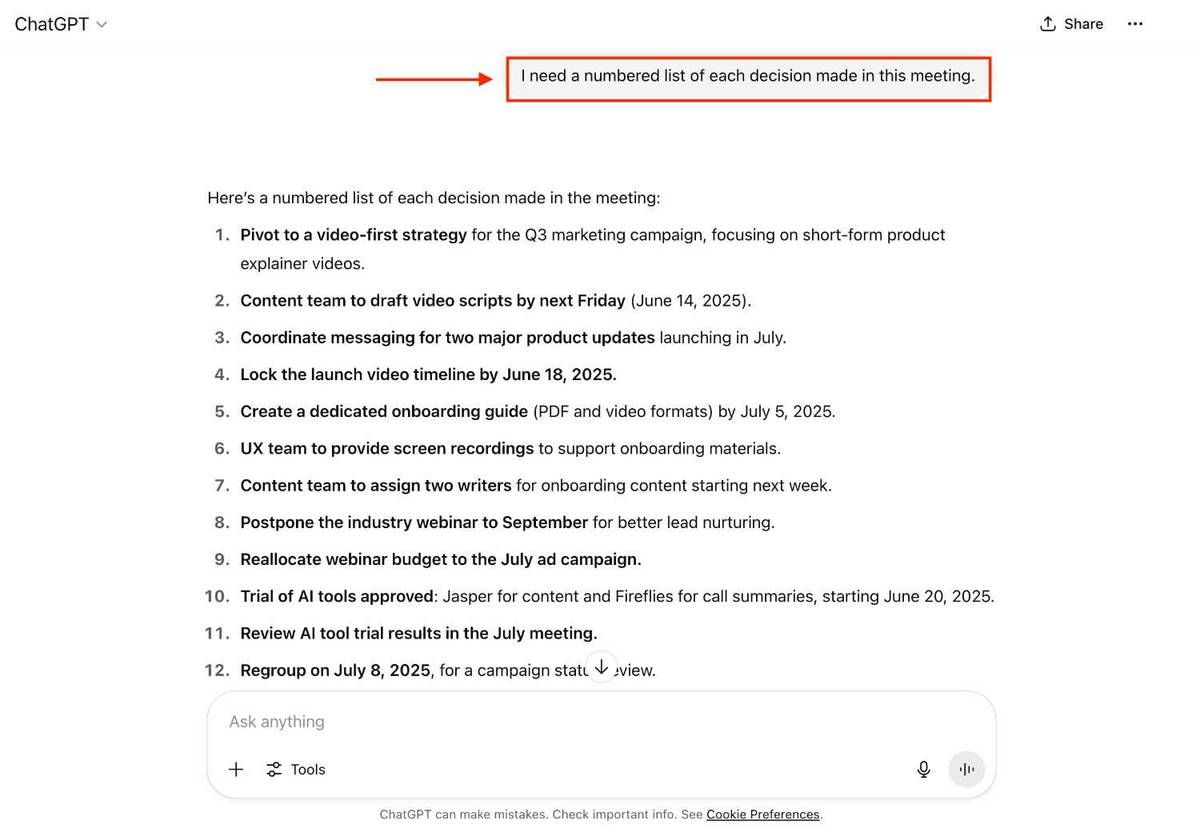
“I need a numbered list of each decision made in this meeting.”
#2 Extract action items and create the next meeting's agenda
These prompts for ChatGPT help you list action items and turn them into a clear agenda for your next meeting.
“What are the action items coming out of this meeting?”
“I need a brief overview of the action items discussed.”
“Highlight the main challenges or issues discussed in the transcript.”
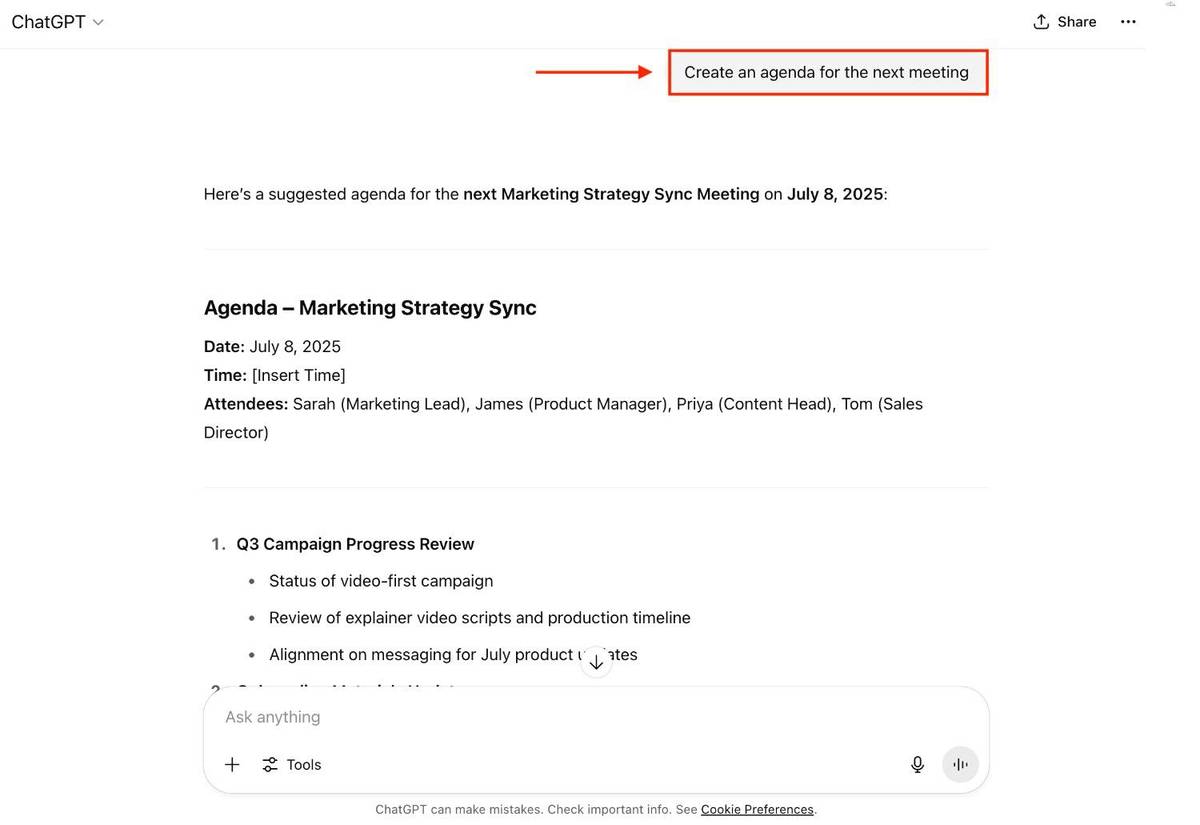
“Create an agenda for the next meeting.”
“What are the deadlines for these action items?”
#3 Break the meeting into different sections
You can specifically prompt ChatGPT to organize your meeting into structured sections, making the flow of the discussion easier to follow.
“Give me a breakdown of this meeting separated by transition points.”
“Break up this transcript into easily digestible sections.”
“Can you give me a recap of this meeting with titles for each part of the discussion?”
“Break the meeting into different sections so the discussion is easy to understand.”
“Organize this meeting by topic areas discussed.”
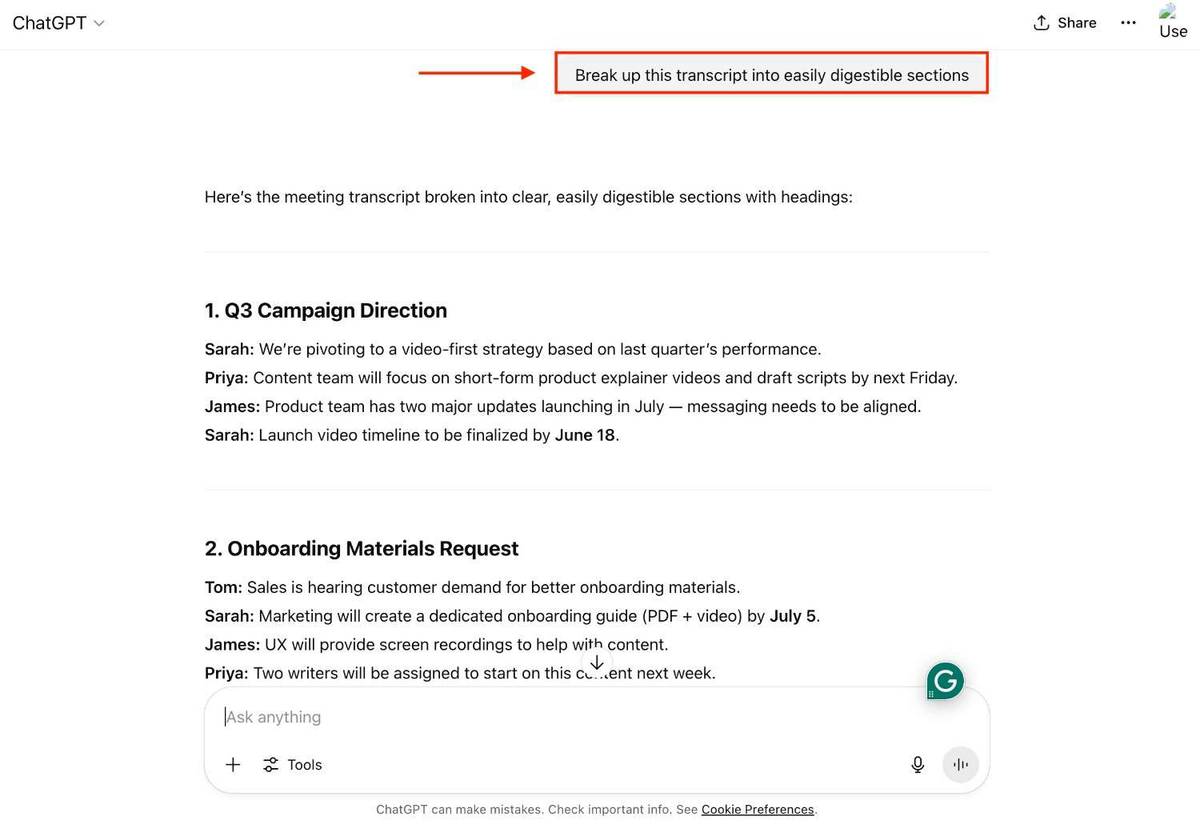
Some of these prompts may not give you exactly what you need on the first try. You can try different prompts or rephrase your request until you get the relevant information. You can even tell ChatGPT, "That's not exactly what I was looking for," and it will help you figure out a better way to ask.
Here's how to give clear and specific prompts with better examples and ideas. Instead of saying, "generate meeting notes," try "Create a 5-point summary focusing on budget decisions and next steps." You can also ask for bullet points like "Organize this by the person responsible" or "Make this a bulleted list instead."
Think of it like training a smart intern. If you provide clear instructions, they’ll get the job done.
How to automate meeting notes
In this section, we'll explore how to automate the note-taking process during a meeting. This helps you and your minute keeper focus on the meeting while AI makes sure you don't miss any important details.
We'll look at three different ways you can automate meeting notes. Some of these productivity tools may be familiar to you, and some may be a pleasant surprise.
#1 Use the built-in note-taking features of Zoom
Zoom has a feature that shows captions during a meeting. It's available in over 30 languages, including English, French, Arabic, and Tagalog. If you need captions in another language, skip to the next option.
Enabling Zoom captions will also generate a text transcript after the meeting is over. It will be in a VTT file that you can access on the cloud. This requires a Zoom Pro, Education, or Enterprise license. If you’re using the free version of Zoom, you should explore other options.
Zoom isn’t really an all-in-one solution for meeting notes. The free version has limited features, and the VTT format makes it harder to create clean summaries.
If you still want to try Zoom, here's how to generate a full transcript:
Step 1: While you're in a Zoom meeting, click “Record” and select “Record to cloud” to begin a cloud recording.
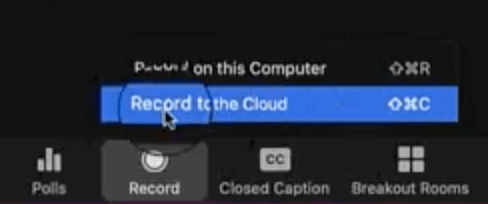
Step 2: After the meeting ends, check your email. Zoom will email you the transcript within a few minutes.
#2 Use Notion’s AI feature
Notion is a document management tool with a built-in AI that can summarize text. It can't record audio or transcribe, but it can create concise notes from your transcript.
This is similar to the ChatGPT method we outlined above. Here's how to use Notion to automate your meeting summaries from a transcript:
Step 1: Open an empty page in Notion.
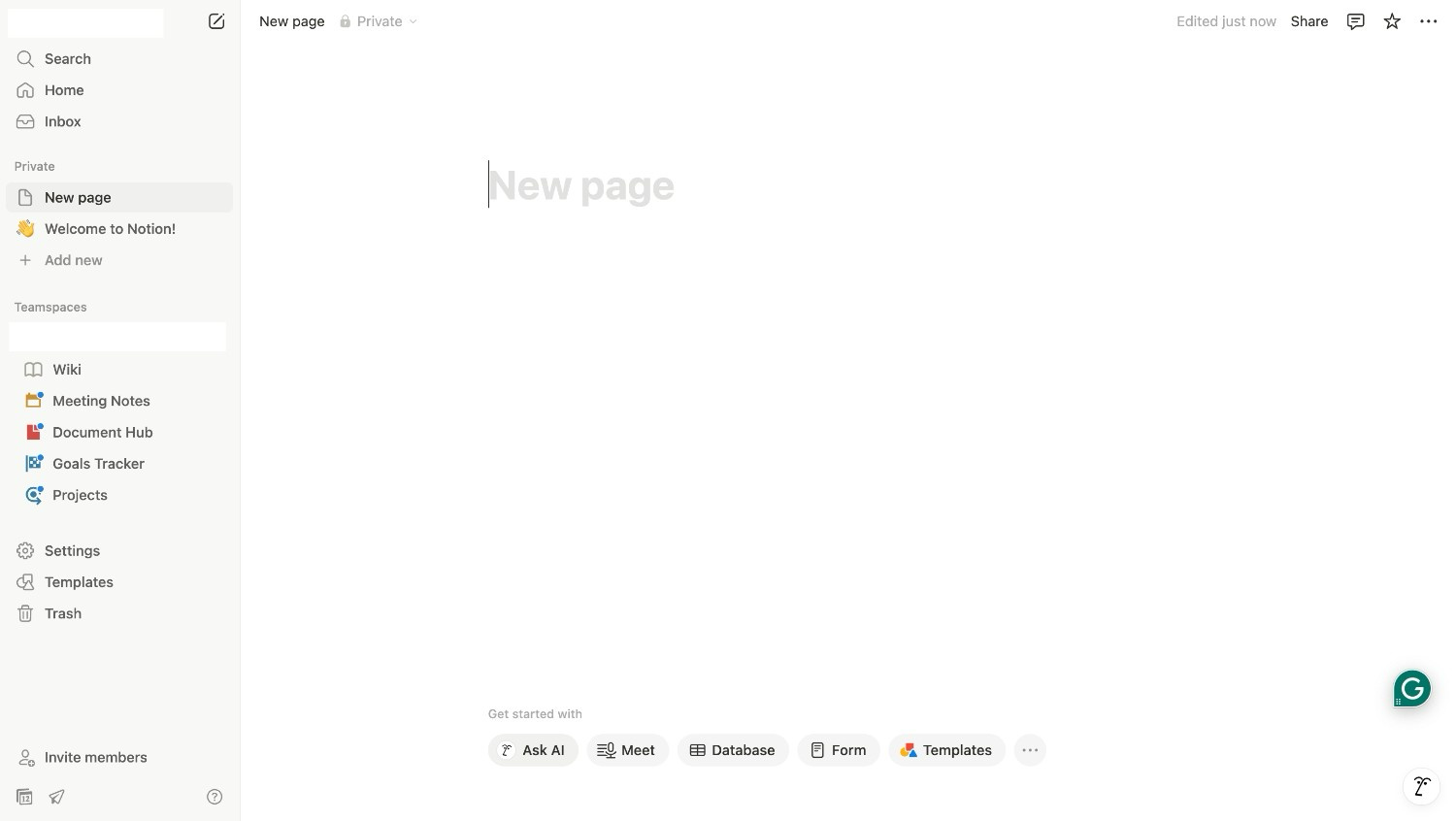
Step 2: Copy and paste your transcript into Notion.
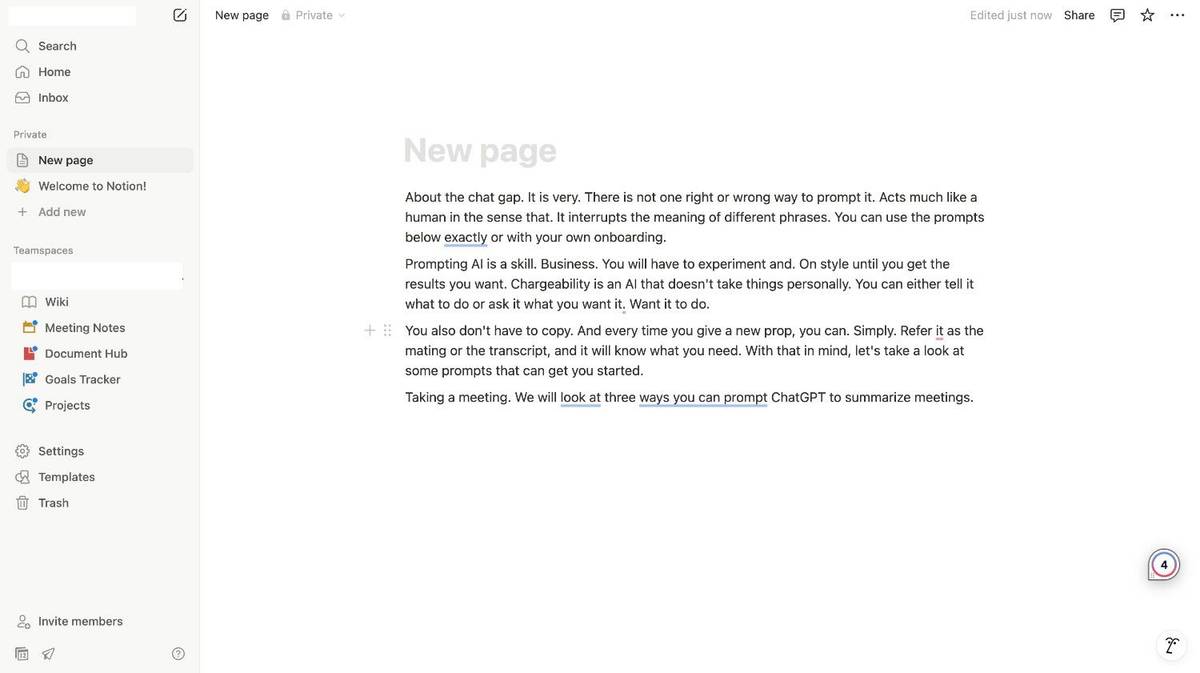
Step 3: Scroll down to the bottom of the transcript and click on a blank line. Then press “Spacebar.”
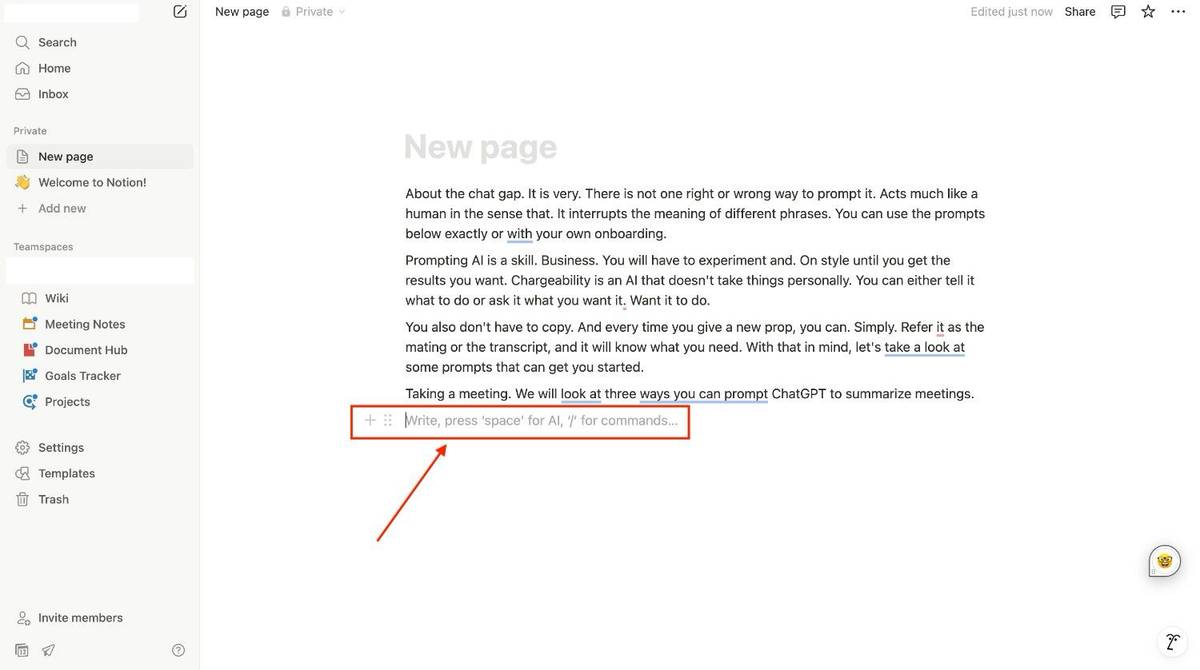
Step 4: Click “Add a Summary.”
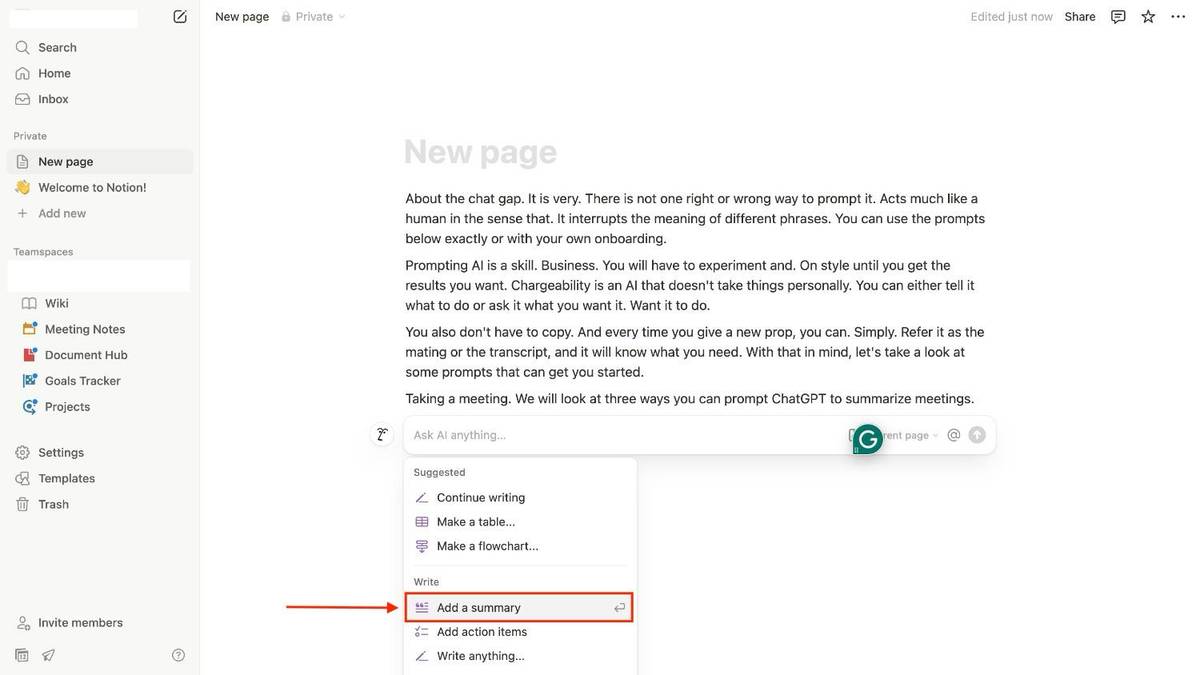
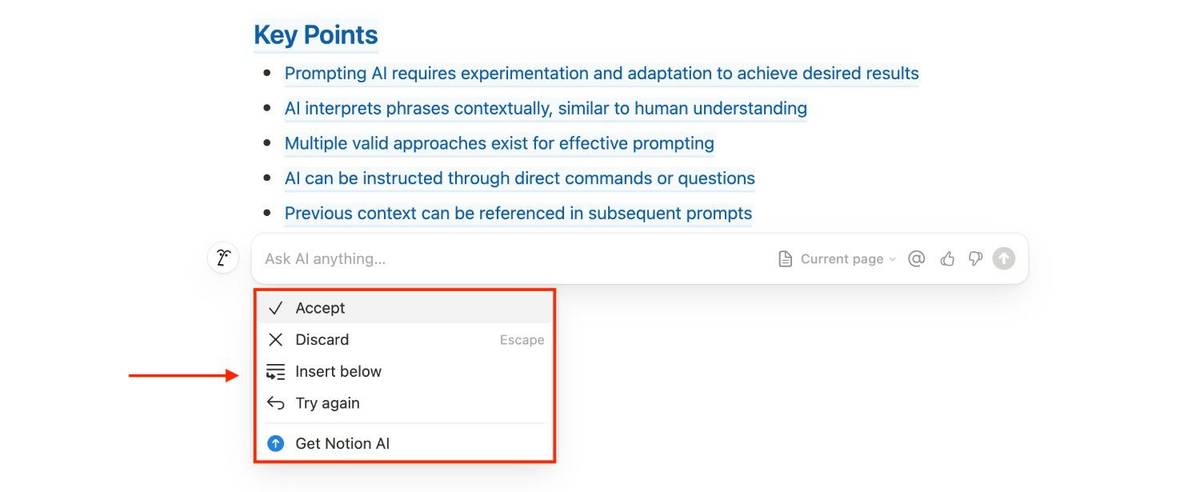
Notion will then try to create a meeting summary. You can use the built-in editing tools to customize the transcript or add specific details.
#3 Notta automated AI transcription and summarization
With this method, we will use Notta to record and transcribe meeting minutes on a Zoom meeting in real-time. Unlike other tools, Notta is designed specifically for meetings, so it can extract key points and identify action items with a better understanding of context and relevance.
It includes features like speaker identification, multi-language transcription, and real-time translation, making it the preferred note-taking app for professionals worldwide.
Notta also integrates with other apps like Slack, Google Meet, and Notion. These features help you turn meeting notes into shareable insights and keep everyone on the same page.
You can also sync your calendar to the platform’s AI assistant. The Notta bot will automatically join the meeting and handle all of the note-taking for you.
Here's how to use Notta’s built-in AI feature to take notes of your meeting.
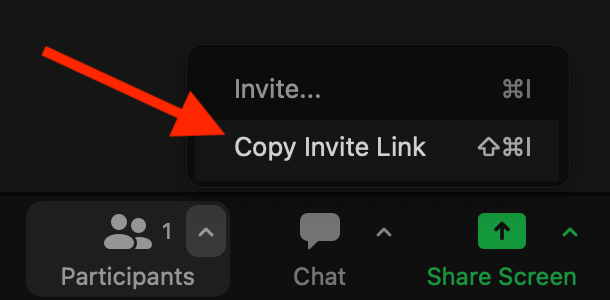
Step 1: Host or join a Zoom meeting. Click ‘Participants’ on the toolbar at the bottom, then click ‘Copy Invite Link.’
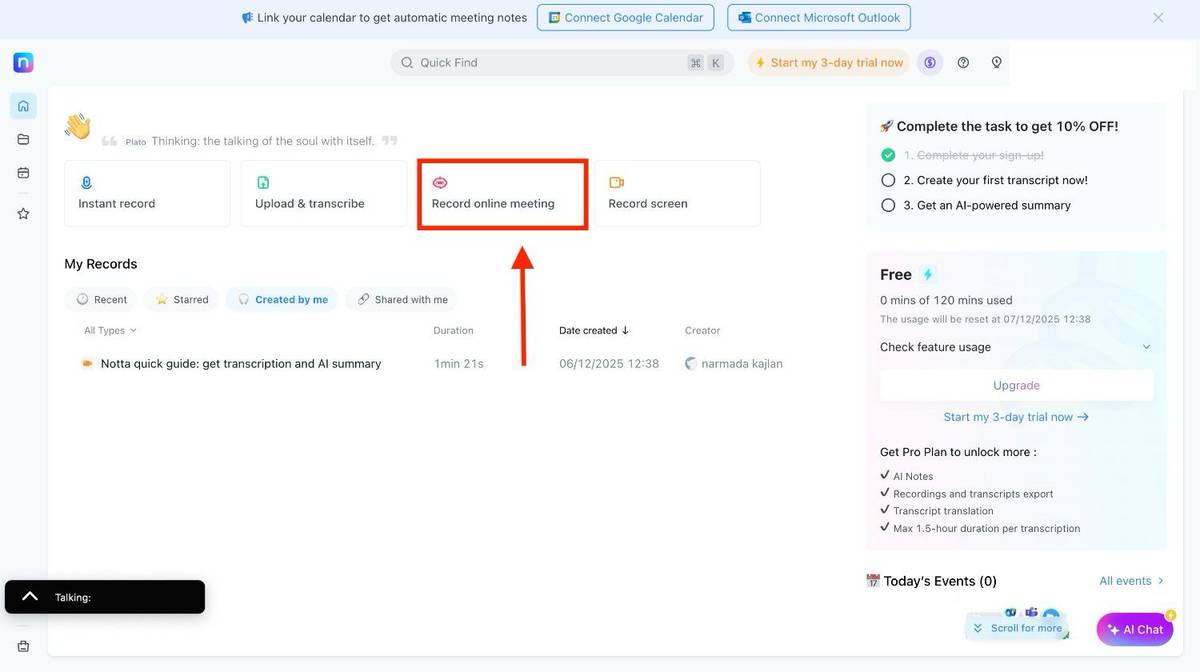
Step 2: Log in to your Notta Dashboard. Click “Record online meeting” in the top middle section of the screen.
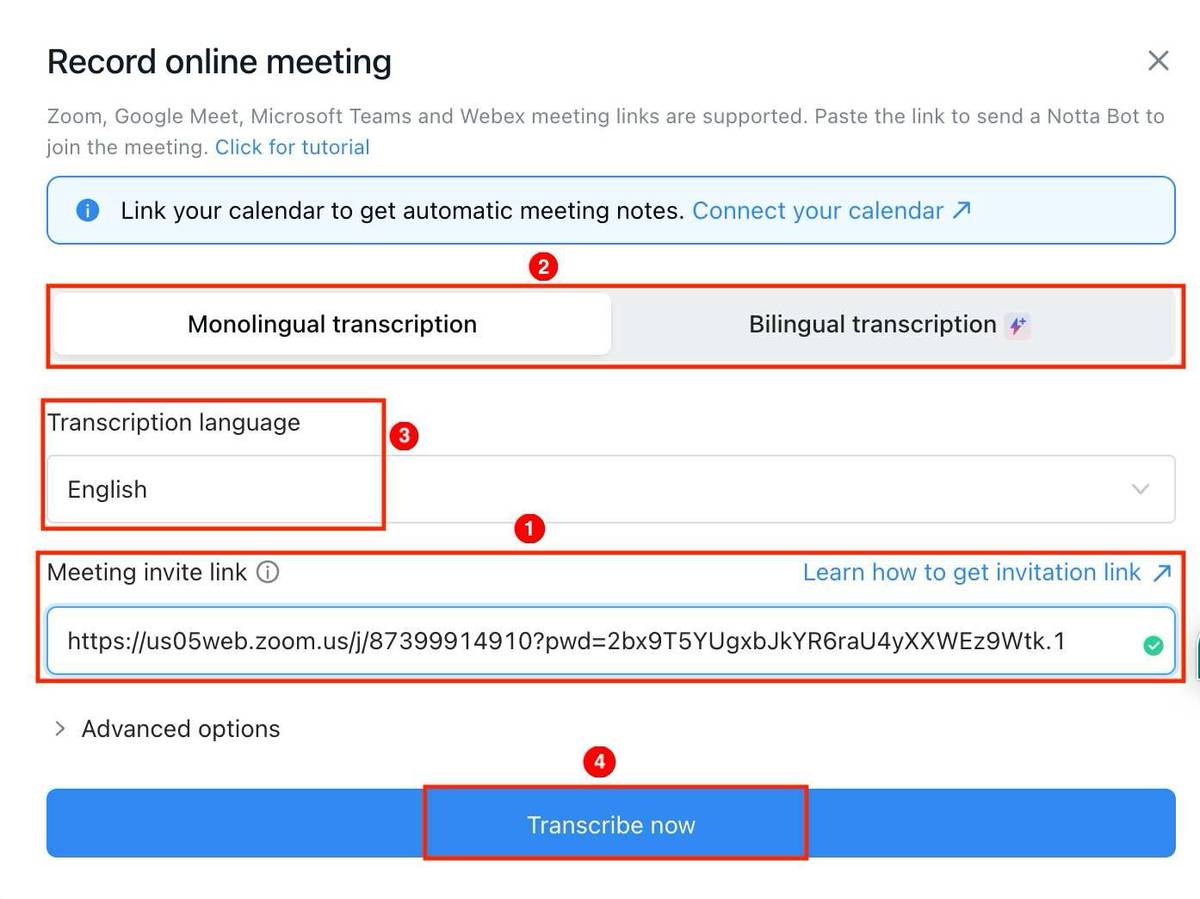
Step 3: Paste your meeting link under “Meeting Invite Link.” Select monolingual or bilingual transcription, select your transcription language, and name your robot. Then click “Transcribe Now.”
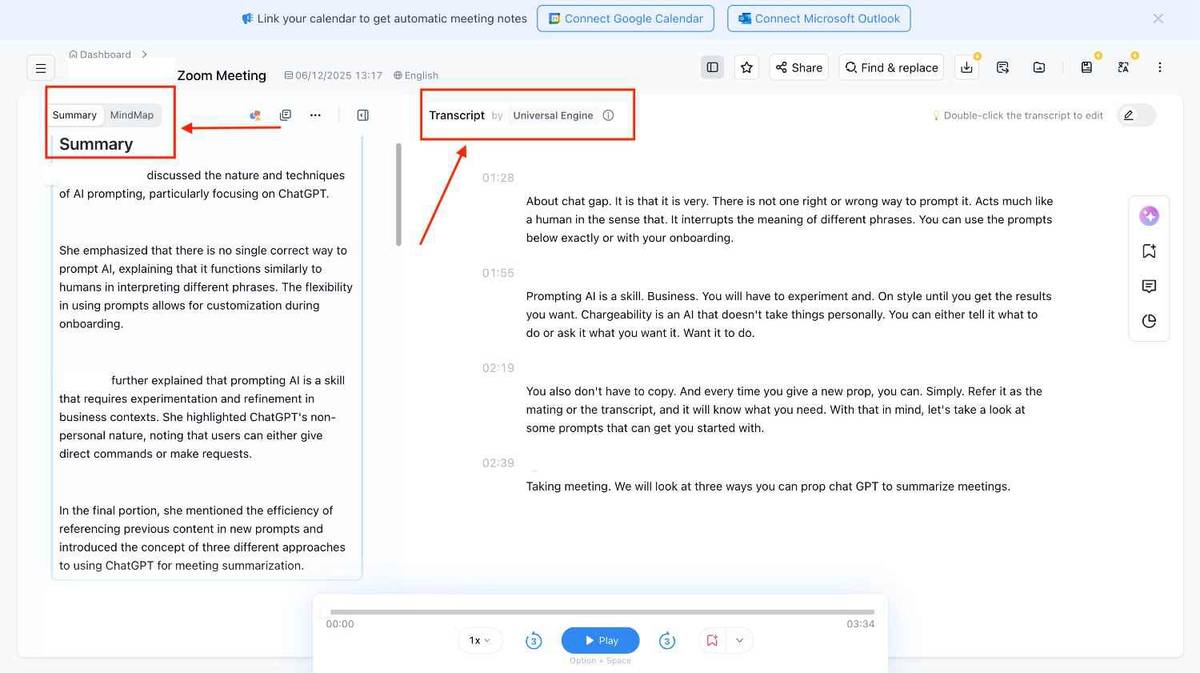
Step 4: After the meeting ends, visit your Notta dashboard and open your transcript. You'll see the meeting transcript with a summary on the left side.
Notta: The best ChatGPT alternative for meeting notes
Notta is the best all-in-one solution for taking meeting notes. You don't have to worry about paying for multiple subscriptions to record, transcribe, and summarize. All these features are built into Notta.
It's also incredibly simple to use. Notta makes it easy to send a bot to the meeting, transcribe it, and highlight the insights you need.
Imagine you're in the middle of a meeting and can't take detailed notes because you're playing an active role. With Notta, you will get a neatly formatted meeting transcript, with speaker identification and a quick summary. If you want Notta to generate a specific type of summary, you can select an option from the template library or use a custom prompt.
There’s no need to install any software. Notta is a web-based platform with top security protocols from Amazon Web Services’ RDP S3 servers.
There are multiple ways to generate meeting notes with Notta:
Upload the recording to Notta, and it will transcribe it for you. Then you can generate an AI summary using any template you choose.
Send a Notta robot to the virtual meeting to record and transcribe it in real-time. Use the AI notes feature to generate detailed notes afterward.
Record an in-person meeting using a microphone connected to Notta. It will record and transcribe the meeting in real-time. Then, generate a summary using Notta AI.
With Notta’s default template, you get a one-paragraph summary and a full breakdown of each topic with chapters. This feature divides the transcript into short chapters that you can skim through easily.
Final thoughts
There are many powerful and intuitive ways to take meeting notes today. ChatGPT is a new and exciting method to summarize your meeting transcript in a few seconds.
ChatGPT is good at summarizing, but it's not a note-taking app. It can’t join or record meetings, sync across calendars, or generate speaker labels. If you just need to summarize, ChatGPT is fine.
But if you want to automate your note-taking (and actually participate in key meetings), you need Notta AI. It’s an affordable solution that records, transcribes, and summarizes your meetings. Sign up for your free account today!
FAQs
Can ChatGPT transcribe audio?
Yes, ChatGPT can transcribe audio, but only with paid plans. OpenAI also offers another AI model called Whisper that can transcribe audio, but it requires programming. If you don’t want to deal with code, you can use speech-to-text applications that already include Whisper to transcribe audio.
How do I use ChatGPT for meeting summaries?
Here’s how to generate a meeting summary with ChatGPT:
Step 1: Sign up or log in to your OpenAI account.
Step 2: Start a New Chat. In the “Message ChatGPT” field, type “Give me a meeting summary for this transcript:”
Step 3: Copy and paste your full transcript and press Enter. ChatGPT will create a summary based on the main ideas in the transcript.
How do I use ChatGPT for note-taking?
ChatGPT is not a note-taking app. But if you have a block of text like a long transcript from a meeting or lecture, you can ask ChatGPT to generate notes about it. Here’s how to use ChatGPT for note-taking:
Step 1: Start a New Chat in ChatGPT.
Step 2: Paste in the information you want to summarize.
Step 3: Type “Summarize this transcript for me,” and press Enter.
How do you write a good meeting memo?
A good meeting memo clearly and quickly states:
Who will be at the meeting
What the meeting is about
Where the meeting will take place
When the meeting will happen
Why the meeting is important
How you should prepare for the meeting
What is the best format for meeting notes?
The best format for meeting notes lets you and others quickly learn what the meeting covered. One of the best formats for this is called the “Quadrant method.”
This involves splitting a blank page into four quadrants:
General meeting notes
Questions
Action items for you
Action items for others on the team
This allows you to identify what is important after each meeting.

