
HR Meeting Guide: Key Objectives, Agenda Ideas, and Best Practices
Saving time and effort with Notta, starting from today!
HR meetings serve as a bridge between employees and the organization, often involving discussions around employee rights, confidentiality, and company policies. These meetings are necessary, but it’s challenging to find the perfect balance between employee and company interests.
Whether you're an employee with questions about an upcoming meeting or an HR manager looking for a little help, this guide gives you practical advice for better HR meetings.
What is an HR Meeting?
An HR (Human Resources) meeting is a formal conversation between an employee and HR or management that focuses on topics like performance, policies, development, workplace concerns, or employment changes. These meetings document decisions, protect employee rights, and ensure the company applies its policies consistently.
How Do HR Meetings Differ From Standard Meetings?
HR meetings differ from standard meetings because they address employment matters rather than projects or deliverables. They follow defined policies, require careful documentation, and often involve sensitive topics like employee performance, conduct, benefits, and compliance.
What are the Most Common Types of HR Meetings?
The most common types of HR meetings include: recruitment and onboarding meetings, benefits enrollment sessions, training and development discussions, health and safety briefings, performance reviews, return-to-work interviews, disciplinary meetings, and exit interviews.
Each meeting type has a clear purpose, from evaluating candidates and onboarding new hires to setting expectations, reviewing progress, and documenting outcomes. Here's a closer look at how they compare:
| Meeting Type | Primary Purpose | Typical Duration | Documentation Level | Frequency/ Timing |
|---|---|---|---|---|
| Recruitment & Onboarding | Candidate evaluation, new hire integration | 30-60 min | Standard notes | As needed during the hiring process |
| Benefits Enrollment | Plan selection, coverage decisions | 20-30 min | Signed election forms | During onboarding and once per year during open enrollment |
| Training & Development | Skill building, career growth | 60-120 min | Attendance & completion records | Periodic; quarterly, annually, or when new skills or systems are introduced |
| Health & Safety | Risk prevention, compliance training | 30-45 min | Safety certifications | Regularly scheduled (quarterly or annually) and after incidents or policy updates |
| Performance Review | Work evaluation, goal setting | 45-60 min | Formal review documents | Scheduled cycles (quarterly, biannual, or annual) |
| Return-to-Work | Reintegration planning, accommodations | 30-45 min | Accommodation agreements | After extended leave, illness, injury, or parental leave |
| Disciplinary | Policy violation, corrective action | 30-60 min | Written warnings, performance improvement plans (PIPs) | As needed when policy or conduct issues arise |
| Exit Interview | Departure feedback, knowledge transfer | 30-45 min | Exit survey, final paperwork | Once, during the offboarding process |
These eight meeting types span the full employee lifecycle. Recruitment and onboarding meetings start the relationship, while training, development, and performance reviews support growth and alignment over time. Health and safety meetings address compliance, disciplinary meetings manage issues, and exit interviews close the cycle while informing future improvements.
What are Recruitment and Onboarding Meetings?
Recruitment and onboarding meetings define job expectations and responsibilities early. Recruitment interviews evaluate a candidate’s skills, goals, and priorities to see if they match the role. These meetings cover the job interview process, skill assessments, and discussions of responsibilities, compensation, and company culture.
Onboarding meetings take place after hiring and help new employees integrate into the company. They introduce new hires to company policies and expectations so employees have a better understanding of their roles and responsibilities.
What are Benefits Enrollment Meetings?
A benefits enrollment meeting helps employees understand and select their workplace benefits during onboarding or annual enrollment periods. These meetings explain available options, costs, and deadlines so employees can make informed decisions.
For example, a benefits enrollment meeting might cover health insurance plans, explain the difference between an HMO and a PPO, and outline employer retirement contributions, such as 401(k) matching.
What are Training and Development Sessions?
Training and development sessions support employee development by building the skills they need to perform and grow in their roles. Unlike onboarding meetings, which introduce company policies and expectations, these sessions emphasize practical knowledge and long-term development.
Employee training includes learning new software, improving customer communication, developing leadership and career progression skills, etc.
Research by Devlin Peck shows that strong training programs correlate with a 17% increase in productivity and a 21% increase in profitability, while 92% of employees say workplace training positively affects their engagement.
What are Health and Safety Meetings?
Health and safety meetings protect employees from workplace risks and ensure compliance with safety regulations. They address topics like hazard prevention, emergency procedures, equipment use, and incident reporting.
For context, there were over 2.5 million non-fatal workplace accidents in the US in 2024, according to the U.S. Department of Labor. This number highlights the scale of workplace safety challenges and the importance of timely health and safety meetings.
What are Performance Review Meetings?
Performance review meetings evaluate an employee’s work over a set period and provide structured feedback. Managers discuss achievements, challenges, and areas for improvement while aligning expectations for the next review.
Unlike informal check-ins, performance reviews influence pay changes, promotions, or development decisions.
Most companies run performance reviews on a regular schedule, typically quarterly, biannually, or annually, alongside compensation or promotion cycles.
What are Return-to-Work Interviews?
Return-to-work interviews are meetings with employees coming back from extended leave, such as illness, injury, or parental leave. They cover how the employee is feeling about returning, what support or adjustments they need, and any changes that happened while they were away.
What are Disciplinary and Conduct Meetings?
Disciplinary and conduct meetings deal with behavior issues, policy violations, or repeated performance concerns. Their purpose is to document what happened, clarify expectations, and explain next steps if the issue continues.
For example, HR may introduce a Corrective Action Plan or a Performance Improvement Plan (PIP) to document expectations and set a timeline for review.
Disciplinary meetings carry legal implications and often involve strong emotions. As a result, all participants must engage with respect and professionalism to support a constructive outcome.
What are Exit Interviews?
Exit interviews take place when an employee leaves the organization and focus on gathering honest feedback about their experience. Employers ask about reasons for leaving, management practices, and workplace culture to identify patterns or issues.
Exit interview insights shape retention strategies, policy changes, and leadership decisions.
What are the Key Objectives of an HR Meeting?
There are three key objectives of an HR meeting: documentation, alignment, and compliance.
Documentation objectives. Meetings are official records of decisions, discussions, and issues that protect both employees and the organization in case of disputes.
Alignment objectives. HR meetings ensure employees understand expectations, policies, and available resources to prevent confusion.
Compliance objectives. Meetings must fulfill legal and regulatory requirements for employee communication, policy enforcement, and workplace safety.
Overall, HR meetings aim to keep employees aligned with company policies and expectations, with documentation in place to support legal protection.
How Do You Create an HR Meeting Agenda?
Create an HR meeting agenda based on the meeting type and the goal you need to achieve. You won’t use the same agenda for every meeting, because each situation requires different documentation depending on the context.
Start by defining the meeting's purpose and outlining relevant policies to ensure the employee understands their rights and expectations. Leave time for employee questions to encourage open discussion. End the agenda with clear next steps, such as action items or follow-up tasks.
With these general principles in mind, let's examine three specific HR meeting agendas for different situations.
HR Meeting Agenda Example: What Does a Standard 1-on-1 HR Meeting Look Like?
A standard 1-on-1 HR meeting follows a structured 30-45 minute format covering performance review, career development, and workplace concerns. HR opens with a casual check-in, reviews recent work, discusses professional goals, addresses any issues, covers administrative items, and closes with documented action items
Meeting Duration: 30-45 minutes
| Time | Topic | Description |
|---|---|---|
| 5 min | Opening & Check-In | • Casual conversation to build rapport • Ask how they're doing personally and professionally |
| 10 min | Performance & Progress | • Review recent accomplishments • Discuss current projects and workload • Address any performance concerns |
| 10 min | Career Development | • Discuss professional goals • Identify skill development opportunities • Review training needs or interests |
| 5 min | Workplace Concerns | • Open forum for any issues or questions • Address team dynamics or work environment • Discuss work-life balance |
| 5 min | Benefits & Administrative | • Review benefits utilization • Update personal information if needed • Address policy questions |
| 5 min | Action Items & Next Steps | • Summarize key takeaways • Document agreed-upon actions • Schedule follow-up if needed |
HR Meeting Agenda Example: How Do You Structure a Disciplinary HR Meeting?
A disciplinary HR meeting follows a clear, formal structure and typically lasts 30 to 60 minutes. The discussion presents the issue, gives space for employee response, reviews context, sets a corrective plan, and ends with documented acknowledgment of outcomes so both HR and employees have a shared record of decisions and next steps.
Meeting Duration: 30-60 minutes
| Time | Topic | Description |
|---|---|---|
| 3 min | Meeting Purpose | • State the formal nature of the meeting • Confirm attendees (manager, HR, employee, witness if applicable) • Explain documentation process |
| 10 min | Issue Presentation | • Present specific facts about the violation/concern • Reference relevant policies and dates • Provide examples with documentation |
| 10 min | Employee Response | • Allow employee to share their perspective • Ask clarifying questions • Listen without interruption |
| 10 min | Discussion & Context | • Review previous warnings or incidents (if any) • Discuss impact on team/organization • Address any mitigating circumstances |
| 10 min | Action Plan & Consequences | • Present corrective action plan • Outline specific behavioral expectations • Explain consequences of future violations • Set review timeline |
| 10 min | Documentation & Next Steps | • Review written warning or PIP document • Obtain employee signature/acknowledgment • Provide copies of all documentation • Schedule follow-up meeting |
| 5 min | Questions & Closing | • Answer any questions • Reiterate support for improvement • Confirm understanding of next steps |
HR Meeting Agenda Example: Key Topics for Monthly HR Department Updates
Monthly HR department updates typically run 60 minutes. They review recruitment metrics, employee relations trends, compliance updates, and benefits administration. A structured agenda checks the hiring pipeline, workplace concerns, and policy changes, then assigns ownership of follow-up tasks to keep HR initiatives on track.
Meeting Duration: 60 minutes
| Time | Topic | Description |
|---|---|---|
| 5 min | Welcome & Agenda Review | • Review meeting objectives • Highlight priority topics |
| 10 min | Recruitment & Hiring Updates | • New positions approved/filled • Pipeline status and hiring metrics • Offer acceptance rates and time-to-fill |
| 10 min | Employee Relations | • Recent concerns or trends • Exit interview insights • Engagement survey results (if applicable) |
| 10 min | Compliance & Policy Updates | • New regulations or legal requirements • Policy changes or reminders • Required training completions |
| 10 min | Benefits & Compensation | • Enrollment updates • Benefits utilization trends • Upcoming renewals or changes |
| 5 min | Learning & Development | • Training program updates • Professional development initiatives • Upcoming workshops or events |
| 5 min | Key Metrics Review | • Headcount and turnover rates • Time-off balances and trends • Budget status |
| 5 min | Action Items & Next Steps | • Assign follow-up tasks • Set deadlines for initiatives • Schedule next meeting |
What are Best Practices for HR Meeting Agendas?
When planning your next HR meeting, keep these tips in mind:
Always send agendas 24-48 hours in advance
Keep meetings on schedule, but allow flexibility for important discussions
Document all meetings, especially disciplinary ones
Follow up with written summaries for formal meetings
Should Employees Have Their Own Agenda Items for an HR Meeting?
Yes, employees should have their own agenda items for an HR meeting, and managers should actively make space for them.
If you're planning an HR meeting, you should clearly communicate that employees can raise questions or concerns and should build time into the agenda for that discussion. Meetings are more productive and less one-sided when managers openly invite employee input.
As an employee, you should think ahead about what you want to discuss, bring notes or examples, and raise issues clearly and calmly. Coming prepared ensures important topics don’t get lost and that the meeting addresses both organizational and individual needs.
What are Best Practices for a Human Resources Meeting?
Best practices for HR meetings focus on alignment, confidentiality, and follow-through. HR managers should protect employee privacy, document discussions, handle emotional situations professionally, and leave every meeting with clear next steps.
AI note-taking software reduces administrative burden and helps HR professionals stay fully present, without sacrificing the accuracy or compliance of their meeting notes.
How Can HR Managers Ensure Confidentiality and Privacy?
HR managers protect confidentiality by handling sensitive information with care, limiting access to those who need it, and following company policies and legal requirements. Secure record storage, clear documentation, and transparent communication with employees help prevent unintentional disclosure. Open communication around what information remains private and what may be shared builds trust.
Should You Take Notes During an HR Meeting?
You should take notes during an HR meeting to create a record of discussions, decisions, and next steps. Notes reduce misunderstandings and protect both HR managers and employees if questions arise later. AI notetakers like Notta automatically record and transcribe HR meetings, allowing everyone to focus on the conversation instead of manual note-taking.
Note: Always get permission from all participants before recording, and follow company policy and local laws.
How Should HR Professionals Handle Emotional or Hostile Reactions?
HR professionals need to manage emotional reactions carefully to keep conversations productive.
As Andrea Lee, CEO of Thought Partners International and author of We Need to Talk: Your Guide to Challenging Business Conversations, explains:
“Too many challenging conversations happen with emotions being expressed inside the conversations, where they disrupt the outcomes. Emotions cloud us, we become unclear about what we want, so the conversations become a massive fumbling in the dark.”
To counteract high emotions, she recommends that HR managers ask themselves:
“Where are we now?”
“Where are we going?”
“How would we like to get there?”
These questions help slow the conversation, acknowledge emotions without escalating them, and refocus the discussion on facts and next steps.
How Important are Follow-Ups and Action Plans?
Follow-ups and action plans are important because HR meetings involve decisions that affect performance, compliance, or employee well-being. Vague expectations cause issues to resurface in future meetings without documented next steps.
A strong action plan follows the 4–5 W rule:
What: Define the specific task or outcome, such as completing training or reviewing a policy
Who: Assign clear ownership so everyone knows who is responsible
When: Set realistic deadlines or checkpoints
How: Note any tools, resources, or support required
Why: Restate the purpose, such as improving performance or resolving an issue
How Can AI Tools Streamline HR Meeting Management?
AI Tools streamline HR meeting management by reducing administrative load and letting managers and employees stay fully present in the conversation.
Notta records HR meetings, generates transcripts with up to 98.86% accuracy, and creates structured notes. AI summaries highlight key decisions and next steps, while automated action items and follow-up tasks reduce manual tracking after the meeting.
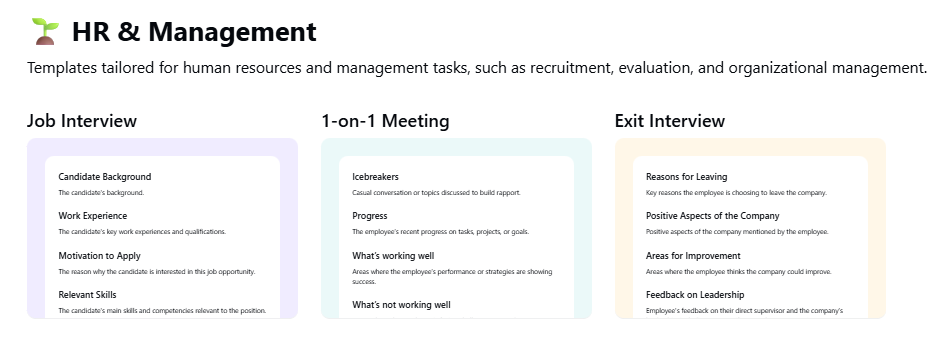
On top of that, Notta provides prebuilt HR meeting templates for job interviews, 1-on-1s, and exit interviews, so your notes are structured and consistent. You can also create custom templates.
Notta integrates with popular tools HR teams use, including video conferencing platforms, Google Calendar, Outlook, Slack, and Zapier for connecting with HR management software. These integrations help centralize recordings and documentation across teams.
Can You Record an HR Meeting with Notta?
Yes, you can record an HR meeting with Notta, both online and in-person. It automatically joins calls on Teams, Zoom, and Google Meet, and records face-to-face conversations through the Notta mobile app or Notta Memo device.
Recording an HR meeting helps managers capture decisions, commitments, and next steps accurately, without relying on memory or rushed notes. Employees receive a clear summary they can review later, reducing misunderstandings and eliminating “he said, she said” moments. Recording creates a shared source of truth that both sides can reference later.
Sign up for Notta today and walk out of your next HR meeting with recordings, transcripts, and automated notes to support every decision.
Frequently Asked Questions About HR Meetings
Can I refuse to attend a meeting with HR?
No, you can’t refuse to attend a meeting with HR directly, but you can ask to reschedule. HR meetings are mandatory, and refusing to attend may be considered insubordination and could result in disciplinary action.
Can I bring a witness or support to my HR meeting?
Yes, you may bring a witness or support to your HR meeting, depending on company policy and the type of meeting. Some organizations allow a union representative, colleague, or support person for disciplinary or formal meetings. Always check the employee handbook or ask HR in advance about your company policies.
Are HR meetings confidential?
HR meetings aren’t totally confidential. HR protects sensitive information such as medical details, personal records, and investigation materials, but shares other relevant information internally when company policy or legal obligations require it.
How long does a typical HR meeting last?
A typical HR meeting lasts 30 to 60 minutes, depending on the topic and complexity. Policy updates and benefits discussions typically average 30 minutes, while performance reviews, disciplinary meetings, or investigations require more time for documentation, questions, and next steps.
Do I have the right to record an HR meeting?
Whether you have the right to record an HR meeting depends on your local laws. In one-party consent regions, you can legally record a conversation you’re part of without informing others. However, even if recording is legal, it may violate company policy and result in termination.
How do I protect myself in an HR meeting?
Protect yourself in an HR meeting by coming prepared with relevant documents, notes, and a clear understanding of company policies. Stay calm, ask clarifying questions, and take notes so you have an accurate record of what you discussed with HR. After the meeting, send a brief recap to confirm next steps and decisions.

