

How Many Uber Drivers in USA 2026 | Uber Stats
Record, transcribe and summarize conversations with one click.
As of late 2025, there are approximately 1 million active Uber drivers in the United States, with California accounting for around 209,000 of those and New York City adding another 80,000. During peak periods, the active figure can climb to between 1 and 2.5 million as part-time drivers come online. Globally, Uber's driver and courier base has grown to 8.8 million across 72 countries.
Beyond the driver count, the numbers that define Uber's scale go well beyond any single statistic. Below are 40+ Uber statistics covering its full driver base, rider demographics, revenue, market share, and future direction all sourced from Uber's own financial reports, investor filings, and third-party research.
Uber stats (top picks)
Uber has 180 million monthly active users worldwide as of 2025, a 15% year-over-year increase.
8.8 million drivers and couriers work on the Uber platform globally as of Q2 2025.
Uber generated $43.97 billion in total revenue in 2024, an 18% year-over-year increase from 2023.
Drivers completed 11.27 billion trips on Uber in 2024, a 19% year-over-year increase.
Uber holds 74% of the US ride-hailing market, with Lyft accounting for the remaining 26%.
Uber recorded $46.7 billion in gross bookings in Q2 2025 alone.
Uber posted a net profit of $9.8 billion in 2024, up from $1.8 billion in 2023.
Overview of Uber’s growth and expansion
How big is Uber as a company? The statistics in the two sections below offer key insights into some of its early milestones and revenue.
Early milestones and global reach
The data below offers some key insights into when Uber was founded and its early milestones.
Uber was founded in 2009 as UberCab, and its shift into the traditional cab services market sparked several legal conflicts.
Its consistent growth over the years led to about 150 million monthly active users as of the fourth quarter of 2023.
By 2023, it had carried out 9.4 billion trips and operated in 70 countries around the world.
Sources: Statista
Revenue and valuation trends
The data below shows how much data Uber generates every year.
In 2023, Uber had generated $37 billion in net revenue.
According to Uber’s financial reports, the mobility segment of its business generated $18.18 billion in just the first nine months of 2024.
Uber's revenue in Q3 of 2024 amounted to $6.41 billion.
The annual revenue of its mobility segment in 2016 amounted to $3 billion and consistently rose each year. However, 2020 and 2021 were poorer years for the company as a result of the COVID-19 pandemic. In 2020, it generated a revenue of $6.09 billion, and this rose to $6.95 billion in 2021. However, its revenue in 2019 was $10.7 billion, significantly higher than the next two years.
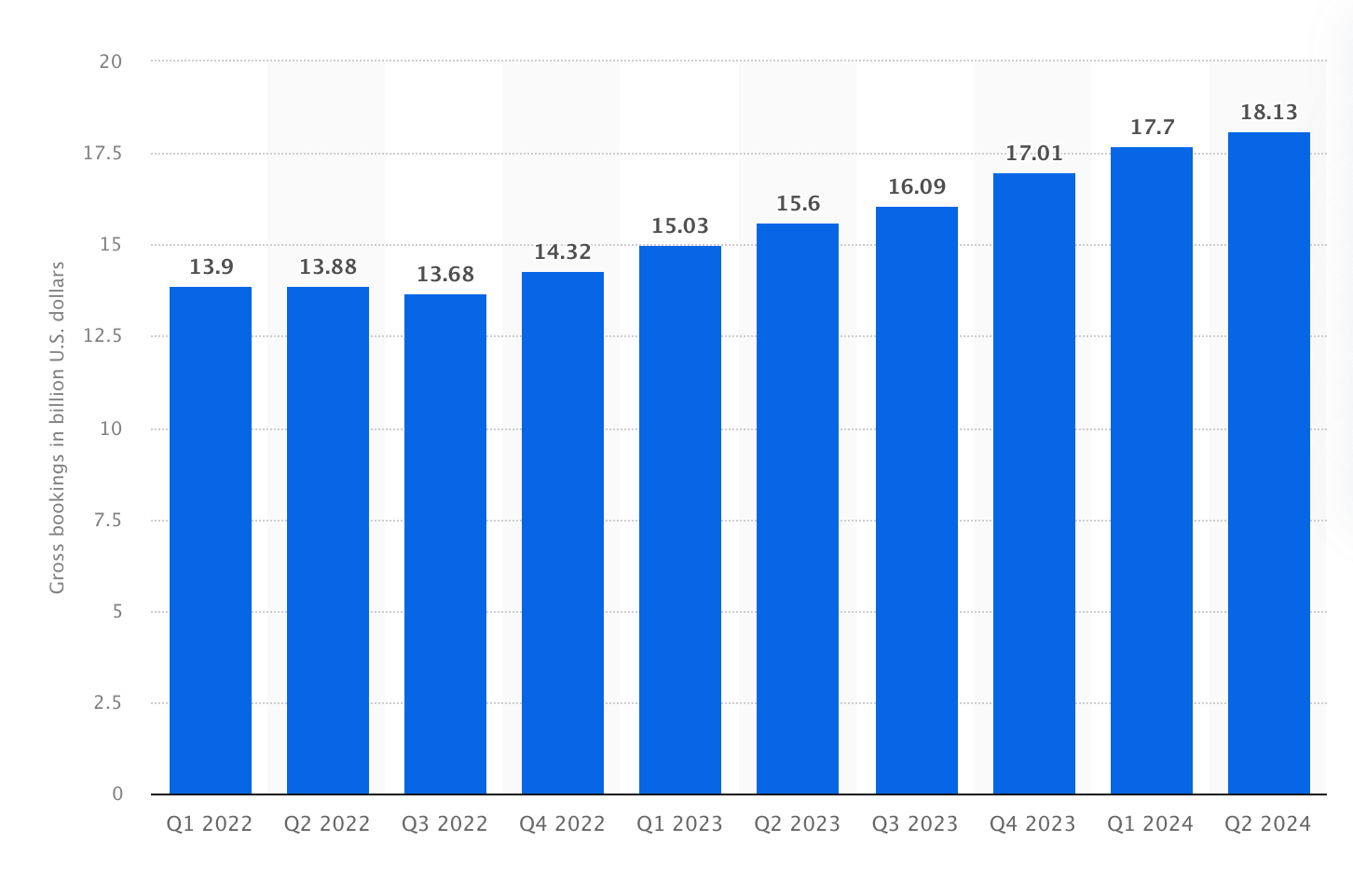
Uber’s delivery wing, Uber Eats, saw gross bookings of more than $18.1 billion during the second quarter of 2024, an increase from $13.9 billion in the first quarter of 2022.
 Sources: Statista, Uber, Statista
Uber user demographics and engagement
Uber’s user base is a key piece of the puzzle in understanding the company's scale and growth over the years. The next two sections offer key details about its user base, demographics, and behavior.
Number of active users worldwide
The data below offers key insights into how many people use Uber worldwide.
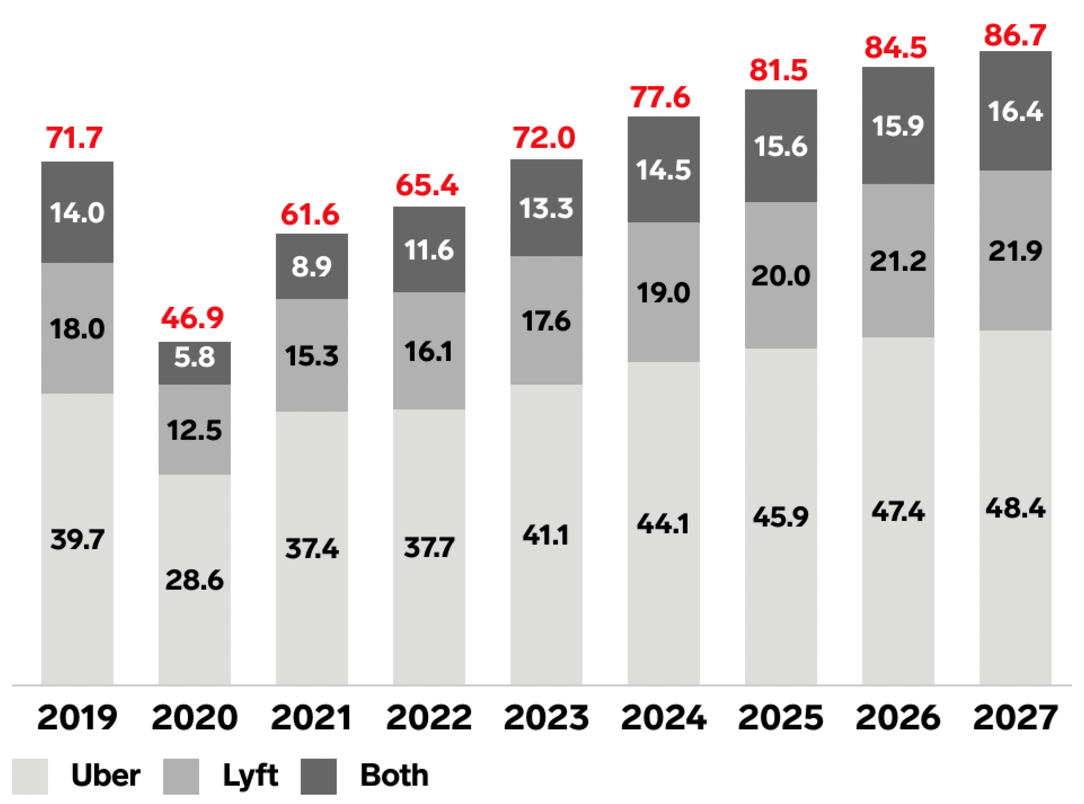
According to data by eMarketer, Uber had 58.6 million users in the US alone in 2024, up from 54.4 million in 2023.
Uber has a much higher user base and market share in the US online transportation market compared to Lyft.
As of 2024, Uber has 44.1 million users, while Lyft’s user base is much lower at 19 million.
According to Uber, the US contributed the most revenue in 2023, at $18.62, whereas the UK contributed $6.52 billion. All the other countries combined contributed $12.14 billion in the same year.
 Sources:
Rider behavior and usage trends
What are some of the key trends among riders and how they use Uber’s services? Here is what you need to know.
According to Uber’s SEC reports from 2019, 24% of the total Uber rides worldwide were booked in New York, Los Angeles, San Francisco, London, and Sao Paulo.
According to GWI, 8% of online adults were using Uber at least once a month.
Those between the ages of 16 and 34 are the segment that uses Uber the most.
Uber drivers: Statistics and insights
How Much Do Uber Drivers Earn?
A Stanford University study remains the most comprehensive independent analysis of Uber driver pay. Its key findings on hourly earnings:
Male Uber drivers earn an average of $21.28 per hour
Female Uber drivers earn an average of $20.04 per hour
Male drivers work an average of 17.98 hours per week, generating weekly earnings of approximately $397
Female drivers average 12.82 hours per week, generating approximately $268 per week
The hourly gap — roughly $1.24 — reflects a combination of route selection, time-of-day preferences, and acceptance rate differences rather than any direct pay discrimination, since Uber's algorithm applies the same fare structure to all drivers.
Looking at monthly earnings, the picture is stark for a significant portion of the driver base. Approximately 45% of Uber drivers earn between $0 and $99 per month, while 39% earn between $100 and $499. Only 2% reach $1,500 to $1,999 per month. These figures suggest that for many drivers, Uber functions as a supplemental income stream rather than a primary one.
Uber Driver Gender Breakdown
The Stanford study — which analysed data from 1.87 million drivers between 2015 and 2017 — found that approximately 27% of US Uber drivers are women. That means roughly 73% are male. The pay gap between male and female drivers is primarily explained by hours worked and the types of trips accepted, but the study also found that women have a higher attrition rate: 68.1% of all drivers quit within six months, with women more likely to leave the platform early than men.
Uber Driver Age and Race Demographics
Based on a 2015 Uber study of its driver-partner base:
19% of drivers were under the age of 30 at the time
24.5% were aged 50 or older — notably younger than the taxi and chauffeur industry, where 44% were over 50
In terms of race and ethnicity: 40.3% were white non-Hispanic, 19.5% were Black non-Hispanic, and 16.5% were Asian non-Hispanic
36.9% held college degrees, and 10.8% had postgraduate qualifications
7.0% of drivers were veterans
Driver Churn and Retention
Uber has a well-documented retention problem. Roughly half of all drivers quit within one year, and Stanford's analysis found that 68.1% leave within six months. The churn is partly structural: many drivers join the platform while between jobs or pursuing short-term financial goals, then exit once those goals are met. Others burn out from the demands of the gig economy or find that earnings fall below expectations once fuel, maintenance, and platform fees are factored in.
The pandemic accelerated the churn cycle dramatically. Chicago, for example, lost more than half its pre-pandemic Uber driver population. To reverse the trend, Uber committed a $250 million driver stimulus package in 2021, using it to boost peak incentives and introduce guaranteed minimum earning rates during high-demand windows.
Sources: Uber
Uber’s financial performance and profitability
Uber has grown at a staggering rate since its founding in 2019. The sections below highlight everything you need to know about its revenue and profitability.
Revenue breakdown by segment
Here is how much Uber makes from every segment it operates in.
According to Uber’s financial reports, Uber Mobility generated a revenue of about $3 billion in 2016.
Between Q1 and Q3 2024, it generated a whopping $18.18 billion in revenue.
As of March 2024, Uber dominated the US ride-hailing market with a 76% market share.
Its market share peaked at 91% in 2015 but has declined since. This is due to other major players in the market, such as Lyft.
Uber Technologies generated an overall $31.88 billion in 2022.
Its delivery segments, Uber Eats and Uber Delivery, generated revenue of $21.2 billion in 2023, an increase from the $10.9 billion it generated in 2022.
Sources: Uber, Second Measure, Statista
Path to profitability
Here are a few insightful data points on how Uber maximizes its profits and investments in autonomous and electric vehicles.
Uber announced in August 2024 that it has partnered with Cruise to merge the company’s fleet with that of Uber. The companies plan on launching their partnership in 2025 with a number of Chevy-Bolt-based autonomous cars.
Uber has also announced that its partnership with Waymo will bring autonomous vehicles to Austin and Atlanta in 2025. Users will be able to book these vehicles via the Uber app, and the company will manage and dispatch a fleet of Waymo’s autonomous Jaguar I-Pace cars.
Uber’s market share and competitive performance
What share of the ride-hailing market does Uber dominate in the US, and what strategies has Uber adopted to stay ahead of its competitors? The next two sections offer some key insights.
Uber vs. competitors in major regions
What success does Uber enjoy when compared to its competitors in major markets across the world? Here are a few key insights.
As of March 2024, Uber dominated the US ride-hailing market with a 76% market share. Its market share peaked at 91% in 2015 but has declined since. This is due to the presence of other major players in the market, such as Lyft.
Despite the launch of Lyft in 2012, Uber continued to dominate the market with a share of 25% in 2022. Lyft, in comparison, had a share of 8% in the same period.
While North America remains its key market, it has also expanded to Europe, the Middle East, and Africa, and its revenues in these regions more than doubled between 2021 and 2022.
However, North America still accounted for 61% of the company’s global revenue in 2022.
Sources: Second Measure, Statista, Statista
Strategic initiatives to maintain dominance
While Uber has maintained its dominance in its segment, certain strategies have helped it do this. Here are a few key initiatives.
Besides offering ride-hailing and delivery services, Uber has also played a key role as an innovator. In 2019, Uber announced the idea of food delivery using drones in urban areas.
According to a report in the Wall Street Journal, Uber was looking to hire an executive to implement its drone delivery initiative.
Besides the potential use of drones, Uber’s partnerships with Waymo, Cruise, and Avride to introduce autonomous vehicles in key markets is another strategy it has deployed to stay ahead of the competition.
This is besides its existing electric fleet, which runs under the Uber Green name.
Sources: Statista, Wall Street Journal, Uber, Uber, Uber, Uber

Notta AI meeting assistant records, transcribes, and summarizes meetings so everyone can stay engaged without missing important details.
Innovations and future outlook
Besides its services, Uber has garnered the reputation of being a key innovator. This section highlights the company’s innovations in autonomous vehicles and environmental efforts.
Autonomous vehicles and AI investments
How big are Uber’s plans for leveraging autonomous vehicular technology and AI? Here’s what you need to know.
Uber’s innovations are closely linked with its strategic initiatives to maintain its dominance in the market, both in North America and the rest of the global market. Its partnerships with Cruise, Waymo, and Avride aim to introduce a fleet of autonomous vehicles in different markets, including Austin, Atlanta, Dallas, and so on.
Uber's partnership with Avride, for instance, will start with sidewalk robots on Uber Eats in Austin before it expands to Dallas and Jersey City. Customers can have their rides or deliveries managed by these sidewalk robots or an autonomous vehicle.
In fact, Avride’s robots are already making deliveries in the US and South Korea, and its autonomous cars are also being tested on public roads.
Its partnership with Waymo will expand the latter’s current operations in Phoenix to cities like Austin and Atlanta, allowing people to enjoy autonomous rides.
Sources: Uber
Environmental and sustainability efforts
As a global company, Uber has also placed great emphasis on its environmental impact and efforts to offer more sustainable solutions. The use of electric vehicles is one such example. Riders can choose to ride in a plug-in hybrid, an all-electric vehicle, or a hybrid electric vehicle, reducing emissions in the process.
Additionally, the company announced in 2020 its goal of becoming a zero-emissions mobility platform. By 2023, it had expanded this commitment to include zero-emission delivery trips and facilitated a transition to the use of more sustainable packaging options.
By 2025, the company aims to package 80% of restaurant orders with Uber Eats in recyclable materials rather than single-use plastics. By 2040, it aims to carry out 100% of its rides in zero-emission vehicles.
Sources: Uber
The bottom line
Uber has been the biggest player in the ride-hailing market for years. This guide lists 40+ Uber statistics that offer key insights into the company's various aspects. If you’re an Uber driver or someone who works at the company, Notta can help you transcribe your meetings, so you have a clear record of your action items.

