
What is a Screening Interview? Purpose, Questions, and How to Prepare
Saving time and effort with Notta, starting from today!
A screening interview is a short, 15-30-minute conversation that recruiters conduct to verify candidate qualifications before advancing them to formal interviews. During screening interviews, recruiters assess basic requirements like experience, salary expectations, and availability to filter the candidate pool efficiently and identify the most promising candidates.
This guide breaks down the screening interview from start to finish, with best practices, common questions, and smart follow-up tactics that help you stand out and move through the interview process with confidence.
What is a Screening Interview?
A screening interview is a 15-30-minute conversation during the hiring process that companies use to filter candidates and verify basic qualifications, expectations, and availability before the main interview stage.
Screening interviews are just one part of pre-employment screening, which also includes:
Application and resume screening
Aptitude tests
Personality tests
Reference checks
Background checks
What are Recruiters Looking for During a Screening Interview?
During a screening interview, recruiters are looking for personality fit, relevant experience, your core qualifications, and motivation to determine if you’re a strong candidate for the position.
They also watch for clear disqualifiers, like inconsistencies with your resume or unprofessional communication. It narrows the pool quickly and focuses on the most qualified candidates.
Who Conducts a Screening Interview?
Recruiters, talent acquisition specialists, hiring coordinators, or HR representatives conduct screening interviews to filter candidates early in the hiring process. In smaller companies, the hiring manager or an assistant handles screening instead of a recruiter.
Organizations increasingly use AI tools and chatbots to support early-stage screening and gather basic candidate information before a human steps in. A 2024 SHRM survey revealed that 64% of organizations that use AI for HR-related activities reported using it for recruiting, interviewing, and/or hiring.
Why Do Employers Use Screening Interviews?
Employers use screening interviews to confirm basic qualifications quickly and prevent unqualified candidates from advancing to time-intensive interviews. Screening saves companies significant resources, since a full interview panel involves 3-5 team members spending 60+ minutes per candidate, while screening requires just one recruiter for 20 minutes.
Screening also reduces hiring risk by catching red flags early, like unrealistic salary expectations, scheduling conflicts, missing qualifications, or communication issues. Companies use screening to keep the process consistent, so every candidate gets evaluated on the same core criteria before advancing.
Should You Discuss Salary Expectations in a Screening Interview?
Yes, you should discuss salary expectations in a screening interview. It saves you and the company time, shows professionalism, and prevents misalignment later. A recruiter often brings up compensation first. If they don't, ask directly and respectfully.
Example: “Can you share the expected compensation range for this role and the benefits structure?”
Experts at Indeed, the world’s largest job site, recommend these tips:
Research the role and current market rate for similar positions
Avoid committing to one fixed number
Provide a realistic salary range and aim toward the higher end
Ask how the company structures bonuses, equity, and benefits
However, you don’t have to discuss your salary expectations right away. If you’re not comfortable answering at this stage, politely deflect the question by saying you’ll share your expectations once you have a better understanding of the full scope of the job.
What is the Difference Between a Screening Interview and a Final Interview?
The difference between a screening interview and a final interview is timing and depth. A screening interview is short and takes place at the start of the interview process to confirm basic qualifications, expectations, and initial role fit. A final interview is more detailed, lasts longer, and evaluates your skills, communication, and readiness for the role before a hiring decision.
| Aspect | Screening Interview | Final Interview |
|---|---|---|
| Duration | 15-30 minutes | 45-90 minutes |
| Conductor | Recruiter, HR | Hiring manager, team |
| Focus | Basic qualifications | Skills, cultural fit |
| Format | Phone, video | In-person, video |
| Questions | 8-12 general | 15+ role-specific |
| Outcome | Advance/decline | Offer/decline |
What are the Most Common Screening Interview Questions?
Screening interviews include standard questions that verify the candidate meets hiring criteria. Recruiters ask about your background, motivation, salary expectations, availability, relevant experience, and career goals to decide whether to move you forward to formal interviews.
Common examples of screening interview questions include:
“Tell me about yourself.” - Checks that your background matches the role and that you can communicate clearly.
“Why are you interested in this role?” - Tests whether your interest is real or if you’re applying without much direction.
“What do you know about our company?” - Confirms you did basic research before the call.
“Why are you looking for a new opportunity?” - Looks for context and potential red flags, like unresolved conflict at your last job.
“What are your salary expectations?” - Ensures you and the company align on budget before moving forward.
“When could you start?” - Confirms that your availability and notice period fit the hiring timeline.
“What relevant experience do you have?” - Verifies your resume claims and how deep your experience actually goes.
“What are your core strengths?” - Checks self-awareness and whether your strengths match the role requirements.
Prepare for these questions with clear, concise answers that connect your experience to the role.
How Do You Prepare for a Screening Interview?
Prepare for screening interviews by covering 5 essential steps: research the company and role, review your resume thoroughly, practice common questions, prepare 4-6 questions to ask, and test technology for video interviews. Preparation takes 2-3 hours, but it significantly increases your chances of advancing to the next stage.
Review the Job Posting
Read the job posting carefully and highlight the required skills, responsibilities, and keywords. Recruiters expect you to reflect the language of the role when you explain your experience. This step helps you answer faster and connect your background to the job expectations.
Research the Company
The interviewer will likely present the company, but it’s important to have some basic knowledge. Research the company’s mission, recent announcements, product direction, and team structure, and tie that information to your experience.
Research the interviewer, too, because their position influences how you communicate. For example, an engineering manager expects more metrics and system ownership, while a recruiter focuses more on timelines, expectations, and communication style.
Review Your Resume
Go through your resume and refresh your memory on dates, skills, transitions, and key decisions. Screening interviews are fast, and recruiters expect you to recall your own timeline without hesitation.
Conduct Practice Interviews
Do short, timed practice interviews out loud to improve pacing and confidence. Practicing makes you more comfortable answering fast questions without losing structure. Ask a friend or family member to help you out, or practice by yourself. You can even hire a career coach to help you out if it’s a high-stakes job.
Take a look at our sample questions to rehearse your responses. Don’t memorize your answers. List your key talking points in bullets instead so you sound natural during the interview.
Pro tip: Record your mock interview with Notta to review your delivery. Notta also transcribes your answers so you can spot where you hesitate or lose flow.
What is the STAR Method for Screening Interview Answers?
The STAR method structures answers in four steps: Situation, Task, Action, Result. As a rule of thumb, keep your answer weighted toward what you actually did: spend about 20% on the Situation, 10% on the Task, 60% on the Action, and 10% on the Result.
The purpose of STAR is to explain a situation, your responsibility, what you did, and the result. Interviewers like it because it keeps your responses concrete and outcome-driven, and MIT’s career office teaches STAR as an effective way to organize behavioral interview responses.
It works especially well in screening because it communicates competence quickly without long explanations.
An example of a STAR answer for a software engineer:
Situation: “Our app was crashing about 12 times a day after peak traffic spikes.”
Task: “I had to reduce crashes and improve stability without delaying the release schedule.”
Action: “I optimized the memory usage, refactored the faulty module, and added automated stress tests.”
Result: “Daily crashes dropped from 12 to 1, uptime hit 99.97%, and support tickets went down by 40%.”
Prepare Your Own Questions
Prepare your own questions before the screening call, as the interview goes both ways. Asking questions helps you evaluate the role, team expectations, and growth opportunities early, and it shows you’re thinking about fit. Keep your questions simple and relevant.
Write down 4 to 6 thoughtful questions about responsibilities, success metrics, team communication, and compensation structure. This step leads directly into the examples section below, where you’ll find strong candidate questions you can ask in your own screening interview.
Sign Up for a Notta Account
Finally, sign up for a Notta account so you can record your interview, whether it’s virtual or in person. Recording the interview lets you review the questions and spot where you hesitated, so you can prepare more effectively for the next one.
Performance metrics to track:
Filler word frequency: Count instances of "um," "like," "actually," and "basically."
Answer length: Flag rambling responses longer than 90 seconds
STAR structure compliance: Verify each behavioral answer includes all four components of the STAR method
Keyword alignment: Check if your answers incorporated the job posting language
Use Notta's transcript search to find every instance where you mentioned specific skills. If 'project management' appears in the job description but you only mentioned it once in a 25-minute interview, that's a missed opportunity to strengthen your candidacy.
You’ll also get transcripts with up to 98.86% accuracy, AI-generated notes, and a clear record of your answers to strengthen your confidence and reduce mistakes in future interviews.
How Long is a Screening Interview?
Screening interviews last 15-30 minutes on average. High-volume roles require just 10-15 minutes for basic verification, while specialized positions extend to 45-60 minutes when companies need a deeper qualification assessment upfront. Technical and executive screening interviews reach 90 minutes when evaluating complex requirements.
What Questions Should You Ask in a Screening Interview?
Ask 4 to 6 thoughtful questions during a screening interview to confirm role fit and show you’re engaged in the process. Focus on responsibilities, team dynamics, success metrics, and compensation so you get the key details before you move on to formal interviews.
Here are some helpful example questions:
| Category | Question to ask | Why it matters |
|---|---|---|
| Role Clarity | "What does success look like in this role during the first 90 days?" | Reveals specific expectations and performance metrics |
| Responsibilities | "What are the core day-to-day responsibilities?" | Confirms role matches your skills and interests |
| Team Structure | "How does the team communicate and collaborate?" | Assesses work environment and culture fit |
| Growth | "What challenges do new hires typically face?" | Shows realistic job preview and support systems |
| Timeline | "What is the hiring timeline and next steps?" | Helps you plan follow-up and other opportunities |
| Compensation | "What is the salary range and benefits structure?" | Ensures budget alignment before investing more time |
What are the Biggest Screening Interview Mistakes to Avoid?
The biggest screening interview mistakes to avoid include showing up unprepared, being unpleasant, talking negatively about your past employer, and not showing curiosity about the role.
Avoid these 5 common mistakes to protect your chances of a successful screening interview and move forward faster:
Poor preparation. Don’t show up to a screening interview without researching the company, role, or values first. Be prepared to answer basic questions about your background and past experiences.
Bad first impression. Joining the call late, checking your phone, weak eye contact, or a messy appearance signal unprofessionalism. According to Psychological Science research, people make trait judgments in as little as a tenth of a second, so it’s important to make a positive first impression.
Negative communication. Criticizing previous employers or coworkers is a major interview red flag. Recruiters expect you to follow standard business etiquette, even if you had difficult experiences in your past role.
Failing to engage. Show curiosity about the role and ask relevant questions. Recruiters assume you’re not motivated or you’re applying without real interest if you don’t engage meaningfully.
Technical issues. Virtual and phone screening interviews come with unexpected technical hurdles. Test your microphone, make sure your video is clear, and take the call in a quiet, clutter-free environment.
How to Follow Up After Your Screening Interview
Follow up after your screening interview by sending a thank you to the interviewer. If you spoke to multiple interviewers, send a different note to each person instead of one message addressed to everyone.
Template e-mail:
Subject: Thank you - [Your Name] - [Position Title] Screening Interview
Hi [Interviewer Name],
Thank you again for speaking with me today about the [Role Title] position. I appreciated the chance to learn more about the team and what success looks like in the role.
Our conversation reinforced my interest in [Company Name], and I’m excited about the opportunity to contribute with my experience in [relevant skill/area].
Thanks again for your time. Please let me know if there’s anything else you need from me, and I look forward to the next steps.
Best, [Your Name]
Review your performance by asking yourself what you did well, what you weren’t prepared for, and how you can improve. Focus on patterns in your answers and don’t judge yourself too harshly.
What if You Fail Your Screening Interview?
If you fail your screening interview, don’t let it shake your confidence. Rejection is part of life, and it doesn’t define your ability to succeed. The smartest move now is to review your performance, spot the weak points, and fix them before the next call.
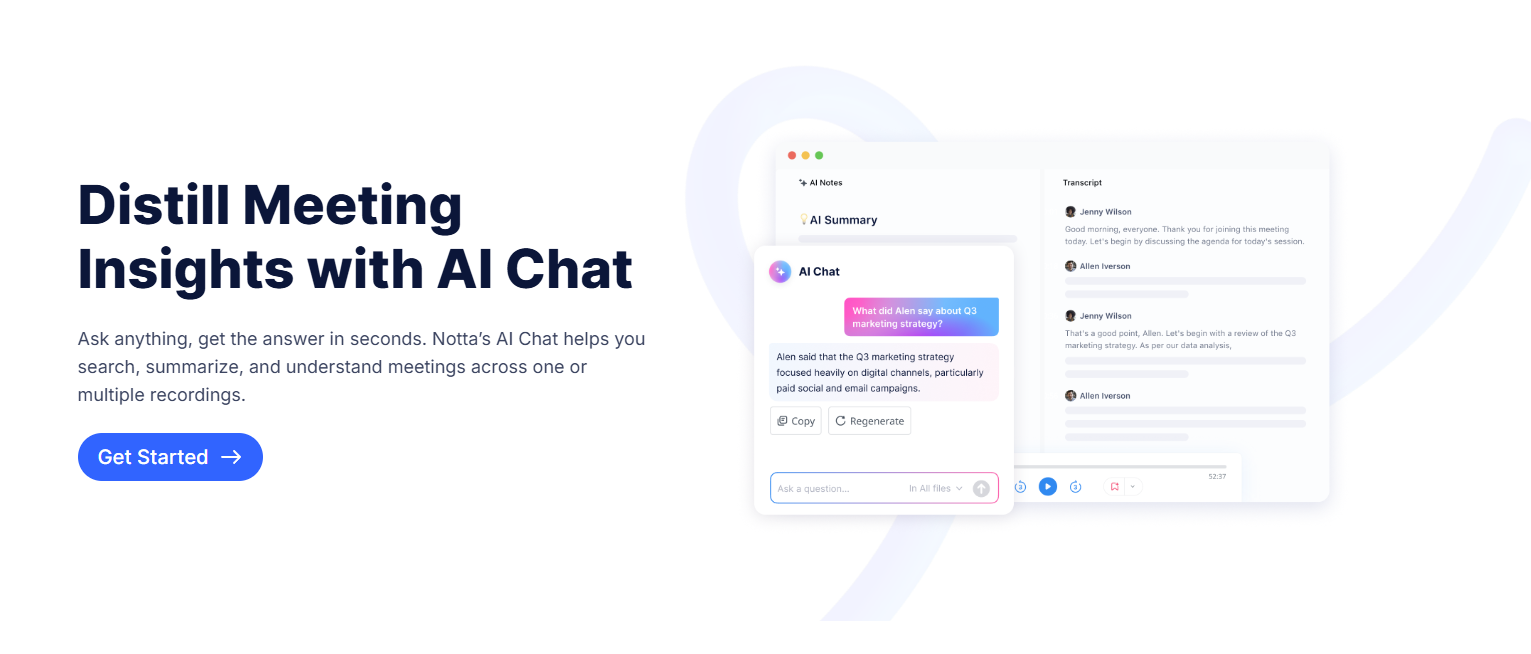
Notta helps by providing a recording and transcript you can analyze, and Notta AI Chat can suggest improvements based on your actual responses.
Can Notta Help You Pass a Screening Interview?
Notta helps you pass a screening interview by recording your practice sessions and catching the issues you miss in real time, like filler words, long-winded explanations, or unclear examples. After the practice run, skim the transcript to see which questions threw you off, where you hesitated, and whether your answers actually matched the job requirements.
Then use the transcript to improve strategically. Pull out your strongest lines, turn them into bullet talking points, and rewrite weak answers using the STAR structure so your responses sound clear and outcome-driven. You can also use Notta’s AI Chat to summarize your key points and create a quick prep sheet for the next round.
Sign up for Notta and run a practice screening interview today. Review the transcript, tighten your answers, and show up to your next call ready to move forward.
Frequently Asked Questions (FAQs)
What are common screening interview formats?
Common screening interview formats include phone, virtual, and in-person. Phone interviews are quick and less formal, while virtual ones are more interactive. In-person interviews are longer and include body language as part of the assessment.
How do you explain gaps in your resume during a screening interview?
Explain gaps in your resume during a screening interview by stating the reason briefly and confidently, without apologizing or oversharing. Mention what you did during that time to grow your skills, then refocus on your readiness for the role.
Does a screening interview mean I have the job?
No, a screening interview doesn’t mean you have the job. It means your background met the initial criteria, and the recruiter sees enough potential to move forward with your application. The next step is the full job interview, followed by the remaining stages of the hiring process.
How long should you wait after a screening interview before checking your status?
You should wait for 3-5 days after a screening interview before checking your status. If the recruiter gave you a timeline (for example, a week), wait another day or two before reaching out. Keep in mind that large companies take longer to screen than small teams.

