

AI Note Taking for Therapists: 7 Best AI Therapy Notes Apps
Saving time and effort with Notta, starting from today!
Therapists spend long hours with clients and add even more hours to paperwork. Progress notes demand careful writing, treatment summaries consume time, and compliance rules increase the workload. As a result, documentation can feel endless.
You can’t skip it, but fortunately, it doesn’t have to drain your energy. With AI note takers, it doesn’t have to. With less time on charts, you’ll have more energy for your clients, and maybe more importantly, for yourself.
In this guide, you’ll learn what AI note takers are, how to use them in a way that’s legally compliant and respectful to your clients, and which tools are the best for therapists today.
What is an AI Note Taker for Therapists?
An AI note taker for therapists analyzes sessions or summaries and generates structured notes such as SOAP, DAP, or treatment reports.
They use three core technologies to work:
Speech recognition converts audio into text.
Natural language processing extracts clinical information.
Machine learning improves accuracy over time.
A survey of 499 therapists by Barbara Griswold, LMFT and progress-note expert, found that the average therapist spends about 10 hours a month on documentation. Ten hours monthly seems manageable until these hours fall after exhausting sessions, when you have the least energy.
AI note takers reduce the burden by drafting notes automatically, so you spend less time and energy on paperwork without compromising your standard of care.
Why Should Therapists Use AI Note-Taking Tools?
AI-powered therapy notes save therapists several hours weekly, improve session focus, reduce administrative fatigue, and help prevent burnout.
Here's how AI-powered note-taking tools can help you break the cycle:
Better patient focus. You can stay fully present with your clients when your notes aren't competing for attention. Instead of glancing at a notepad or laptop, you can focus on listening, observing, and building rapport. As a result, your sessions feel more connected and meaningful.
Reduced paperwork. Progress notes, treatment plans, and compliance forms are an unavoidable part of therapy, but they don’t need to consume all your time. AI tools handle the formatting and structure, so you only need to review the results and make minor edits.
Lots of time saved. Most therapists finish progress notes long after the session ends. According to Forbes, each 50-minute session can add 15 to 20 minutes of unpaid documentation, five to eight times a day. An AI progress note generator helps you save time by generating professional notes in seconds.
Avoid admin fatigue. Repetitive clerical work is draining and can leave you mentally exhausted before you’ve even started clinical planning. By automating documentation, you’ll have more energy left for client care, self-care, and professional growth.
Reduce burnout. You know the dangers of burnout, and excessive documentation makes it worse (Mayo Clinic Proceedings, 2024). Many clinicians experience it when hours of paperwork follow long days of sessions. Automating notes helps you reclaim your evenings and restore balance between work and personal life.
These benefits build on each other. Saving time lightens the documentation load, which helps prevent therapist burnout. As a result, they have more energy and focus to deliver better care to their clients.
How Do I Choose the Right AI Note-Taking App?
Imagine ending your last session of the day and finding every progress note already written, neatly formatted, and waiting for your review. That’s the goal of the best AI note-taking app for therapists. So how do you choose an app that delivers on that promise?
To answer that, let’s explore the features that separate a good tool from a great one.
HIPAA Compliance and Data Security
You need a tool that is fully HIPAA compliant to keep Protected Health Information (PHI) safe. A violation can put your license at risk and damage client trust. The right platform should include data encryption, secure cloud storage, and a Business Associate Agreement (BAA) so that every session stays private.
AI Transcription and Summarization Quality
Choose a tool that uses advanced natural language processing (NLP) to understand clinical context. The best platforms use machine learning algorithms that improve accuracy with each session and recognize mental health terminology like DSM diagnoses, treatment modalities (CBT, DBT, EMDR), and clinical observations.
EHR and Practice Management Integrations
If your notes don’t sync with your EHR or practice management system, you’ll waste time retyping and copying data. Look for integration that covers autofill fields, pushing notes into client charts, and linking with scheduling or billing. A tool that works smoothly with your system reduces errors and avoids data duplication.
Customization Options for Note Templates
You might prefer writing SOAP notes, or maybe BIRP or DAP notes. You might prefer a narrative style or a structured format. Pick a tool that lets you build custom templates, edit sections, and save your own formats so your notes fit the way you already work.
User-Friendliness and a Gentle Learning Curve
A tool can have all the features in the world, but if it’s confusing or slow, you won’t use it. Look for clean interfaces, useful onboarding or tutorials, and features such as live transcript editing. The easier it is to use, the faster it becomes part of your daily routine.
What Are the Best AI Note-Taking Apps for Therapists?
The best AI note takers for therapists in 2025 include Notta (best overall), Upheal (complete platform), Heidi (clinical documentation), Supanote (EHR integration), Jamie (EU compliance), Quill (no recording), and Soapnote (SOAP-focused).
Choosing the best AI note taker for therapists is a big decision, since accuracy and patient confidentiality are always on the line. To help you make the right call, here are the 7 top options in 2025 and what each brings to your practice.
Notta: The Best Overall AI Note Taker for Therapists
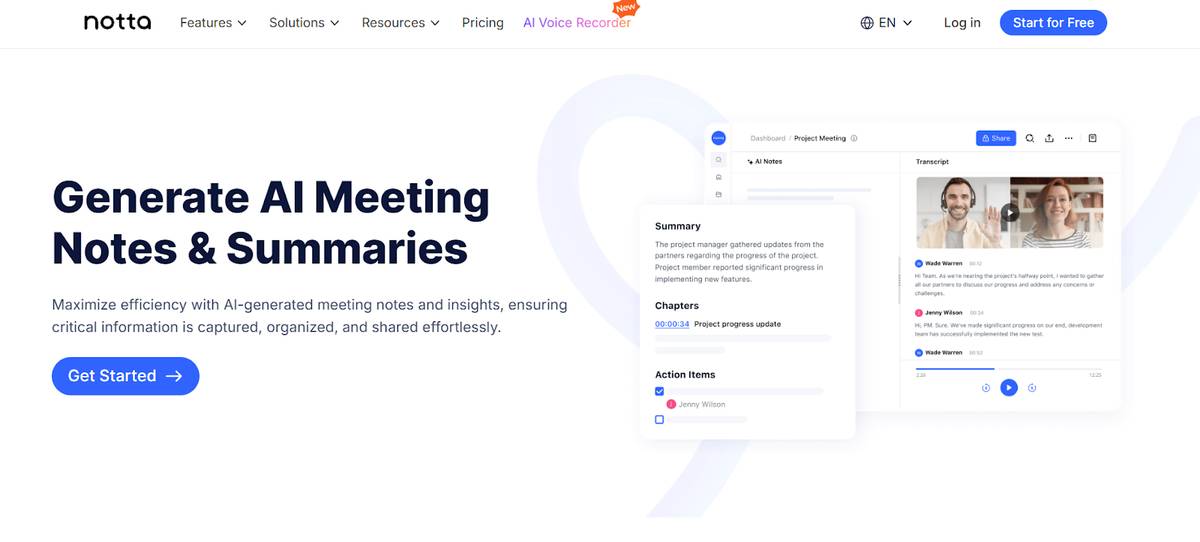
Notta is the best AI note taker for therapists because it transcribes sessions with 98.86% accuracy and creates summaries you can turn into SOAP, DAP, or BIRP notes.
Confidentiality isn’t optional in therapy, and Notta takes it seriously with GDPR, SOC2, and HIPAA compliance.
It integrates with Google Meet, Zoom, and Microsoft Teams for telehealth, and bot-free transcription with the mobile app makes it just as effective for in-person sessions.
You get full control with editable summaries and custom templates, and searchable notes to track progress and prepare for the next session.
If you’re just starting out, Notta offers a generous free plan to help you set up your practice. It also has affordable paid options for both solo and group providers.
Pros:
You can create custom summaries in your preferred format.
Works for both in-person and telehealth sessions.
The Notta Bot automatically joins and transcribes your video sessions.
Cons:
Only offers SOAP notes by default, but you can create custom templates for DAP, BIRP, and other formats.
Pricing:
Free plan available
Pro: $8.17 per month
Business: $16.67 per month
Enterprise: Custom pricing
OS availability: Android, iOS, Web, Chrome Extension
Regulatory compliance: HIPAA, CCPA, GDPR
2. Upheal: Best Complete Telehealth Platform
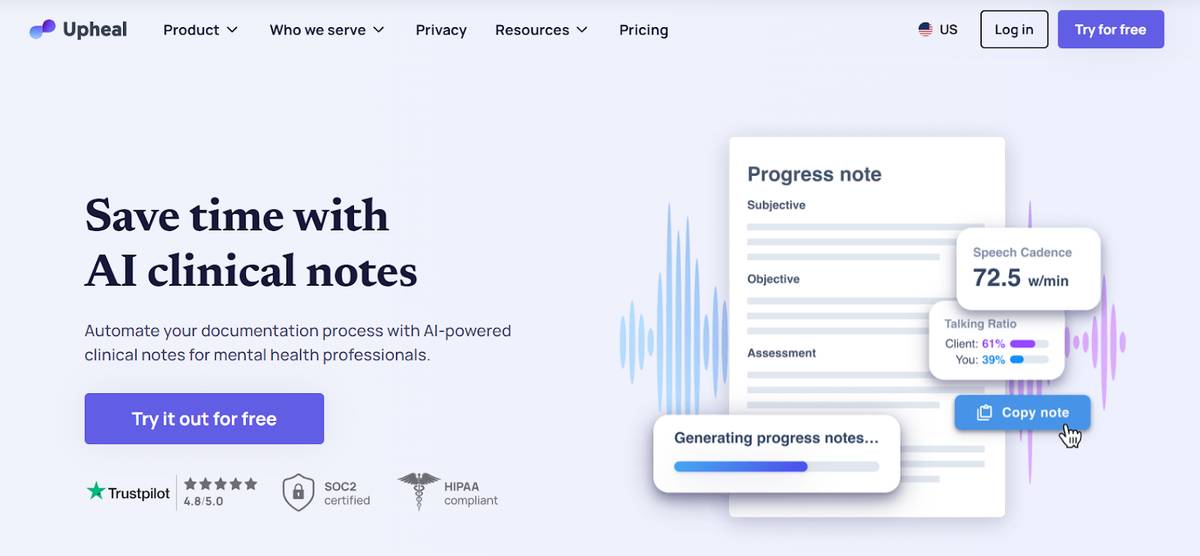
Upheal offers built-in note-taking with templates like SOAP, DAP, and BIRP, plus the option to design your own with 170+ customizable sections. You can also manage scheduling, video sessions, and clients directly from the platform, but it has very limited integration options.
Pros:
Scheduling, video calls, note-writing, and client management in one platform.
Cons:
You can only take notes inside Upheal’s own built-in video session system.
Pricing:
Solo practice:
Free plan available
Starter: $29 per month
Premium: $99 per month
Group practice & Enterprise: Custom pricing
OS availability: Web, Chrome Extension, iOS
Regulatory compliance: HIPAA, PHIPA, PIPEDA & GDPR
3. Heidi: Best for Clinical Documentation
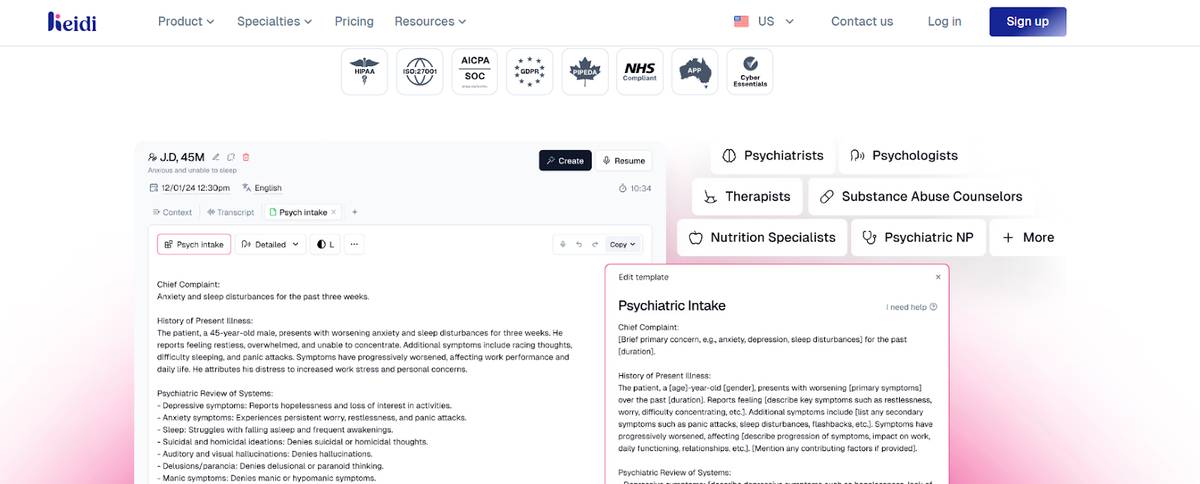
Heidi is an AI note taker built for behavioral health and clinical documentation. It transcribes your sessions and turns them into intake notes, progress notes, assessments, or custom templates you design yourself.
The platform is designed to meet healthcare standards, with full HIPAA and GDPR compliance and security practices used in hospital systems. The memory feature adapts to your style, and macros let you insert repeated phrases quickly, so your notes stay consistent and accurate.
Pros:
You can add patient history and test results directly into Heidi, which gives it the context to create better notes without repeating yourself in session.
Cons:
Heidi can be expensive, especially if you’re a solo provider or just starting your practice.
Pricing:
Free plan available
Pro: $99 per month
Together: $1,199 per month
Enterprise: Custom pricing
OS availability: Android, iOS, Web, Chrome Extension
Regulatory compliance: GDPR, HIPAA
4. Supanote: Best for EHR Integration
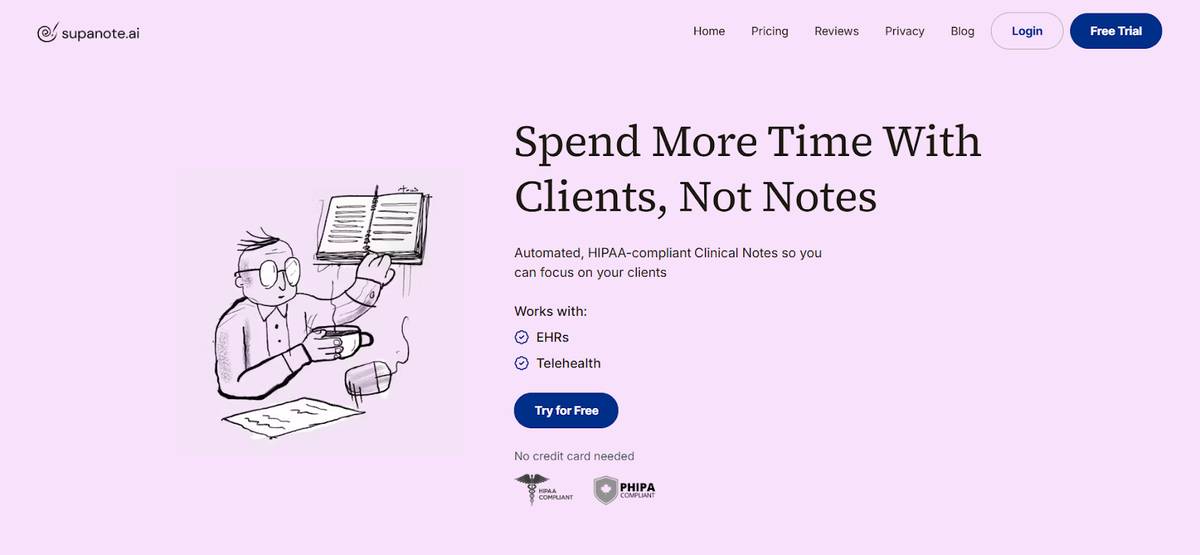
Supanote is built for EHR integration, letting you capture session notes and send them directly into your electronic health record with a single click. It saves you from copy-pasting or duplicating work, but its features are limited compared to AI-powered options like Notta.
Pros:
Supanote can scribe those from any browser-based telehealth provider, like Gmeet and Doxy.
Cons:
Limited features compared to other AI notetakers.
Pricing:
7-day free trial
Starter: $29.99 per month
Pro: $49.99 per month
Master: $89.99 per month
OS availability: Web-based
Regulatory compliance: HIPAA, PHIPA, PIPEDA, and GDPR
5. Jamie: Best for EU-based Therapists
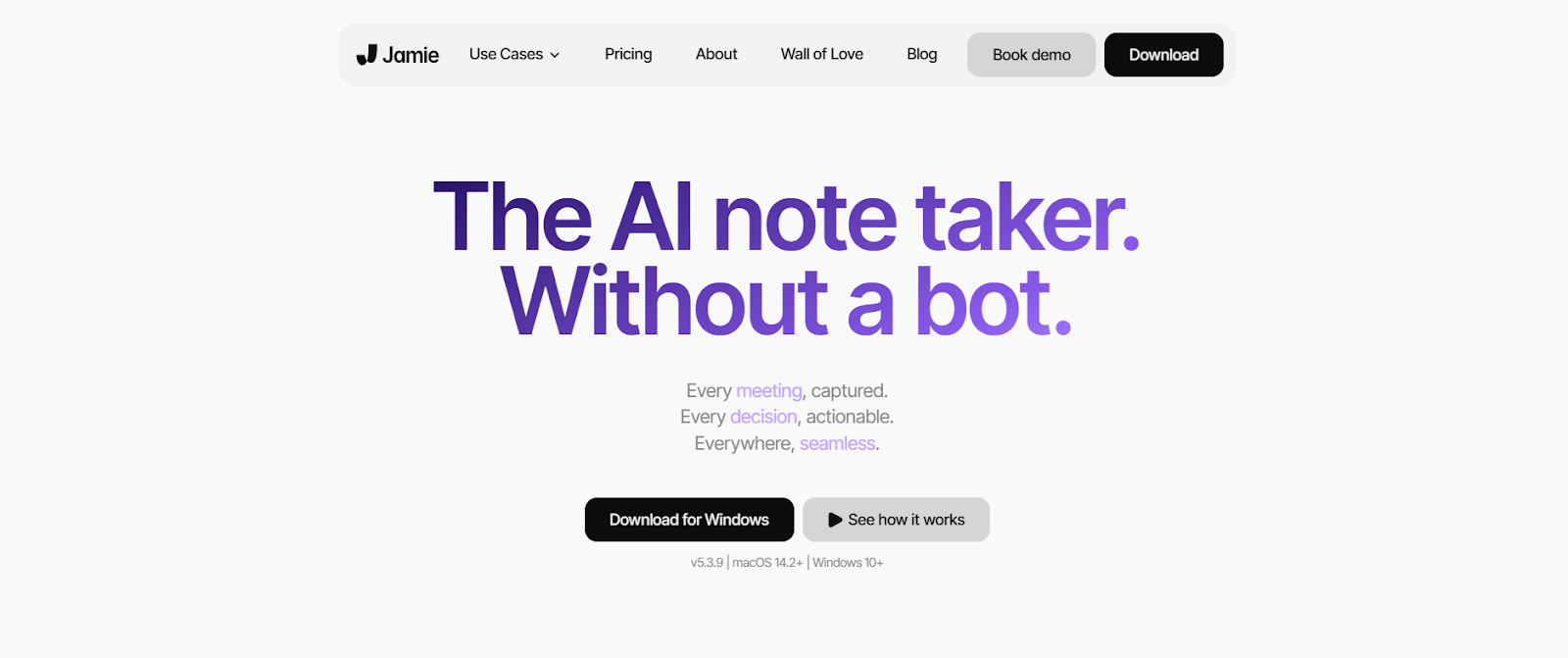
Jamie is a good option if you’re in the EU, since it’s fully EU-based and GDPR compliant, making data privacy straightforward for therapists. It works both online and in person, and doesn’t require a meeting bot to join your sessions.
Jamie lacks mental health-specific templates and comes with limited features on the free plan. Notta provides better value and affordability for most therapists.
Pros:
Bot-free transcription improves privacy and client comfort.
Cons:
No dedicated mobile app, which limits convenience.
Pricing:
Free plan available
Standard: 24€ per month
Pro: 47€ per month
Executive: 99€ per month
OS availability: MacOS, Windows
Regulatory compliance: GDPR
6. Quill: Best for Session Notes Without Recording
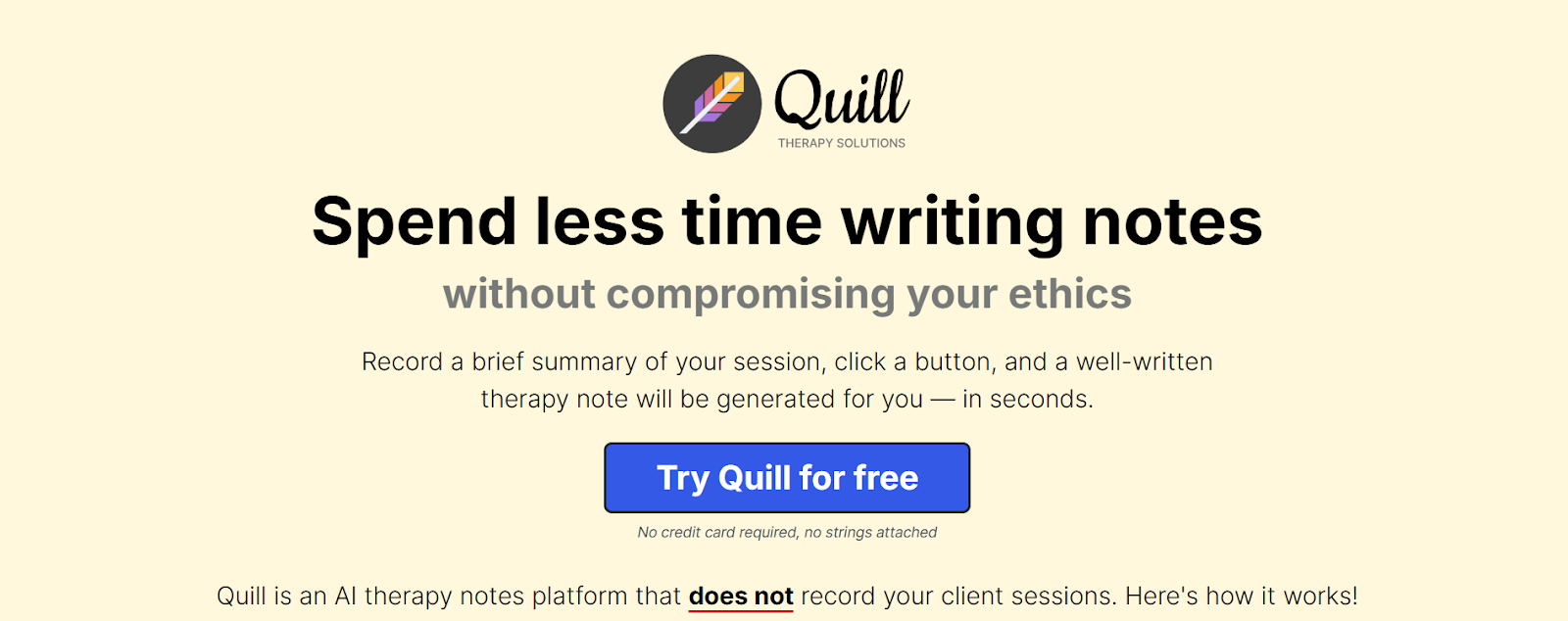
Quill is best for mental health professionals who want structured session notes without recording their sessions. You just provide a quick session summary, and Quill’s AI turns it into a polished note in the format you need: SOAP, DAP, BIRP, PIRP, or its exclusive SIMPLE format.
Pros:
Unlimited progress notes and custom documentation.
Cons:
You still have to manually write or record a session summary before Quill restructures it into a proper note.
Pricing:
Free trial available
Individual: $20 per month
Team: $20 per month plus $16 for each additional user
Enterprise: Custom pricing
OS availability: Web-based
Regulatory compliance: HIPAA
7. Soapnote: Best for SOAP Notes
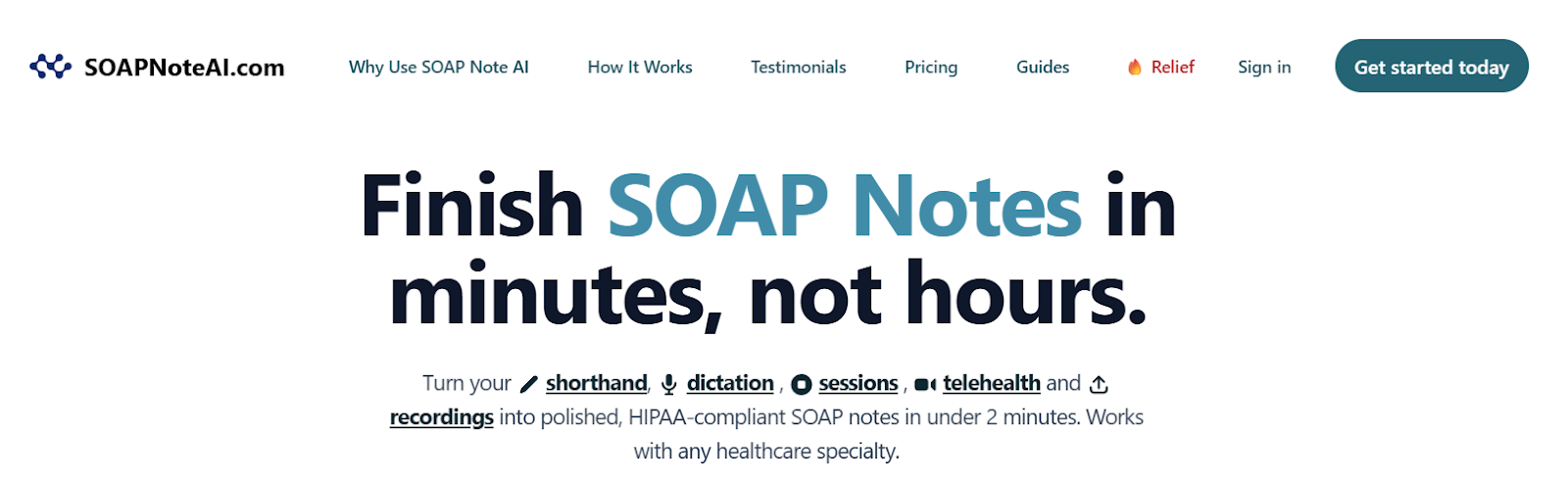
Soapnote is best for creating SOAP notes quickly and consistently. It’s built around the SOAP format, so you can enter your session details and instantly generate a structured note. This makes it a simple, reliable choice if SOAP notes are the standard in your therapy practice.
Pros:
It’s very simple to use.
Cons:
It’s limited to the SOAP format.
Pricing:
Subscription plans:
$69 per month
$79 per month
Pay as you go:
Basic Pack: $9 for 10 credits
Pro Pack: $19 for 25 credits
Ultra Pack: $59 for 100 credits
OS availability: Web-based
Regulatory compliance: HIPAA
Is It Ethical for Therapists to Use AI?
If you feel hesitant about adding AI to the therapy room, you have good reason.
AI note-taking tools analyze client sessions to generate documentation, which raises privacy concerns. Clients deserve to know that you’re using artificial intelligence, how it works, where the data goes, and whether they can opt out.
Ethical use of AI note takers means more than meeting HIPAA or GDPR rules. It means protecting the therapeutic alliance and keeping client trust at the center of your practice.
How to Ethically Introduce an AI Note Taker to Your Clients
As Dr. Marlene Maheu, founder of Telehealth.org, points out, informed consent is a legal and ethical requirement. “Informed consent is an integral and foundational ethical principle in psychotherapy,” she says, “and it becomes even more critical when introducing technological tools into clinical practice.”
Surprising a client with a transcription tool or glossing over the details risks damaging trust and may cross ethical lines. You should approach AI the way you would any clinical intervention: with transparency, respect, and client autonomy in mind.
Here are a few guidelines:
Be transparent from the start. Explain clearly that you use an AI transcription or note-taking tool, what it does, and why. Keep the language simple, not technical.
Give clients a real choice. Offer the option to opt out without penalty. Let them know therapy can continue with or without AI support.
Explain privacy and security. Clients will wonder who else can see the transcript, where it’s stored, and whether it’s safe. Offer clear assurances about encryption, storage, and compliance.
Check for comfort regularly. Consent is not one-and-done. Revisit the conversation occasionally, especially if clients show concern.
Prioritize the relationship. Frame the AI as a helper for documentation, not as a replacement for attention. Make it clear that their trust and the therapeutic bond come first.
Can AI Note-Taking Help Prevent Burnout and Administrative Fatigue?
Ethical use of AI isn’t only about compliance or informed consent. It’s also about the well-being of therapists.
The APA Ethics Code makes this clear: psychologists have a responsibility to maintain their own health and competence so they can protect clients (Standard 2.06). You can't show up for your clients if you’re burned out or drained.
Using tools that help with documentation can support that responsibility. In this way, AI note-taking supports both therapist health and client care.
Frequently Asked Questions about AI Note Takers for Therapists
Can therapists use AI to write notes?
Yes, therapists can use AI to write notes. However, you need to confirm the platform complies with your local regulations, and you’re still responsible for applying professional and ethical standards when finalizing the documentation.
Is AI note-taking HIPAA compliant?
AI note-taking isn’t automatically HIPAA compliant. Notta offers HIPAA-compliant transcription. Always confirm that your AI note taker meets compliance standards before you use it with clients.
How does the AI handle complex therapeutic jargon and acronyms?
AI handles therapeutic jargon and acronyms through pattern recognition and adaptive learning. Pre-trained tools recognize common clinical terms like CBT, DBT, and DSM codes. Other platforms learn your terminology through corrections and repeated use, improving accuracy over time.
What is the typical cost of an AI note-taking app for therapists?
The typical cost of an AI note-taking app for therapists ranges from free basic plans to about $20-$100 per month. The cost depends on the platform you use, its features, and usage limits.
Can these AI tools distinguish between multiple speakers in a session?
Yes, AI tools like Notta can distinguish between multiple speakers in a session. Speaker diarization is especially useful for group therapy or family sessions, where you need to know exactly who said what to keep accurate and organized notes.
How much time can I realistically save with an AI note taker?
Realistically, you can save several hours a week with an AI note taker. The exact time depends on how many clients you see, how detailed your notes need to be, and whether you use features like custom templates or automatic summaries.
Making the Right Choice for Your Practice
Notta is the most complete solution for therapists who need reliable note-taking. It works for both in-person and online sessions, offers 98.86% transcription accuracy, and gives you customizable AI summaries.
With bot-free transcription and full regulatory compliance for US-based practices, you can focus on clients, knowing your notes are accurate and secure.
Other tools may offer niche features, but Notta combines everything therapists actually need into one easy-to-use platform. It’s affordable, accessible, and built to save time while protecting sensitive client information, making it the clear best choice for your practice.
Try Notta today and bring more focus, security, and time back into your practice.

